
A brain dump template is a simple page layout that gives every stray thought a place to land, so your mind can stop looping. You open your junk journal, set a timer for 15 minutes, and write down everything buzzing in your head, from unpaid bills to worries you cannot name. Then you sort the mess into small groups, pick your top three actions, and close the journal feeling lighter. This guide shows the exact layout to copy, how to run a 15-minute dump, and how to turn it into a daily and weekly routine.
Key Takeaways
- A brain dump moves thoughts from your head onto paper, which frees up working memory and lowers stress.
- The template has four parts: a dump zone, sort zones, a top 3 box, and a notes corner.
- Fifteen minutes is enough for a full dump, and a timer keeps the session honest.
- Sort every item into work, home, money, ideas, or worries, then act on only three.
- A short morning dump and a longer weekly dump keep the habit light.
- Never judge, edit, or organize while you dump. Sorting comes after the timer stops.
What a Brain Dump Is
A brain dump is the act of writing down every thought, task, worry, and idea floating around in your head, without filtering or organizing it first. The point is to empty your mind onto paper so you can see what is actually there. Most of us carry dozens of open loops at once, and together they leave you feeling scattered and tired.
Writing thoughts down works because your brain stops trying to hold them. Psychologists call this the Zeigarnik effect: unfinished tasks keep demanding attention until they are resolved or written down somewhere safe. A journal page is that safe place. Once a thought is on paper, your mind can let go of it. The journaling page on Wikipedia describes how regular writing helps people process thoughts.
A junk journal is the perfect home for a brain dump, because it is already messy, personal, and forgiving. You do not need a clean planner or perfect handwriting. If you are new to the craft, our junk journal guide explains how to start one from scratch with supplies you already have at home.
The Brain Dump Template Layout to Copy
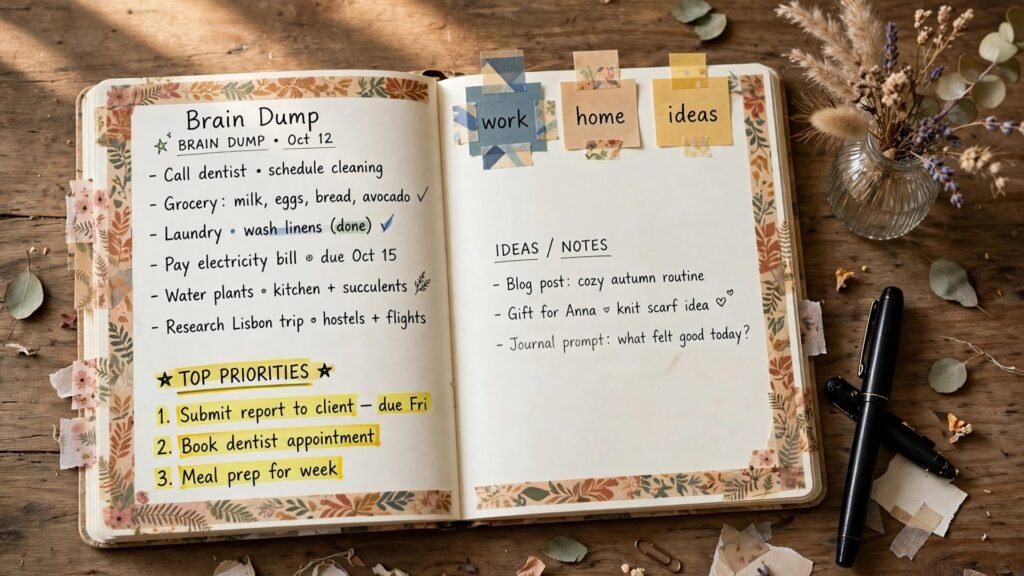
The template below fits on one junk journal spread, two facing pages, and you can draw it in under two minutes. Use the left page for dumping and the right page for sorting. Keep the layout the same every time.
1. The Dump Zone
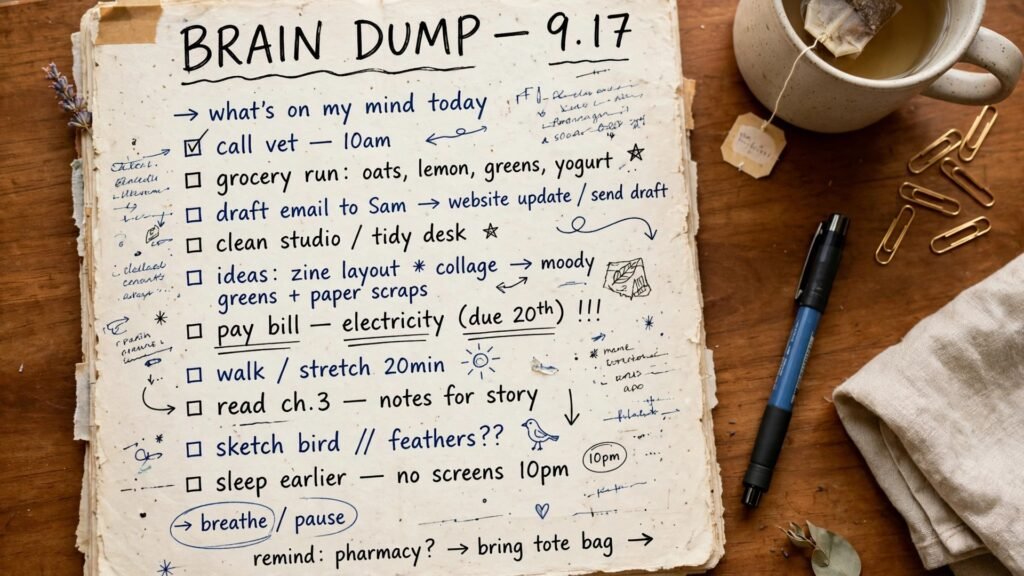
The dump zone is the biggest area on the page, and it is deliberately free-form. Draw a loose box across the top two thirds of the page, write the date at the top, and fill it with whatever comes to mind. Write in any direction, and do not worry about spelling or neatness. One line per thought works best, and short fragments are fine: “call dentist,” “idea: autumn garland,” “pay electric bill.”
2. The Sort Zones
Under the dump zone, draw four or five small boxes, each with a label at the top. These are your sort zones, and they turn the raw dump into something you can act on. Common labels are work, home, money, ideas, and worries. After the timer stops, read each item and copy it into the matching sort zone. Items that fit nowhere go into a small “later” box. The goal is to see your thoughts grouped into a few clear piles instead of one big cloud.
3. The Top 3 Box
The top 3 box is the most important part of the template, and it is also the smallest. Draw a small highlighted box in a corner of the page. Then choose the three items from your sort zones that matter most today. Three is the magic number: one is too few to feel like progress, and five is too many to finish on a busy day. Your top 3 should mix one urgent task, one that moves a bigger goal forward, and one quick enough to finish in ten minutes.
4. The Categories to Use
The right set of categories makes sorting fast and painless. Start with five: work, home, money, ideas, and worries. Work holds job tasks and deadlines. Home holds chores and family reminders. Money holds bills and budgets. Ideas holds creative sparks and things to try someday. Worries holds anxious thoughts with no clear action yet, and writing them down is often enough to shrink them. If a category stays empty for a week, swap it for one that fits better, such as health, friends, or projects.

How to Do a 15-Minute Brain Dump
Fifteen minutes is the sweet spot: long enough to empty your head, short enough to fit into a lunch break. Set a timer, open your journal to a fresh template page, and follow the steps below. The timer matters, because a deadline stops you from overthinking.
Step 1: Set the Scene
Sit somewhere comfortable with your journal, a pen you like, and a drink. Put your phone on silent and face down, because a single notification can pull you out of the flow. This is about giving your brain a clear signal that this is thinking time, not scrolling time.
Step 2: Start the Timer and Write Everything
Start a 15-minute timer and write nonstop in the dump zone. Do not pause to think, do not cross anything out, and do not worry about whether a thought is important. Write tasks, worries, ideas, and reminders. If you run dry after five minutes, sit with the quiet and ask yourself: what else is on my mind? A second wave almost always arrives after the obvious thoughts are out.
Step 3: Stop When the Timer Rings
When the timer rings, put your pen down, even if you are mid-thought. You can finish the sentence, but do not start a new one. Take a slow breath and look at the page. It will probably look messy, and that is a good sign: a messy dump page means you were honest. If the page is nearly empty, your mind is already calm.
Step 4: Sort Into Zones
Spend five minutes moving each item into a sort zone. For each item ask one question: which box does this belong in? Worries go in the worries box without trying to solve them. Ideas go in the ideas box without judging them. If an item feels too big, break it into a smaller first step. “Plan holiday” becomes “look up train times.”
Step 5: Pick Your Top 3 and Close the Journal
Choose your top 3 from the sort zones and write them in the top 3 box. Then close the journal. Closing the journal is a small ritual that tells your brain the work is done for now. Many people find that pairing a brain dump with a short gratitude list makes the pair even stronger: the dump clears the noise, and the gratitude list ends the session on a warm note.
How to Sort Your Brain Dump
Sorting is where a brain dump turns into a plan: sort by action, not by topic alone. For each item, ask three quick questions. First, does it need doing at all? If not, cross it out. Second, can it be done in under two minutes? If yes, do it now or write it in the top 3. Third, does it belong to someone else? If so, note who should handle it. Everything left over goes into a sort zone with a rough time attached: today, this week, or someday. The Library of Congress journal picture collections hold old diaries that show people have sorted their thoughts on paper for centuries.
Worries deserve special care during sorting. A worry is not a task, and forcing it into a to-do box only makes it heavier. Instead, write the worry down as it is, then add one small question underneath it: what is one thing I can do about this? Sometimes the answer is a phone call, sometimes it is a walk, and sometimes it is simply to notice the worry and let it sit on the page. The Internet Archive journal collections hold old handwritten diaries full of worries, a reminder that people have always used paper to carry what their minds could not. Ideas get the same gentle treatment: park them in the ideas zone and revisit them during your weekly review.
Daily and Weekly Brain Dump Routines
A brain dump works best as a rhythm, not a one-time rescue. A short daily dump keeps the pile small, and a longer weekly dump keeps the bigger picture in view. For the daily version, use five minutes each morning or evening: dump quickly, sort loosely, and pick your top 3. Morning dumps are good for planning. Evening dumps are good for sleep, because they move tomorrow’s worries onto paper so they stop circling at bedtime.
For the weekly version, set aside 20 to 30 minutes on a quiet day. Do a full 15-minute dump, then spend ten minutes sorting and reviewing the week ahead. Look back at last week’s top 3 and tick off what you finished. Move unfinished items forward or cross them out if they no longer matter. Check your ideas zone for anything worth starting, and glance at your worries zone to see which ones faded on their own. Our goal setting planner guide shows how to turn weekly priorities into monthly goals. If you enjoy making journals as much as filling them, our how to make a journal guide and our junk journaling guide will help you build a journal that fits this routine perfectly.
Common Brain Dump Mistakes to Avoid
The first mistake is organizing while you dump. If you stop to sort or rewrite neatly in the middle of a dump, the flow breaks and the quieter thoughts never surface. Dump first, sort later, always. The second mistake is skipping the timer. Without one, a dump can stretch into an hour of rumination, or shrink into two lines written in a hurry.
The third mistake is making the template too fancy. A brain dump page should take two minutes to draw, not twenty. If you spend longer decorating the page than dumping your thoughts, the template has become procrastination in disguise. Keep the boxes simple and use one pen. The fourth mistake is picking too many top priorities. A top 10 list is not a plan, it is a second brain dump. Three is enough. Finally, do not judge what comes out. A dump page is private, and no one will grade it.
Frequently Asked Questions
What is a brain dump template?
A brain dump template is a page layout with four parts: a free-form dump zone, sort zones labeled by category, a top 3 box, and a small notes corner. You write every thought into the dump zone first, then sort the items into zones and pick three priorities. It gives a messy brain dump a clear structure, so you can repeat the habit in any junk journal.
How long should a brain dump take?
Fifteen minutes is ideal for a full brain dump, plus about five minutes to sort and pick your top 3. A daily version can be as short as five minutes. The timer matters more than the exact length, because it keeps you writing instead of overthinking, and it stops the session from turning into rumination.
What categories should I use in my brain dump?
Start with work, home, money, ideas, and worries. These five cover most of daily life. Swap in categories that fit you better, such as health, school, friends, or projects, and drop any category that stays empty for a week. Keep the set small, because five clear boxes sort faster than ten vague ones.
Should I do a brain dump every day?
A short daily dump of five minutes works well for most people, and a longer weekly dump of 20 to 30 minutes keeps the bigger picture in view. Morning dumps help with planning, and evening dumps help with sleep. If daily feels like too much, try three times a week. The best routine is the one you actually keep.
What do I do with a brain dump when I finish it?
Keep the page in your journal as a record, and carry your top 3 forward into your day or your planner. Cross off finished items, move unfinished ones to the next dump, and delete anything that no longer matters. During your weekly review, check the ideas zone for projects worth starting and the worries zone for fears that faded on their own.
Looking for ready-made vintage pieces? Browse the Etopica shop on Etsy for printable journal pages, vintage ephemera, and aged papers to fill your brain dump journal.
Our Etsy shop is full of adorable printable cliparts — birthday boys & girls, sweet animals, summer and spring themes — designed to print at home and layer straight into your journal.
Browse the Clipart Shop ↗
Leave a Reply