
A gratitude list is a simple page of thanks in your own hand, and in a junk journal it becomes something you can see, touch, and return to on a hard day. You write down the people, comforts, and small moments you are glad for, then dress the page with paper scraps, photos, and color. This guide shows you how to start, gives you 30 simple ideas in five categories, offers three templates to copy, and covers hard days. A pen, a page, and five honest minutes are enough to begin.
Key Takeaways
- A gratitude list in a junk journal is a page of thanks in your own hand, dressed with paper scraps, photos, and color.
- Start small: five items, five minutes, one honest line about why each matters.
- The 30 ideas in this guide fall into five categories: home and comfort, people, small daily pleasures, nature and seasons, and growth and hard days.
- Three templates, a simple list, a pocket page, and a photo page, fit any journal and any amount of time.
- On hard days, write about the smallest true things: a warm room, a finished meal, a kind word.
- A weekly habit keeps the page alive past November.
What a Page of Thanks Looks Like in a Junk Journal
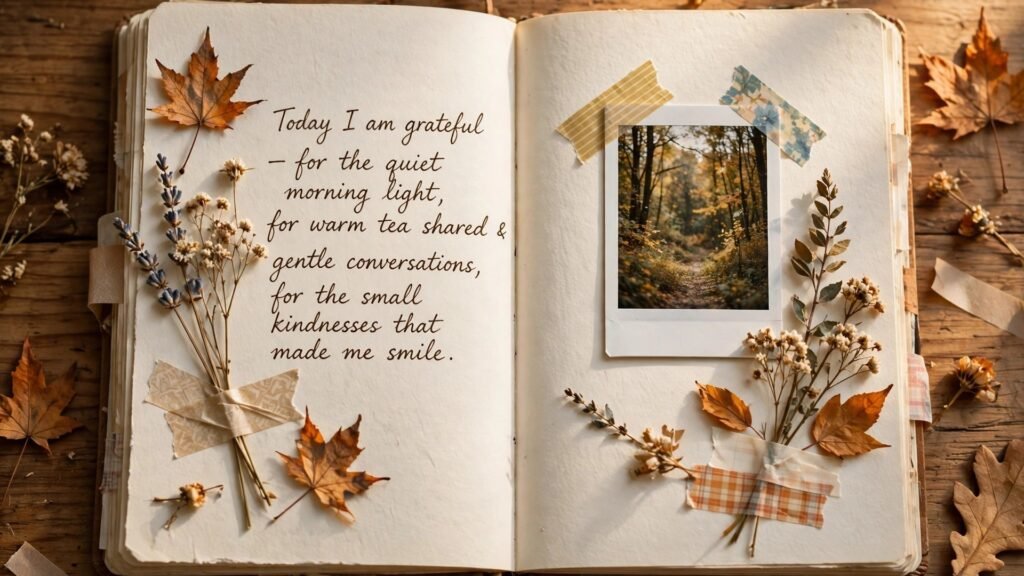
A page of thanks in a junk journal is not a formal list on lined paper. It is a spread that mixes handwriting with the things of your life: a ticket from a good day, a photo of a person you love, a strip of wrapping paper in a favorite color, a dried leaf from a walk you enjoyed. The writing sits in the middle of these small keepsakes, so the page reads like a memory rather than a chore.
The format is flexible because gratitude itself is flexible. You can list things you are glad for today, things that carried you through a hard week, or things you only noticed in hindsight. Write in full sentences, single words, or little drawings. What matters is that the words are yours and the details are specific. Specific thanks age well, and they are the ones you will smile at when you open the journal again. Our guide to the gratitude junk journal shows how a whole journal can grow around this one habit, one page at a time.
How to Start Your First Page of Thanks
Starting is the hardest part, so make the first page too small to fail. Five items, five minutes, no decorating until the words are down. Follow these five steps in order, and you will have a finished page before your tea goes cold.
- Pick a page and date it. Open your journal to a fresh page and write the date at the top, so you can find this day again later.
- Write five things you are glad for today. Keep them small and specific: a warm shower, a text from a friend, a finished chore, a good meal.
- Add one line about why each one matters. A short reason turns a list of nouns into a record of a real day.
- Add one small piece of ephemera. A photo, a ticket, a leaf, or a strip of patterned paper beside the words.
- Close the journal and repeat next week. The same five steps, the same small page, and the habit will build itself.
If five items feel like too many on a tired evening, write three. If the words will not come at all, write one true sentence and stop. A short honest page is worth more than a long page you forced yourself to fill. Berkeley’s Greater Good gratitude journal practice suggests writing down up to five things you are grateful for, and keeping the habit short and regular.
30 Simple Ideas for Your Gratitude List
These 30 ideas are grouped into five categories, six ideas each, so you can borrow a whole category or pick one line from each. Circle the ones that feel true today and write your own version beside each one.
Home and Comfort
Home gives us dozens of small comforts we stop noticing. Write about the rooms, objects, and routines that make your house feel like yours.
- A warm bed on a cold night. Clean sheets, a heavy blanket, and the feeling of sinking into sleep.
- Your favorite mug. The one that fits your hand, and the drink you make in it each morning.
- A meal you cooked this week. Something simple that filled the kitchen with a good smell.
- A chair that is yours. The corner where you read, rest, or watch the light change.
- Hot water from the tap. A shower after a long day, or warm hands under the faucet.
- A tidy shelf or drawer. One small space you put in order, and the calm it gives you.
People Who Show Up
People carry us through ordinary weeks in quiet ways. Think of the calls, the help, and the company that made a recent day easier.
- A friend who called at the right moment. The call that arrived just when you needed to hear a familiar voice.
- Someone who helped without being asked. A lifted bag, a shared ride, a chore done quietly.
- A family member who makes you laugh. The joke, the story, or the face that breaks a tense day.
- A neighbor you can wave to. The small greeting that makes your street feel friendly.
- A teacher, nurse, or helper from this year. The person whose patience or skill made a hard day easier.
- A pet who waited by the door. The greeting that says you were missed, every single day.
Small Daily Pleasures
Small pleasures are the easiest thanks to write, because they happen every day. This category collects the tastes, sounds, and moments that make an ordinary day feel good.
- The first cup of tea or coffee. The quiet minutes before the day begins, steam rising from the cup.
- A song you love on the radio. The one you turn up, and the memories that come with it.
- Fresh air through an open window. The breeze that clears a stuffy room and wakes you up.
- A good book at bedtime. Ten pages that carry you somewhere else before sleep.
- A finished task, however small. A made bed, a washed dish, a replied message, done.
- A moment of quiet. Five minutes alone with your thoughts, and nobody needing anything.
Nature and the Seasons
The seasons give us new things to be glad for all year. Step outside and write about what the sky, the trees, or the light is doing today.
- Autumn leaves under your feet. The crunch, the color, and the smell of a November walk.
- The first snow, or the first warm day. The season changing in front of your eyes.
- A garden plant that survived. The herb, the flower, or the tomato that kept going.
- Birds in the morning. The song outside the window before the house wakes up.
- A sunset worth stopping for. The sky turning gold, and the minute you stood still to watch.
- Rain on the roof. The sound that makes a room feel safe and warm inside.
Growth and Hard Days
The hardest thanks are often the most valuable, because they mark the ways you grew. This category is for the lessons and the small wins that came out of difficult weeks.
- A hard conversation you finished. The words you were afraid to say, said at last.
- A habit you kept for a week. A walk, a page, a phone call, kept even when it was hard.
- Something you learned this year. A skill, a fact, or a truth about yourself.
- A mistake that taught you something. The lesson that stayed, even though the mistake stung.
- Your body carrying you through. Legs that walked, hands that worked, lungs that breathed.
- A day that ended better than it began. The evening that surprised you after a rough morning.

Three Templates to Copy
A template takes the deciding out of the page, which is useful on tired evenings. Pick one of these three, copy its layout, and fill it in.
The simple five line page
Write the date at the top, then five numbered lines down the page, one thanks per line, with a short reason after each. Add a strip of washi tape along the edge and you are done. This is the best template for a daily habit, because it is fast and it always looks tidy. If you keep a jar of thanks at Thanksgiving, the lines from this template transfer neatly onto slips of paper, and our guide to the Thanksgiving gratitude jar junk journal shows how to turn a season of small lists into a jar the whole family can open together.
The pocket page
Glue a small envelope or a folded pocket onto the page, then write your thanks on three or four tags that slide inside it. The page itself shows only a title and a decoration, while the thanks stay tucked away until you pull them out. This template suits private thanks you want to write honestly. Date each tag, and when the pocket is full, start a new page.
The photo page
Choose one photo from the week, a person, a place, or a small moment, and glue it in the middle of the page. Write three lines of thanks around it, one for what the photo shows, one for what it does not show, and one for the person who was there with you. The photo does half the remembering for you, and the page becomes a keepsake in its own right. Old photographs in the Library of Congress Prints and Photographs Division show how one picture can hold a whole season of thanks.
Writing Thanks on Hard Days
Some days gratitude feels far away, and a blank page can feel like an accusation. On those days, lower the bar until it touches the ground. Write about the smallest true things: the bed was warm, the water was hot, the phone stayed silent for an hour, a stranger held a door. These are not small thanks. They are proof that good things kept happening even on a day that felt bad, and writing them down is a way of believing that again. You do not need to feel grateful to write a true sentence about something good.
If even small thanks will not come, write about what you wish you were thankful for, or about a past day when thanks came easily. Both count. A list of wishes is still a list of things that matter to you, and a memory of a good day is still a good day, kept. You can also write a single line and close the journal. The habit survives a one line day.

Keeping the Habit Past November
Thanksgiving starts many gratitude habits, and December often ends them. Tie the habit to something you already do. Write your five lines with your morning tea, or before bed on Sunday evenings, or while dinner cooks. Pick one fixed moment in the week and protect it, even if the entry is only three lines long.
At the end of the year, read your pages back in order. You will see the hard months, the small comforts, the people who kept showing up, and the hopes that quietly came true. Our new year journal prompts pick up where this page leaves off, with prompts for looking back at the year and writing hopes for the one ahead, so your journal carries you from thanks into January without a gap.
Frequently Asked Questions
How many items should a gratitude list have?
Five items is a good number: enough to make you think, short enough to finish in five minutes. On tired days, write three.
What if I cannot think of anything to be grateful for?
Start with the smallest true things: a warm room, hot water, a finished meal, a kind word. The feeling often follows the writing.
How is a gratitude list different from a diary?
A diary records what happened. A gratitude list records what you are glad happened, and why it mattered. The list is shorter and easier to read back at the end of the year.
Can children make a gratitude list in a junk journal?
Yes, and they often enjoy it more than adults do. Let them draw their thanks, or write one word per item and add stickers.
How often should I write a gratitude list?
Once a week is enough to build the habit. Pick one fixed moment, such as Sunday evening, and protect it. A short weekly page beats a long page you only write once.
Looking for ready-made vintage pieces? Browse the Etopica shop on Etsy for printable gratitude journal ephemera, vintage journal cards, aged papers, and tags that layer beautifully into pages of thanks.
Our Etsy shop is full of adorable printable cliparts — birthday boys & girls, sweet animals, summer and spring themes — designed to print at home and layer straight into your journal.
Browse the Clipart Shop ↗
Leave a Reply