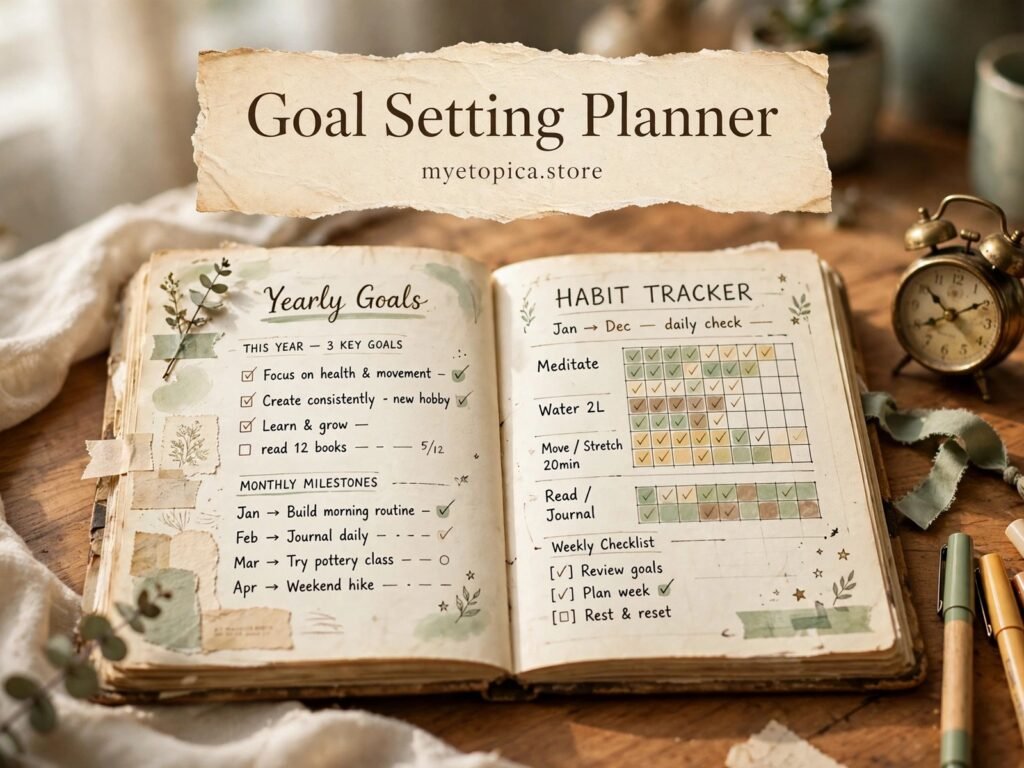
A goal setting planner kept inside a junk journal turns a vague wish for the year into pages you can see, touch, and open every morning. Instead of a goal buried in an app notification, you get a spread that shows the whole year at a glance, a quarterly page that breaks the year into four seasons, and a weekly page that holds only the next small step. This guide shows you how to build that planner, choose three goals that matter, and break each one into quarters, months, weeks, and days. The journal you already own, a pen you like, and an hour of setup are enough to begin.
Key Takeaways
- A paper planner keeps your goals visible daily, which beats an app you can swipe away.
- Choose three goals at most: one for your craft, one for your health or home, and one for learning or earning.
- Break each year goal into a quarterly milestone, a monthly target, a weekly action, and one small daily step.
- Build six simple pages: year at a glance, quarterly spread, monthly goals, weekly actions, habit tracker, and a review page.
- Track progress with simple marks and review the pages once a month.
- A stalled goal is not a failed goal: shrink the step, change the method, or move the deadline.
Why a Goal Setting Planner on Paper Beats an App
An app goal is easy to set and just as easy to forget. You type it once, the app sends a reminder, you swipe it away, and the goal disappears under other notifications. A paper planner works the other way around. It sits on your desk, and you see it every time you sit down with your morning tea. The goal is a page in a book you made with your own hands, not a notification you can dismiss.
Writing by hand slows you down in a good way. When you write a goal in ink, you have to choose the words, and choosing the words forces you to decide what you really mean. “Get healthier” becomes “walk for twenty minutes after lunch, five days a week.” Research on goal setting has long shown that specific, written goals are easier to act on than vague intentions.
Choose Three Goals That Matter
Three goals is the right number for a year. One goal is too few, because a single setback can sink the whole year. Ten goals is too many, because your attention splits until nothing gets done. A good trio is one goal for your craft, one for your health or home, and one for learning or earning. Keep only the wishes that make you feel lighter when you imagine them done.

Break a Year Goal into Quarters, Months, Weeks, and Days
A year goal is too big to act on. Nobody can do “finish twelve spreads” today. Cut the year into smaller pieces until the next piece is so small you could do it before lunch. Quarters give you four seasons, months give you twelve checkpoints, weeks give you fifty-two chances, and days give you one small step at a time.
Quarters: four seasons, four milestones
Divide the year into four quarters and give every goal one milestone per quarter. If the year goal is twelve journal spreads, the quarterly milestone is three spreads. If the goal is to walk one hundred times, the milestone is twenty-five walks per quarter.
Months and weeks: the checkpoints that keep you honest
Each month, split the quarterly milestone into a monthly target, then split the month into four weekly actions. A month that asks for one finished spread needs one weekly action: gather materials, build the background, add photos and journaling, then finish it. A walking month that needs nine walks needs two or three walks a week, not nine crammed into the last weekend.
Days: one small step, done today
The daily step should be almost too small to fail: ten minutes of walking, one paragraph of writing, one pocket glued into a spread. Small steps survive busy days and tired evenings. Write tomorrow’s step at the bottom of today’s page, so you never sit down wondering where to start.
Planner Pages to Build in Your Junk Journal
Your planner needs six pages, and each one has a single job. Build them in order, from the widest view to the smallest, and leave the decorating until the structure is done. Start with plain lines and simple boxes, use the pages for a month, and only then add the washi tape. You can find the basic materials in our guide to junk journal supplies.
Year at a glance
Open a double spread near the front of the journal and write the year at the top, then list your three goals down the left side with one line each. Across the top, write the twelve months. One look tells you which goal belongs to which month and whether the year is balanced. Mark the months you know will be busy with a small star.
Quarterly spread
Give each quarter its own spread: three months across the top, your three goals down the side, and one milestone in each box where they meet. Leave a wide margin at the bottom for notes. At the end of a quarter, write two lines there: what helped, and what got in the way.
Monthly goals page
At the start of each month, make a fresh page with the month at the top, your three goals below it, and one target under each goal. Add a small box for the month’s focus, the one thing that matters most if everything else slips, and a box for things to look forward to. If you love writing prompts, our december writing prompts can fill a quiet evening page in the same journal.
Weekly action page
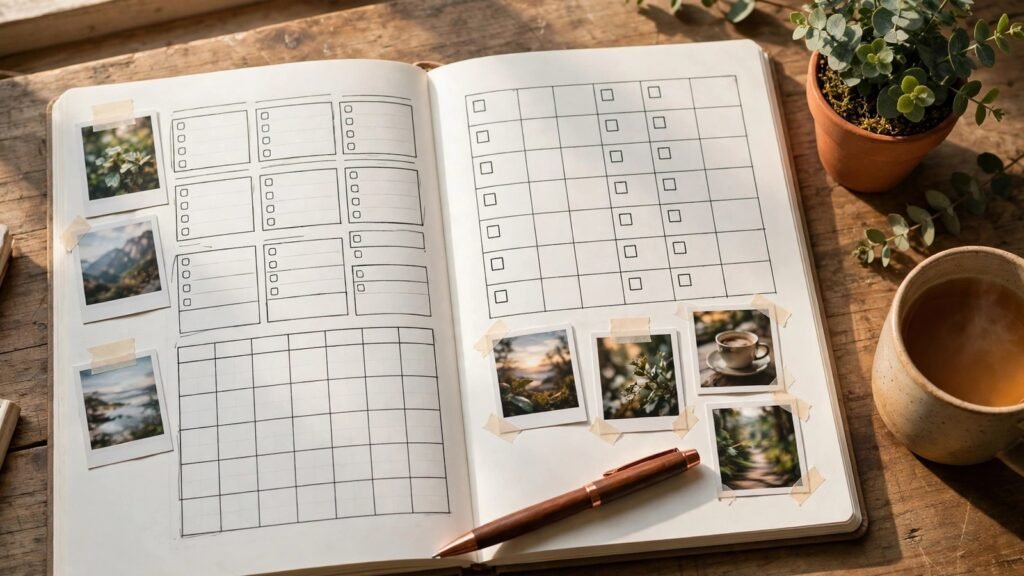
The weekly page is where plans become actions. Divide a page into seven small boxes, one for each day, and write one action in each box, no more. Put the hardest action on the day you have the most energy, and leave one day blank on purpose, a catch-up day or a rest day.
Habit tracker
A habit tracker is a simple grid: your daily habits down the side, the days of the month across the top, and one small box where they meet. Track no more than five habits, the daily steps your three goals need, plus one habit that is purely for joy, such as ten minutes with a book. The Library of Congress diary collections hold daily records like this from generations past.
Gratitude and review pages
End each month with a page that holds three small lists: three things you are grateful for, three things that went well, and three things to try differently next month. Goals can make a year feel like a test, and gratitude pages remind you that the year is also a life.

Track Progress with Simple Marks
Complicated tracking systems fail because they ask for too much. A planner kept in a junk journal needs marks a child could understand: a tick for done, a cross for missed, a dot for moved to another day, and a star for a day that went better than planned. Use the same four marks on every page, so a glance at any spread tells the story of the week.
A Worked Example: One Goal Across Every Page
Here is how one goal travels through the whole planner, so you can copy the shape for your own goals. Meet Sara, a fictional journal keeper who wants to build a small Etsy shop from her craft table. Her year goal is: sell twenty handmade journal kits by December 31. It is specific, it has a number, and it has a date.
Take one month inside quarter one, say March. Her monthly target is two finished kits and a shop page with photos. Her weekly actions split that target into four steps: cut and fold the papers, sew and decorate the covers, photograph both kits in daylight, then list them in the shop. Her daily step is twenty minutes at the craft table after lunch, One goal, carried through every page, from a year number down to twenty minutes a day. If you would like to see how a whole journal comes together, our junk journals guide shows the wider craft this planner lives inside.
Hold a Monthly Review Ritual
A planner without a review is just a wish list, so give yourself one quiet hour at the end of each month. Make a warm drink, open the journal to the monthly page, and read the month the way you would read a letter from a friend. Start with the numbers: how many ticks, how many walks, how many pages.
What to Do When a Goal Stalls
Every goal stalls at some point, usually in the second month, when the excitement has faded and the work is still there. A stalled goal is not a sign that you chose badly. It is a sign that something in the plan needs to change. Open the pages and look for the pattern: are the ticks missing on the same day every week?
Shrink the step before you shrink the goal
When a goal stalls, shrink the daily step first, not the goal itself. Twenty minutes becomes five minutes. One full spread becomes one pocket glued in. A three mile walk becomes a walk to the end of the street and back. A step so small it feels silly is a step you can do on your worst day, and worst days are when goals are usually lost.
Change the method, move the deadline, or let the goal go
If shrinking the step does not help, change the method. A goal that needs early mornings may work better in the evening. If a new method still does not help, move the deadline: a goal for December can become a goal for March. And if the goal no longer matters, let it go, cross it out with a single kind line, and choose a new third goal. The old planners in the Internet Archive show the same truth across a hundred years: the plans that survived were the ones their keepers were willing to rewrite.
Frequently Asked Questions
How many goals should a goal setting planner hold?
Three goals is the right number for most people: one for your craft or creative life, one for your health or home, and one for learning or earning. Three goals give the year balance without splitting your attention. If your life is very full right now, two goals are fine, but more than four usually means nothing gets finished.
Do I need a new journal for a goal setting planner?
No. The journal you already own is the best one, because it already holds your days and you already reach for it. Start the planner in the next blank spread, or at the front if the journal is new. A fresh journal is lovely, but waiting for the perfect journal is one of the easiest ways to never start.
How much time does a goal setting planner take each week?
About ten minutes to set up the weekly page and five minutes a day to mark the tracker and write the next small step, plus one quiet hour at the end of the month for the review ritual. The daily habit itself takes whatever time your goal needs, but the planner pages stay small on purpose.
What is the difference between a goal setting planner and a bullet journal?
A bullet journal is a flexible system for daily tasks, notes, and collections, while a goal setting planner is a focused set of pages inside a journal that carries three year goals down through quarters, months, weeks, and days. You can keep a goal setting planner inside a bullet journal, inside a junk journal, or inside any notebook you already use.
What should I do if I fall behind on my goals?
First, shrink the daily step until it is almost too small to fail, then change the method or move the deadline if the small step still does not work. Count your ticks weekly, not daily, and compare this week with last week instead of with a perfect week. A missed week is not a failed year.
Looking for ready-made vintage pieces? Browse the Etopica shop on Etsy for printable goal planner pages, vintage ephemera, habit tracker templates, and aged papers that layer beautifully into junk journal planner spreads.
Our Etsy shop is full of adorable printable cliparts — birthday boys & girls, sweet animals, summer and spring themes — designed to print at home and layer straight into your journal.
Browse the Clipart Shop ↗
Leave a Reply