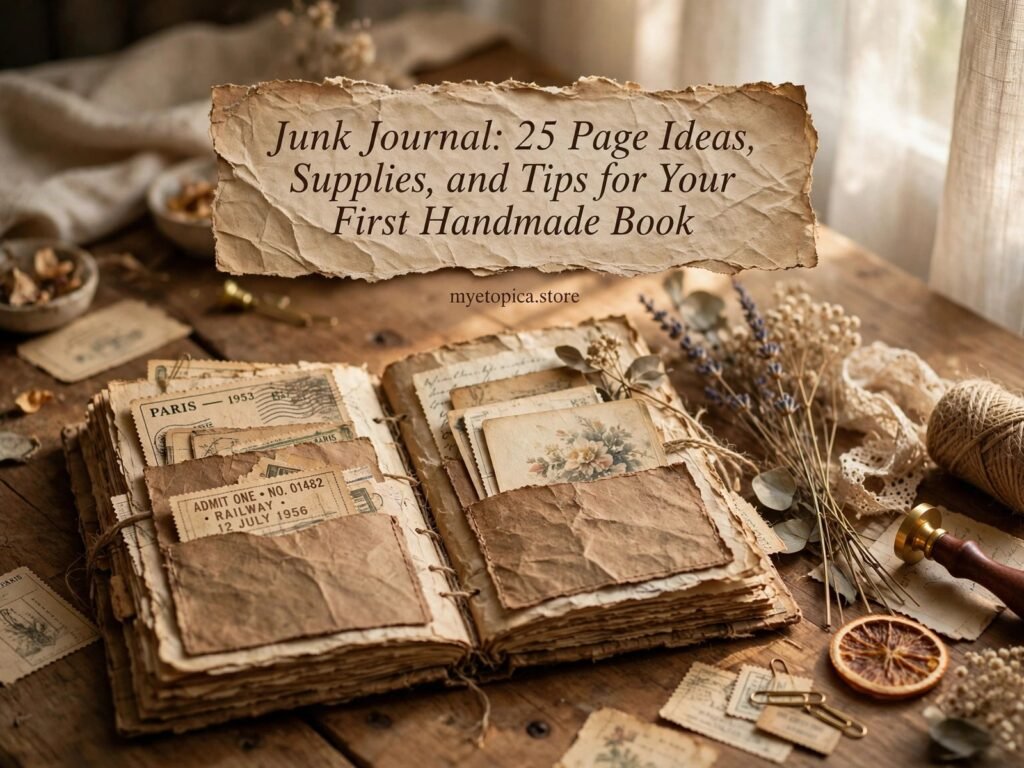
A junk journal is a handmade book built from ordinary paper: old book pages, envelopes, tickets, maps, and scraps, bound together and filled with memories, lists, photos, and small keepsakes. It is part scrapbook, part diary, and part art book, and there is no right way to make one. Some people build a themed book about travel or Christmas, and others fill an eclectic book with whatever the week brings. This guide is a complete reference: what a junk journal is, the two main styles, what goes inside, the supplies that matter, and 25 page ideas you can start today, plus simple binding and finishing tips.
Key Takeaways
- A junk journal is a handmade book of collected papers, pockets, and keepsakes, made to hold memories.
- Themed books follow one subject, eclectic books follow the week, and both are equally valid.
- Ordinary paper works best: old books, envelopes, maps, tickets, and wrapping paper.
- A small kit covers the first book: paper, glue, scissors, thread, and a few pens.
- The 25 page ideas in this guide mix memory pages, pockets, lists, and art pages.
- Bind simply, finish slowly, and let the book grow one page at a time.
What a Junk Journal Is
A junk journal is a book made from paper that would otherwise be thrown away: old book pages, envelopes, maps, tickets, wrapping paper, and brown paper bags. The word junk is a joke and a promise at the same time, because the materials cost almost nothing, yet the finished book feels rich, since every page carries a real memory. Unlike a shop bought diary with lined pages in a set order, a junk journal has pages of different sizes, colors, and textures, and you can fill them in any order you like.
The craft has grown into a large community of makers who swap paper, share page ideas, and teach each other binding methods. Our guide to junk journals explains the basic shape of the book and how the pages come together, and this guide goes further, acting as a reference you can return to whenever you need a fresh idea or a reminder of what the book can hold.
Handmade books have a long history, and the junk journal sits happily in it. The junk journal entry on Wikipedia traces the modern form, a book built from found and recycled paper, and old scrapbooks in the Library of Congress collections show ordinary people pasting clippings, letters, and keepsakes into books of their own. Your journal joins that tradition, and it needs no special training, only paper and a little time.
Themed or Eclectic: Two Ways to Build One
Every junk journal leans one way or the other, and neither way is better. A themed book follows one subject from cover to cover, so every page adds to a single story. An eclectic book follows the week, so a page about a walk sits beside a page about a recipe, and the book becomes a portrait of a life. Many makers keep one of each, and the two books teach different skills.
Themed books
A themed book gives you a clear answer when you wonder what to put on the next page, because the theme decides. A travel book holds tickets, maps, and postcards from one trip. A Christmas book holds gift lists, recipes, and photos from December. The theme also makes a lovely gift, since the whole book tells one story from start to finish.
Eclectic books
An eclectic book asks for no plan at all, which makes it the easiest book to start. You simply glue down what the week gave you: a leaf, a label, a funny note, a photo. The charm of an eclectic book is surprise, because pages you forgot about turn up months later and feel new again.

What Goes Inside
A junk journal holds more than writing, and the best pages mix several kinds of things. Pockets and tuck spots hold tickets, postcards, and small letters. Tags carry quotes, dates, and reminders. Envelopes hide private notes and tiny keepsakes. Fold out pages give a map or a long list room to breathe. The mix is the point, because a page with a pocket, a photo, and a line of writing feels alive in a way a plain page never does.
What you write matters as much as what you glue down. Dates turn a pretty page into a memory you can find again. Short captions say what a photo cannot, such as who laughed, what the weather did, or why a place mattered. A junk journal is not a diary that demands a page a day, it is a book that takes whatever you have, whenever you have it.
Supplies for Your First Book
You can start a junk journal with things already in your home, and most makers add supplies slowly, buying only what they actually use. Our guide to junk journal supplies lists the basics in detail, and the short version is paper, glue, scissors, thread, and a pen you enjoy.
Paper and ephemera
Paper is the heart of the book, so gather more than you think you need. Old books with yellowed pages, brown paper bags, maps, envelopes, and wrapping paper all work. Add ephemera as you find it: tickets, postcards, stamps, labels, and tags from gifts. Keep it all in one box, so you can see what you have when a page needs something.
Tools that do the work
A glue stick handles most pages, and a small bottle of white glue helps with heavier pieces. Small sharp scissors cut clean edges, and a ruler and a craft knife help with straight lines. A needle and strong thread bind the pages, and a hole punch makes tidy holes for rings. A black pen and one or two colored pens cover the writing, and washi tape holds flaps and frames photos.
- Paper of many kinds: old book pages, maps, envelopes, and brown paper bags.
- Ephemera: tickets, postcards, stamps, labels, and gift tags.
- A glue stick and a small bottle of white glue.
- Small scissors, a ruler, and a craft knife.
- A needle, strong thread, and a hole punch.
- Pens you enjoy, plus washi tape for flaps and frames.

25 Page Ideas to Try
Use these ideas in any order, and repeat the ones you love. Each idea fits on one page or one spread, and most take less than thirty minutes.
Memory and story pages
- Glue down a ticket stub from a day out, add the date and one line about the best moment, and let the ticket tell the story.
- Make a first day page for a new season, a new job, or a new home, with a photo and three hopes for what comes next.
- Write a short letter to your future self on a folded page, seal it with washi tape, and open it in a year.
- Pair one favorite photo with a handwritten caption that says what the camera missed, such as the smell of rain or a joke told twice.
- Sketch a simple map of a favorite walk, mark the bench, the bakery, and the tree, and glue a leaf from the route beside it.
Pocket and tuck spot pages
- Sew or glue an envelope to a page to make a pocket, then tuck in a postcard, a receipt, or a note from a friend.
- Slide a decorated tag into a tuck spot made from a folded corner, and write a quote on the tag that fits the week.
- Hide a small note under a paper flap, so the page has a secret that only the reader finds.
- Turn an old library card into a pocket for tiny lists, and slip a pencil stub behind it for notes on the go.
- Glue a recipe card to a page with washi tape along the top, so it lifts like a flap and shows a photo underneath.
List and record pages
- Keep a running list of books read, with the date finished and one line on each, and watch the list grow through the year.
- Record films watched on a page of small stars, one star per film, with the title written small beneath each one.
- Write a list of small joys from the week, such as warm bread, a phone call, or rain on the window, and date it.
- Note garden wins and losses on a page with a pressed leaf, so next year you remember what grew and what did not.
- Make a monthly favorites page with five small boxes, one for a book, a meal, a walk, a song, and a kindness received.
Seasonal and nature pages
- Press a leaf between pages for a week, then glue it down with the date and the name of the tree it came from.
- Paint five small autumn color swatches on a page, label each one, and write where you saw that color that day.
- Glue a seed packet to a spring page, add the sowing date, and return later to note what sprouted and what did not.
- Build a winter photo page with one snowy picture, a scrap of tartan ribbon, and a line about the coldest day.
- Tuck a summer postcard into a corner pocket, add a shell or a grain of sand in a tiny glassine bag, and date it.
Art and play pages
- Wash a page with one watercolor color, let it dry, and write a single sentence across it in dark ink.
- Stamp a row of shapes with a cork or a carved potato, then fill the gaps with dots and small doodles.
- Tear paper into strips and glue them into a collage, leaving white space, and add one found word that sums up the day.
- Draw a simple doodle border round a blank page, so tomorrow you have a ready frame for a list or a photo.
- Frame a small photo with strips of washi tape, add a paper doily behind it, and write the date in a corner.

Binding and Finishing Your Book
Binding sounds hard, and it is the step most beginners fear, yet the simplest methods need only a needle and thread. A pamphlet stitch runs through the fold of each folded group of pages, called a signature, and ties at the center. If sewing feels too much, binder rings through punched holes hold the book together and let you add pages later.
Finish the book slowly, because the cover is the first thing you touch. A piece of card covered in fabric or pretty paper makes a sturdy cover, and a label on the front with the theme and the year turns it into a keepsake. Date the first page, add a pocket inside the back cover for loose bits, and your book is ready to fill. If you want a full walkthrough, our guide to making your own junk journal covers each step in detail.
Keeping Your Book Going
A junk journal grows best with small, regular attention rather than long rare sessions. Aim for one page a week, even a small one, and keep your paper box where you can see it, so a ticket or a leaf lands in the box instead of the bin. Date every page.
Frequently Asked Questions
What is a junk journal?
A junk journal is a handmade book built from collected papers, pockets, and keepsakes, such as old book pages, envelopes, tickets, and maps. It holds memories, lists, photos, and small treasures, and there is no right way to make or fill one.
Do I need special supplies to start a junk journal?
No. Start with paper you already have, a glue stick, small scissors, a needle and thread, and a pen. Buy extra supplies only after you know which ones you reach for again and again.
What is the difference between a themed and an eclectic junk journal?
A themed junk journal follows one subject, such as travel or Christmas, from cover to cover. An eclectic junk journal follows the week, mixing walks, recipes, photos, and lists, so the book becomes a portrait of everyday life.
How many pages should a junk journal have?
Most first books have between 40 and 80 pages, made from 4 to 6 signatures of folded paper. A smaller book is easier to finish, and a finished small book teaches more than a large book that stays empty.
Can I buy junk journal supplies instead of collecting them?
Yes. Printable ephemera, aged papers, and journal cards are sold in craft shops, and they save time when you want a themed book fast. Many makers mix bought printables with collected paper, so the book still feels personal.
Looking for ready-made vintage pieces? Browse the Etopica shop on Etsy for printable junk journal ephemera, vintage collage sheets, aged papers, and journal cards that layer beautifully into handmade books.
Our Etsy shop is full of adorable printable cliparts — birthday boys & girls, sweet animals, summer and spring themes — designed to print at home and layer straight into your journal.
Browse the Clipart Shop ↗
Leave a Reply