A vintage maps junk journal turns old atlases, road maps, and chart pages into the working material of a journal — not just decoration, but backgrounds you write on, pockets you tuck things into, fold-outs that open wider than the page, and covers that already tell a story before you add a single word. If you have ever kept a folded map because it meant something — a childhood home, a first trip, a route you walked every day — that map already belongs in a journal.
This guide treats maps as a material and a technique, not as a travel diary. You will learn how to choose maps that survive journaling, twenty practical ways to use them, and how to build a complete maps journal step by step, including non-travel uses such as marking “where this story happened” for a family memory. If you are building a journal around an actual trip, start with How to Start a Junk Journal for the base, then come back here for the map techniques — the two guides are companions, not repeats.
Why Old Maps Work So Beautifully in a Junk Journal
Maps bring three things no plain paper can: instant colour, instant texture, and instant meaning. The faded blues of an ocean, the contour lines of a hillside, the grid of a city street plan — all of it reads as “a place” at a glance, so even a simple page looks finished. At the same time, a map is a document with a history of its own: the creases where it was folded, the pencil route someone drew, the stamp of a library. That history is exactly what junk journaling celebrates.
Maps are also forgiving. A torn edge looks intentional on a map page. A coffee stain looks like age. A crooked cut looks like a route. If you are nervous about “ruining” pretty paper, maps are the kindest material to practise on, because their imperfections are part of their charm.
Choosing Maps: What to Use and What to Avoid
Not every map journals well. Use this quick filter before you cut anything precious.
- Best for backgrounds and layering: thin atlas pages, old school geography book pages, and photocopies or prints of public-domain maps. They fold, tear, and glue flat without bulking up the spine.
- Best for pockets and fold-outs: sturdier road maps and tourist maps. Their fold lines are already scored, which makes them natural fold-outs, and their weight holds a pocket’s shape.
- Best for covers: a single strong map with one clear feature — a coastline, a river bend, a city centre — rather than a busy, small-print sheet. The cover needs to read from arm’s length.
- Avoid for now: glossy laminated maps (glue and ink slide off them), maps printed on both sides in dark ink if you plan to write directly on the back, and any map you cannot replace if it is the only copy of a family memory — scan or photocopy those first.
Where do old maps come from? Charity shops and second-hand bookshops often sell outdated atlases for very little, because nobody navigates from them any more. Libraries discard old atlases too. For printing at home, the Library of Congress and the Internet Archive host enormous public-domain map collections — historic city plans, survey maps, and atlases you can download and print freely. Always check the licence on a modern map before photocopying it for a journal you might sell; for a personal journal, your own old maps and public-domain prints are the safe route.
20 Ways to Use Vintage Maps in a Junk Journal
Work through these as a menu, not a checklist. A good maps journal uses five or six of them well, not all twenty at once.
1. Map Background Pages
Glue a whole map page flat as a background, then journal in the margins or on a small plain-paper panel pasted on top. Keep writing off the busiest printed areas so it stays readable.
2. Torn Map Strips and Borders
Tear maps into strips and layer them along page edges like a border. Torn edges blend better than cut ones, and the layered strips add depth without bulk.
3. Map Pockets
Fold a map section into a simple side pocket and glue three edges down. Pockets hold tickets, photos, and journaling cards, and the map itself becomes the decoration. My ephemera guide covers pocket folds in detail if you want the measurements.
4. Fold-Out Maps
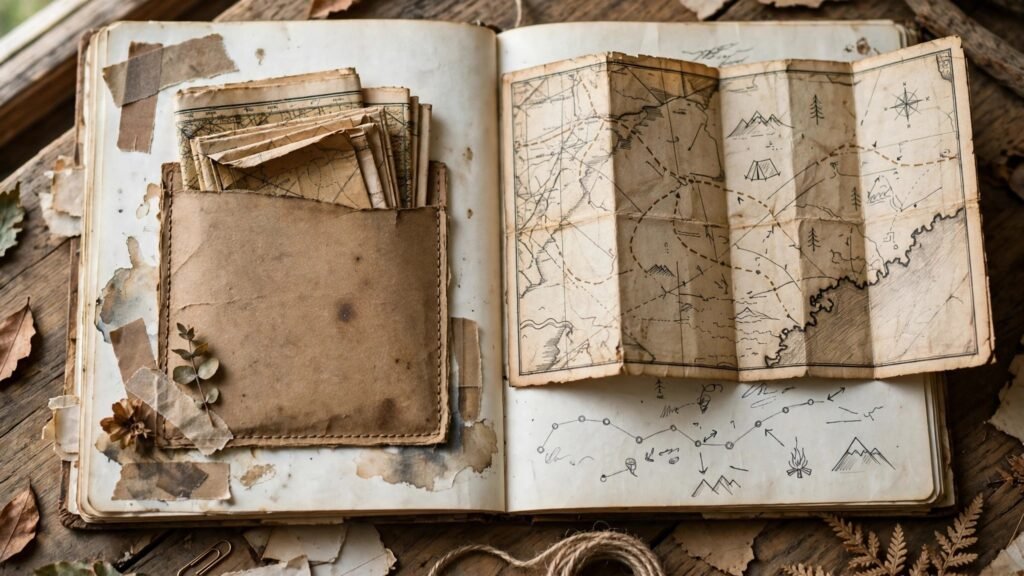
Attach a folded map to a page by one edge only, so it opens out wider than the journal. Fold-outs are perfect for a “big picture” page — a whole region on one spread, with your journaling on the facing page.
5. Tiny Map Tags
Cut small map pieces into tag shapes, punch a hole, and add twine. A tag cut from the exact place a memory happened is a tiny, powerful label — “Gran’s street,” “the lake,” “home.”
6. Map Covers
Wrap a journal cover in a map, or paste a framed map panel onto a kraft cover. Seal it with a thin layer of matte medium so it survives handling.
7. Explorer and Field-Notes Pages
Style a spread like an explorer’s notebook: a map fragment, a hand-drawn compass rose, a dated note, and a list of “observations.” This works for a walk in your own neighbourhood just as well as for a far-flung trip.
8. Compass Spreads
Build a spread around a large compass rose drawn or stamped over a map background, with journaling radiating from the centre — north for what you hope for, south for what you are leaving behind, and so on.
9. Journey Logs
Draw a route on a map in pencil or pen and date each stop along it, with a sentence per stop. The route can be a real journey, a move between houses, or even the route of a single memorable day.
10. “Where This Story Happened” Pages
This is the non-travel use that makes maps journals personal rather than touristy. For a childhood memory, a family story, or a recipe from a particular town, paste in a small map of that place and mark the spot. The map anchors the memory in a real place without turning the journal into a holiday album.
11. Map Collage Layers
Layer two or three map fragments at angles under a photo or journaling card, so only edges and corners show. Collage layers add the map feeling without covering the page in print.
12. Hidden Journaling Spots
Glue a map flap over a journaling panel, so the reader lifts the map to find the writing underneath. Hidden spots suit private memories and letters you want tucked away.
13. Map Envelopes
Fold a map into a simple envelope shape and glue it into the journal as a container for loose notes, dried flowers, or small keepsakes.
14. Dream-Travel Pages
Mark places you have never been but dream about, with a note about why each one calls to you. Dream-travel pages keep a maps journal going long after the real journeys run out.
15. Map Washi and Tape Strips
Cut narrow map strips and use them like decorative tape across page tops, photo corners, and journaling cards. They tie a spread together with almost no effort.
16. Place-Name Word Art
Cut out printed place names from maps and arrange them as titles or word clusters on a page — “home,” “north,” “river,” “harbour” — letting the map’s own typography do the decorating.
17. Before-and-After Map Pages
Pair an old map of a place with a recent print of the same place and journal about what changed. This is a beautiful spread for a hometown, a childhood street, or a place you returned to years later.
18. Map Bookmarks and Tucks
Cut a long, narrow map strip as a bookmark that tucks into the journal’s spine, or as a tuck spot — a slit in a page where a map card slides in and out.
19. Signature Dividers
Use a full map page as the divider between sections of the journal, with a hand-lettered title on a plain label pasted over it. Dividers give a thick journal its structure.
20. Map Cover Pockets
Add a map pocket to the inside front cover for loose maps, notes, and the next map you find. A journal that collects its own material is a journal that keeps growing.
How to Build a Vintage Maps Junk Journal Step by Step
You can build this journal from an old book, a kraft notebook, or a handmade signature. The order below keeps the map pages from becoming a pile of loose sheets.
- Pick your map story first. One sentence on page one: “This journal maps the places my family has lived,” or “This journal holds the walks of one year.” That sentence filters every map you add.
- Gather before you glue. Spend one evening collecting maps: one atlas, a few road maps, and a handful of public-domain prints. Sort them into “backgrounds,” “pockets and fold-outs,” and “covers.”
- Make the structure first. Build pockets, fold-outs, and dividers before you start journaling, so every map has a home. Flat background pages go in first; bulky fold-outs go near the back of a signature so the spine stays balanced.
- Add one spread per sitting. One place, one memory, one map technique. A maps journal built slowly stays joyful; a marathon session turns it into a collage pile.
- Journal on top, not just beside. Write directly on map margins, on plain panels pasted over busy print, or on tags tucked into pockets. A map without your words is decoration; with your words, it is a journal.
- Leave room for found maps. Reserve two pockets at the back for maps you have not found yet. The best map in a maps journal is often the one you find after you thought the journal was finished.
Keeping Map Pages Flat and Readable
Maps bulk up a journal faster than plain paper, so a few habits matter. Glue with a thin, even layer and press pages under a heavy book overnight after a big gluing session. Alternate a bulky fold-out spread with a flat background spread so the spine does not wedge open. If a page will hold writing, test your pen on a scrap of the same map first — some old inks smudge, and gel pens behave differently from ballpoints on aged paper. And if you are starting from an old book rather than a notebook, the old-book method gives you sturdy pages that hold pockets and fold-outs well.
Where to Find Old Maps Without Spending Much
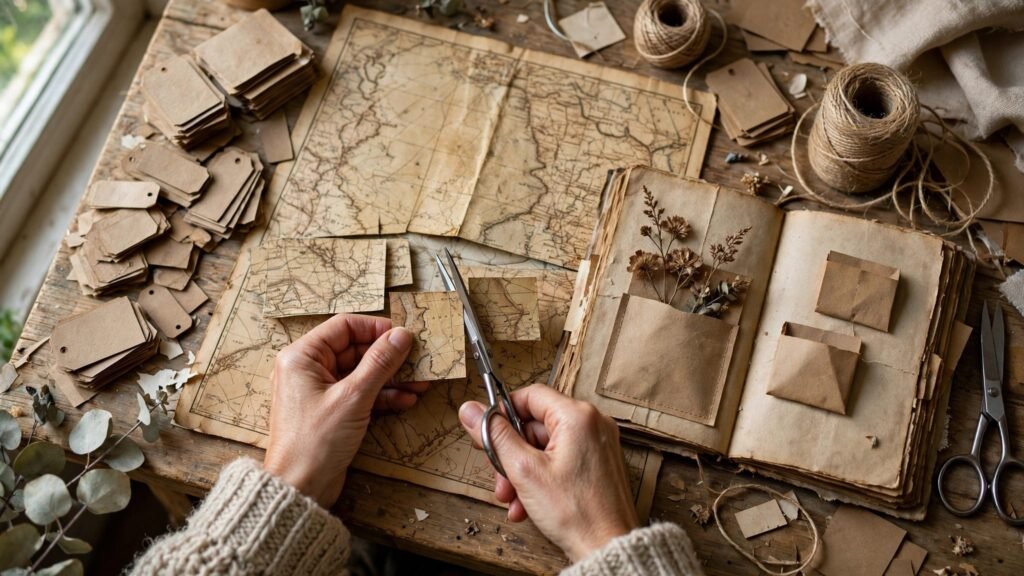
Start with what you already own: glove-box road maps, tourist maps from past trips, and the atlas gathering dust on a shelf. Then try charity shops, library sales, and second-hand bookshops, where outdated atlases sell for very little precisely because they are out of date for navigation — which is exactly what makes them perfect for journaling. For printing, public-domain collections at the Library of Congress and Internet Archive are the reliable free sources, and Wikipedia’s cartography overview is a useful starting point if you want to identify the style and era of a map you have found. If you want ready-made map pages to start with, my Etopica shop has printable journaling pages and ephemera sets you can cut, fold, and tuck into pockets right away: visit the Etopica shop on Etsy.
Key Takeaways
- A vintage maps junk journal uses old maps as working material — backgrounds, pockets, fold-outs, tags, and covers — not just decoration.
- Choose thin atlas pages for backgrounds, sturdier road maps for pockets and fold-outs, and one strong, readable map for the cover.
- The twenty techniques range from torn map borders and tiny place tags to compass spreads, journey logs, and “where this story happened” pages.
- Maps journals are not only travel journals: a map can anchor a family memory, a childhood home, or a dream destination just as well as a holiday.
- Build structure first (pockets, fold-outs, dividers), journal one spread at a time, and leave pockets at the back for maps you find later.
- Old atlases from charity shops and public-domain prints from the Library of Congress and Internet Archive are the cheapest, safest map sources.
What is a vintage maps junk journal?
A vintage maps junk journal is a handmade journal that uses old maps as its main material: map background pages, map pockets, fold-out maps, map tags, and map covers, combined with handwritten journaling. Unlike a travel journal, it does not have to document a trip, it can map family memories, dream destinations, or the places of a single life.
Where can I find old maps for junk journaling?
Charity shops, library sales, and second-hand bookshops sell outdated atlases cheaply, and your own old road maps and tourist maps are a free starting point. For printing at home, the Library of Congress and Internet Archive offer public-domain maps you can download and print freely.
Can I use a map I already own if it is precious?
Scan or photocopy it first and journal with the copy, keeping the original safe. That way you keep the memory and the map, and you can print the copy at any size your journal needs.
How do I keep map pages from making the journal too bulky?
Alternate bulky fold-out spreads with flat background spreads, glue thinly and press pages under a heavy book overnight, and put the bulkiest fold-outs near the back of a signature so the spine stays balanced.
What is the difference between a maps junk journal and a travel junk journal?
A travel journal documents a specific trip, in order, with tickets and itineraries. A maps journal uses maps as a material and a technique across any subject — family history, dream travel, a hometown, or a single year of walks — and cross-links to a travel journal rather than repeating it.
Can I write directly on a map page?
Yes, if you test your pen on a scrap first. Write in the margins or on a plain panel pasted over busy print so the writing stays readable, and avoid gel pens on very glossy or heavily inked map areas where they can smudge.
Do I need to be good at geography to make a maps journal?
No. A maps journal is about the places that matter to you, not about cartographic accuracy. If you know where a memory happened, that is all the geography the journal needs.
Our Etsy shop is full of adorable printable cliparts — birthday boys & girls, sweet animals, summer and spring themes — designed to print at home and layer straight into your journal.
Browse the Clipart Shop ↗
Leave a Reply