
A printable reading log is a simple page you print, glue into your junk journal, and fill in every time you finish a book or a chapter. It turns finished books into a record you can look back on, with titles, authors, ratings, quotes, and short notes all in one place. This guide shows you how to choose a layout, which columns to include, how to make and print your own page, and how to fill it in daily.
Key Takeaways
- A reading log records the title, author, dates, rating, and one line about each book you read.
- Daily, weekly, and monthly layouts all work, so pick the one that matches how often you read.
- Keep columns short and simple, because a log you can finish in two minutes is a log you will keep.
- Print on light cardstock or plain paper, cut the page to size, and glue or tape it into your journal.
- Mini reviews and one favorite quote make an old log fun to reread years later.
- A tiny daily habit, one line after reading, keeps the log alive better than a big weekly catch up.
What a Reading Log Is
A reading log is a dated list of the books you read, kept in one place so you can see your reading life at a glance. Each entry usually holds the book title, the author, the date you started and finished, a star rating, and a sentence or two about what you thought. Some readers add the page count, the genre, or a favorite quote. Others keep it very plain, just title and date, and that is fine too. Reading on Wikipedia describes reading as a way to learn, relax, and enjoy stories.
In a junk journal, a reading log feels at home. Junk journals are made from mixed papers, old book pages, envelopes, and scraps, and a printed log page sits happily beside all of them. You can glue a log into a spread, tuck it into a pocket, or tape it to the inside cover. Our junk journal guide explains how these mixed paper books are put together, and our junk journaling guide covers the basic supplies and first spreads.
Reading Log Layouts to Choose From
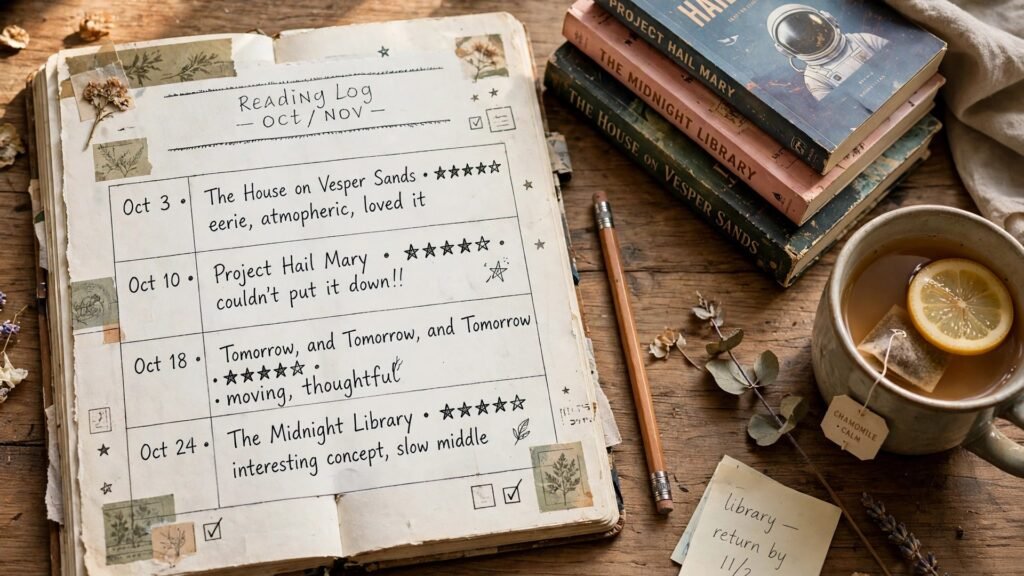
The best layout is the one you will actually use, so choose by how often you read and how much you like to write. A daily layout suits a reader who finishes a chapter every night, a weekly layout suits a slower reader, and a monthly layout suits someone who reads a few books a month. Try one layout for a month before you change it.
Daily reading log
A daily log gives you one line per day, with space for the date, the book, the pages read, and a word or two about the session. It is perfect if you read every day and want to build a streak. The daily line can be as short as, “Tuesday, 20 pages, loved the ending of chapter four.” If you miss a day, just leave the line blank and start again the next day, because a gap is not a failure.
Weekly reading log
A weekly log gives you seven small boxes or lines, one per day, plus a short summary box at the end of the week. It works well if you read in bursts, with busy days and long reading weekends. You can note total pages for the week, the book you finished, and the book you plan to start next. A weekly page also leaves room for a doodle, a sticker, or a small photo of the book cover.
Monthly reading log
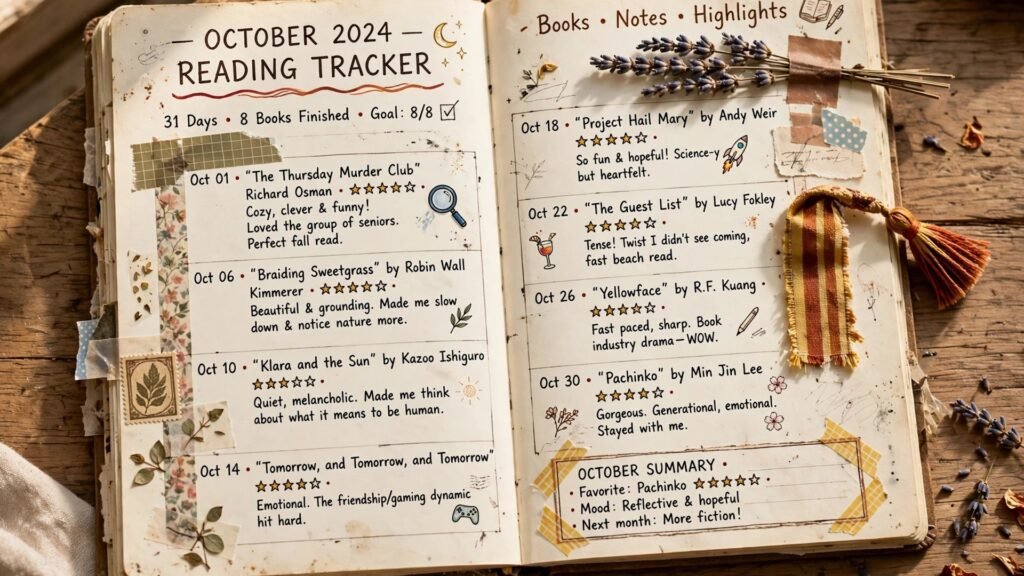
A monthly log is one page per month, with a row for each book you finished that month. It is the simplest layout, and the best choice if you want a year of reading on twelve pages. Add a small box at the top for the month, the number of books finished, and your favorite book of the month. At the end of the year, you can flip through the twelve pages and see your whole reading year in a few minutes.
Columns to Include in Your Log
Columns are the small boxes across the top of your log, and they decide what you record for each book. Too many columns make the page cramped and slow to fill in, while too few leave you wishing you had noted the author or the date. Start with five or six columns, use the log for a month, and then add or drop one column based on what you actually missed.
- Date finished: the day you closed the book, so you can see your reading year in order.
- Title and author: the full title and the author name, written clearly so you can find the book again.
- Genre: one word, such as mystery, memoir, or poetry, which helps you spot your favorite types.
- Pages: the page count, useful if you like to track how much you read in a month.
- Star rating: one to five stars, quick to fill in and easy to compare at a glance.
- One line review: a short sentence about what you liked, or did not like, in plain words.
- Favorite quote: a line from the book you want to keep, with the page number if you like.
If you borrow books from the library, add a column for where the book came from, so you remember whether it was a library book, a gift, or a charity shop find. If you read in print and on a screen, a column for format, print, ebook, or audio, can be useful too. Leave a little white space at the end of each row for a sticker or a small star.
How to Make a Printable Reading Log
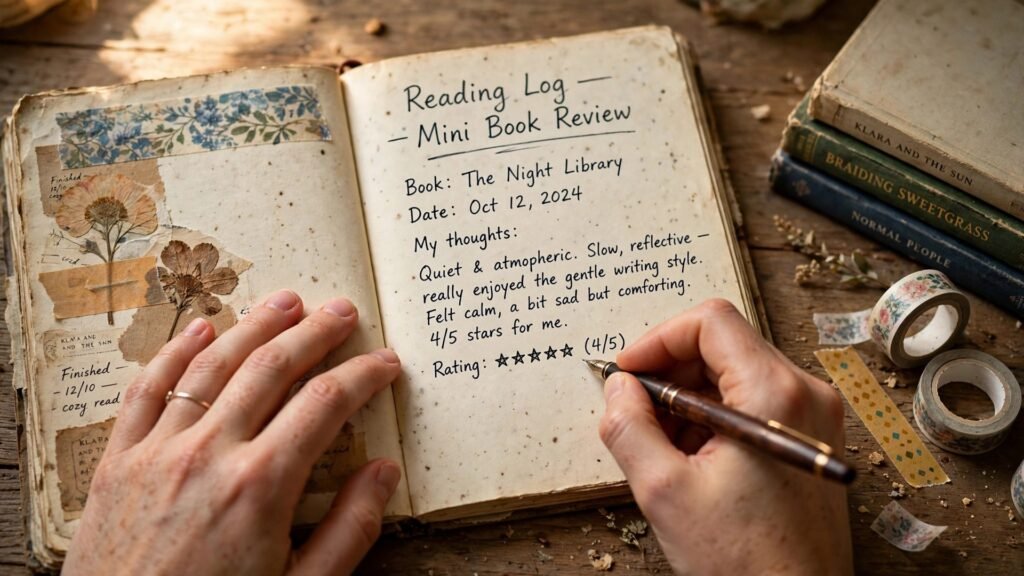
You can draw a log by hand, or you can design a printable reading log on your computer and print it as many times as you need. A printed page saves time, because the lines, boxes, and headings are already in place, and every page in your journal looks neat and consistent. Start by deciding the page size, then draw the table, then test print one copy before you print a whole stack.
First, pick a size that fits your journal. A half letter or A5 page fits most junk journals, while a full letter or A4 page works if your journal is large. Leave a margin of at least half an inch on the side you will glue or stitch, so the writing does not disappear into the spine. Draw a header row with your chosen columns, then add eight to twelve empty rows below it, which is enough for a month of books for most readers.
You can make the page in a word processor, a free design tool, or a spreadsheet, which is handy for neat tables. Use a clear, readable font at 11 or 12 points, with dark gray or black lines so the page prints cleanly. Keep the design plain, with lots of white space, because you will write on it by hand. Print a test copy in black and white first, check that the columns are wide enough for a long title, and fix any cramped boxes before you print more.
To print, use plain paper or light cardstock, around 65 lb, and set your printer to its best quality setting. Let the ink dry fully, then trim the page with a paper trimmer or a craft knife and a ruler. Glue it into your journal, or tape the edge with washi tape. Our how to make a journal guide shows how pages are bound, and our junk journal supplies list covers paper, glue, and tools.
How to Fill In Your Log Every Day
Filling in a log every day sounds like work, but it takes less than two minutes once it becomes a habit. Keep your journal and a pen beside the place where you read, such as your bedside table or your favorite chair, so the log is always within reach. When you stop reading for the day, write one line before you close the book, with the date, the pages you read, and a word about the session.
If you finish a book, fill in the full row that same day, while the ending is still fresh in your mind. Write the title and author, the date, your star rating, and one honest sentence. You do not need a clever sentence, and you do not need to praise a book you did not enjoy. “Slow start, strong ending, would read the author again” is a perfect review, because it tells future you exactly what to remember.
Mini Reviews and Favorite Quotes
A mini review is a review in one to three sentences, written in your own words, and it is the part of the log you will enjoy most when you reread it. It does not need to sound like a book critic, and it does not need to cover the plot. Say what stayed with you, such as a character you loved, a scene that made you laugh, or an idea that changed how you think. You can also note who you would lend the book to, or what to read next if you loved it. Our gratitude list guide has prompts that pair well with a reading page.
Favorite quotes deserve a small space of their own, because a single line can bring a whole book back to you. Copy the quote by hand, in your best writing, and add the page number and the name of the character who said it, if you know it. Keep quotes short, one or two lines, so they fit in the box and stay easy to read. The Internet Archive book collections hold many old books you can read and quote from for free, and they are a lovely source for classic lines to copy into a journal.
Keeping the Reading Habit Going
A reading log only works if you keep using it, so make the habit as small and pleasant as you can. Read at the same time each day, even if it is only ten minutes before bed, and keep the journal open to the log page so you do not have to search for it. Set a gentle goal, such as one book a month, and celebrate when you reach it with a sticker or a new bookmark.
If your reading slows down, change the log instead of giving it up. Switch from a daily log to a monthly log, drop the quote column for a while, or move the log to a smaller journal you carry with you. A busy month, a new job, or a new baby can all change how much you read, and the log should bend with your life, not fight it. The Library of Congress book collections are a good place to browse for a fresh title when you feel stuck.
Frequently Asked Questions
What should I write in a reading log?
Write the title, author, date finished, star rating, and one short sentence about each book. You can also add the genre, page count, and a favorite quote if you have room. Keep it short, because a log you can finish in two minutes is a log you will keep using.
Can I use a printable reading log in a junk journal?
Yes, a printed log page works beautifully in a junk journal. Print it on plain paper or light cardstock, trim it to fit, and glue or tape it into a spread or a pocket. Choose a half letter or A5 size for most journals, and leave a margin on the bound edge so the writing stays easy to read.
How often should I update my reading log?
Update it on the day you finish a book, and add one short line on the days you read but do not finish. A daily line takes less than a minute, and it keeps the log current. If you fall behind, fill in only the books you remember clearly, and start fresh from today.
What is the best layout for a reading log?
The best layout is the one that matches how often you read. A daily log suits daily readers, a weekly log suits readers who read in bursts, and a monthly log suits readers who finish a few books a month. Try one layout for a month before you change it, and keep the columns to five or six so the page stays easy to fill in.
Do I need to write a review for every book?
No, you do not need a full review for every book. One sentence is enough, such as what you liked, who you would lend it to, or why you stopped reading it. A short note is more useful than a long review you never write, because it captures the book while it is still fresh in your mind.
Looking for ready-made vintage pieces? Browse the Etopica shop on Etsy for printable reading ephemera, vintage book pages, and aged papers for your journal.
Our Etsy shop is full of adorable printable cliparts — birthday boys & girls, sweet animals, summer and spring themes — designed to print at home and layer straight into your journal.
Browse the Clipart Shop ↗
Leave a Reply