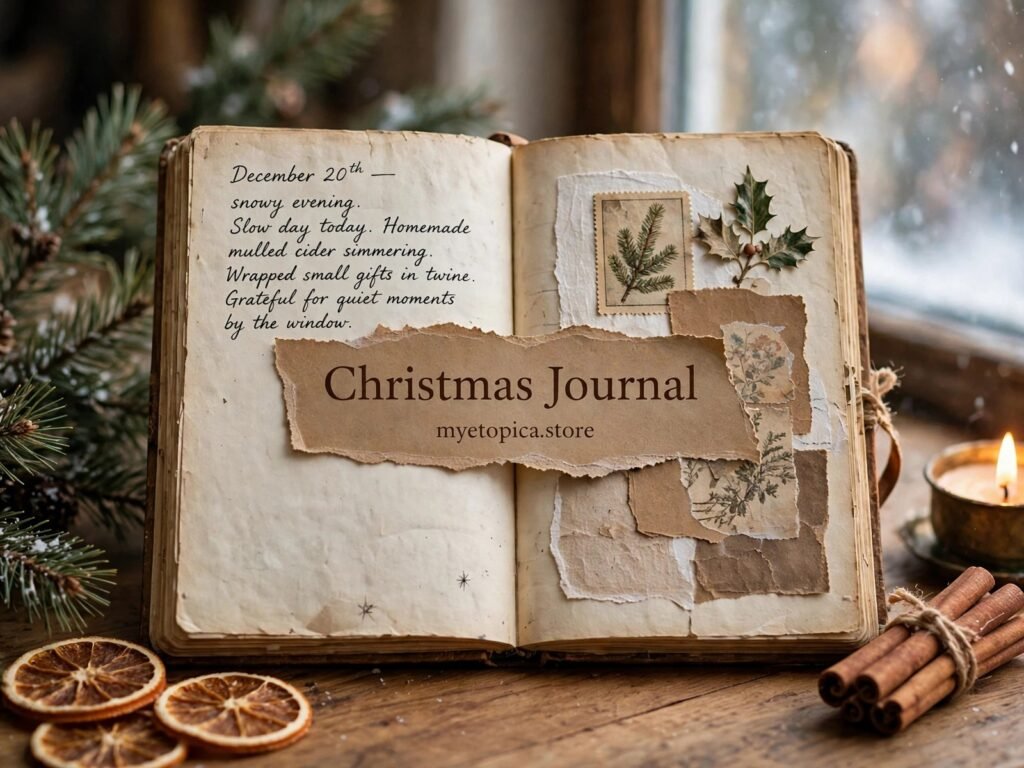
A christmas journal is a simple notebook where you keep December on paper: a few lines a day, a photo or two, a recipe that worked, and the small moments that usually disappear by January. You do not need a fancy system, a full craft room, or an hour a day to keep one. This guide shows you how to start a christmas journal from scratch, choose a journal and supplies that suit you, pick a format you can actually keep, and finish the month with a book you will love opening again next year.
Key Takeaways
- A christmas journal keeps one December on paper, a few minutes of writing a day.
- Choose a small, sturdy journal and a pen you enjoy, then add supplies you already own.
- Pick one format for the month, such as daily pages, memory keeping, or a mix of prompts and photos.
- Write five quiet minutes a day, and use a weekly catch-up page for anything you missed.
- Capture small, specific moments and skip anything that feels like a chore.
- Close the book in early January, label it with the year, and store it for next December.
What a Christmas Journal Is, and How It Differs from Other Holiday Journals
A christmas journal is the general, how-to-start guide to keeping a festive journal through December. It is one notebook for one season: the decorating, the baking, the letters, the quiet evenings, and the big day itself. You write in it during December, a little at a time, and when the month ends the book is finished. That simple shape is what makes it easy to begin. You are keeping a record of one December, in your own handwriting.
It helps to know how this guide differs from the other holiday journals on this site. Our christmas memory journal is a year-after-year keepsake book, built to hold the same traditions across many Decembers, while this guide is the general starter guide for a single December. Our christmas journal prompts post is a list of twenty prompts for days when you are stuck for words, and this guide is the full starter guide, of which prompts are only one part. Our christmas journal ornament is a tiny tree-hanging journal, while this guide covers a full-size journal you write in at the table. Pair it with a december daily junk journal if you love the daily rhythm, or with our holiday memory journal to carry the memories into the new year.
Christmas carries a long history of gathering and giving, as the history of Christmas shows, and old photographs in the Library of Congress Christmas photograph collections show families decorating trees a hundred years ago with the same feeling you are catching on your pages. Your journal does not need to be grand. It needs to be honest, and it needs to be yours.
Choose Your Journal and Supplies
Start with the journal, because everything else follows from it. The right journal is the one you will pick up every evening, not the prettiest one on the shelf. If it is too big, you will leave it at home. If the paper is too thin, your pen will bleed through and you will stop writing. Choose a book that feels friendly.
Pick a journal you will actually carry
A small to medium journal works best for December, about the size of a paperback book, with 60 to 100 pages. That gives you room for daily pages, a few pockets, and some full spreads, without feeling endless. If you already own a journal, use it. Write the year on the cover, so you know at once which December it holds.
Gather simple supplies first
You need very little to begin: a pen that writes smoothly, a pencil for planning, a glue stick, and a small pair of scissors. Add coloured pencils or a few markers for headings and dates, some kraft paper and old book pages for layering, and a small stack of printed photos. Our guide to junk journal supplies lists the basics in detail, and most of them are things you already have in a drawer.
- A small to medium journal, 60 to 100 pages.
- A smooth pen, plus a pencil for planning.
- A glue stick and small scissors for photos and paper scraps.
- Coloured pencils or markers for dates and headings.
- Kraft paper, old book pages, and printed photos for layering.
- A kraft pocket inside the back cover, for loose keepsakes.

Pick a Format That Fits Your December
A format is simply the shape your pages take, and the best format is the one you will keep on a tired evening. Choose it before December 1, write it on the inside cover, and stick to it for the month. You can change formats next year, but changing mid-month is how journals get abandoned. Keep the pages simple: a date at the top, a few honest lines, and one small decoration is a complete page.
Daily December pages
Daily pages give every day of December its own space, from December 1 to December 25, with a short entry for each. Number the pages in advance, one date per page, and leave the rest blank for the month to fill. The dates lead you through the month in order. The risk is a missed day, and the fix is simple: write the missed line the next morning, date it for the day it belongs to, and carry on.
Memory keeping pages
Memory keeping pages are looser. Instead of one page per day, you give a spread to each event: the tree going up, the first snow, the baking afternoon, the gift wrapping evening. Each spread holds a few lines, a photo or two, and one small keepsake, such as a gift tag or a pressed pine sprig. Label each spread with its date and event, so the book still reads in order next year.
Prompts, photos, recipes, and letters
The mixed format brings four small habits together in one book. A prompt gives you a starting line on days when your mind is blank, such as the best smell in the house today, or the gift you are most excited to give. A photo page holds the pictures that matter, one per spread, with a caption in your own words. A recipe page holds the dish that worked this year, written the way you actually made it. A letter page holds a short note to someone you love, or to your future self, sealed in a small envelope and glued into the book. Old recipe cards in the Internet Archive Christmas collections show families kept notes like these for generations.
A Simple December Rhythm You Can Keep
A journal survives December only if the daily ask is small. Five minutes a day is enough, and five minutes is honest about what December is really like. The tree needs decorating, the shopping needs doing, the house fills up, and the evenings run short. A journal that asks for an hour will be closed by December 5. A journal that asks for five minutes will still be open on Christmas Eve. Set a fixed time for it, such as after dinner, when the house is quiet, and the habit will carry itself.
Five quiet minutes a day
Keep the five minutes to three small moves. First, write the date and one line about the day, the truest line you can manage. Second, add one small detail, a smell, a sound, or something someone said, word for word. Third, stick in one thing, a photo, a gift tag, or a scrap of wrapping paper. Then close the book. On a big day, let the entry take a full spread, and let ordinary days take five lines.
A weekly catch-up page
Even a five minute habit slips sometimes, so build in a weekly catch-up page every Sunday. Use it to fill any missed lines while you still remember them, to print the photos from the week, and to plan the next seven days. A journal with a weekly catch-up page never falls more than a few days behind, and that is the difference between a finished book and a book abandoned on December 12.

What to Capture, and What to Skip
The hardest part of a christmas journal is not the writing. It is choosing what to keep. December is full, and if you try to record everything, the journal becomes another chore, and chores get dropped. Choose the small, specific moments instead. The light on the tree at four in the afternoon, the smell of cinnamon, the exact words your child said when they saw the lights: these small details are the ones you will want in ten years, and a photo alone cannot save them.
Capture the small, specific moments
Write what only you could have noticed. Note who was there, where everyone sat, and what was said, because the people are the memory, not the table setting. Save one recipe the way it was really made this year, with the changes and the mistakes, and note who made it and how it tasted. Add the weather, one line, because in ten years you will not remember whether it snowed on Christmas Day, and the journal will tell you.
Skip the pressure to record everything
Skip the daily to-do list, the shopping list, and the full menu plan, unless a list itself tells a story. Skip the perfect handwriting and the perfect layout. Skip the guilt when a day goes by unwritten. One honest line is a complete entry, and a finished journal with gaps is worth more than a beautiful journal that stops on December 8.
Finish It, Store It, and Open It Again Next Year
A journal is not finished when December ends. It is finished when you close it properly, and closing it properly takes one quiet evening in early January. Read it through from the first page to the last, with a warm drink, and add a short closing page: the best day, the funniest moment, the recipe you will make again, and the one thing you want to remember next year. Write the year on the cover, large enough to read from the shelf.
Close the book in early January
Do not leave loose ends for later, because later never comes. Glue in the last photos, tuck the last gift tags into the back pocket, and press any pine sprigs flat between the pages so they do not stain the paper. A closing page with a few honest lines turns a stack of pages into a book.
Store it where next December can find it
Store the finished journal upright on a shelf, beside your other holiday books, with the year facing out. Keep it away from damp and direct sun, and keep the box of leftover supplies with it, so that next November you can open the box, open the book, and begin again without hunting for anything. Over a few years, the small stack on the shelf becomes a family record no photo album can match.

Frequently Asked Questions
When should I start a christmas journal?
Start in late November, a few days before December 1. Set up the journal, number the pages, gather your supplies, and write the year on the cover. If you find this guide mid-December, start on the day you find it, and write one short summary page for the days you missed.
How much time does a christmas journal take each day?
About five minutes a day is enough: one line about the day, one small detail, and one photo or scrap stuck in. Big days, such as Christmas Eve or Christmas Day, may take ten minutes and a full spread.
What is the difference between a christmas journal and a christmas memory journal?
A christmas journal, as this guide covers it, is the general starter guide for keeping one December on paper, in a full-size journal you write in through the month. A christmas memory journal is a year-after-year keepsake book that holds the same traditions across many Decembers, so you can compare one year with the next.
Do I need special supplies to keep a christmas journal?
No. You need a journal, a pen you enjoy, a glue stick, and small scissors, plus paper scraps and printed photos you already have. Coloured pencils, kraft paper, ribbon, dried orange slices, and pine sprigs add festive colour for almost nothing.
What do I write if I miss a day?
Write the line the next morning, while you still remember the day, and date it for the day it belongs to. If you miss a whole week, write one short summary page for that week and start fresh on Monday. A missed day is not a failed journal.
What do I do with the journal after Christmas?
Close it in early January with a short closing page: the best day, the funniest moment, and the recipe you will make again. Write the year on the cover, glue in the last photos, and store it upright on a shelf beside your other holiday books.
Looking for ready-made vintage pieces? Browse the Etopica shop on Etsy for printable Christmas journal ephemera, festive page templates, vintage holiday designs, and aged papers that layer beautifully into December journal spreads.
Our Etsy shop is full of adorable printable cliparts — birthday boys & girls, sweet animals, summer and spring themes — designed to print at home and layer straight into your journal.
Browse the Clipart Shop ↗
Leave a Reply