
A christmas memory journal is a keepsake book that grows by one spread each year, so that every Christmas you celebrate gets its own pages, with photos, traditions, and stories recorded while they are still fresh. Instead of starting a brand new journal every December and forgetting the old ones, you keep a single book that you open again each Christmas, add the new year, and read back through the years that came before it. This guide shows you how to set up that year after year book, what to record on each spread, and how to keep it going for decades, so your family’s Christmases become a story you can hold in your hands.
Key Takeaways
- A christmas memory journal is one book that grows by one spread per Christmas, not a new journal every year.
- Each yearly spread records the same simple things: who was there, what you ate, one tradition, one photo, and one story worth remembering.
- Set up the book once with a year index at the front, then add spreads in order, leaving the same amount of space for every year.
- Photos matter more than perfect handwriting, so print small photos at home and glue them in the same week as Christmas.
- Read back two or three past spreads together each Christmas Eve, because rereading is what turns a record into a family ritual.
- Keep the book sturdy and simple: a bound journal, acid free glue, and pockets for loose cards will outlast fancy decorations.
What a Christmas Memory Journal Is and Why It Works
A christmas memory journal is different from a December daily journal, which records one page every day of the month, and different from a general Christmas ideas book, which collects craft projects. This book has a slower rhythm: one spread per year, filled in during the week after Christmas, then closed until next December. The slowness is the point, because it makes the book easy to keep up with for twenty years or more, and it means the pages you read back show real change, children growing taller in the photos, new people joining the table, recipes changing, and traditions shifting year by year. A book like this becomes more precious with every Christmas you add to it.
The format suits any family shape, a household with young children, a couple building traditions together, or one person keeping their own holiday memories. You do not need to be artistic, and you do not need expensive supplies, because the value of the book comes from the memories it holds, not from how decorated the pages are. A plain bound journal, a pen, a glue stick, and a few printed photos are enough to start, and you can add washi tape borders, vintage ephemera, or pressed holly later if you enjoy decorating. The habit matters more than the supplies: if you fill in your spread within a week of Christmas while the details are fresh, the book stays honest and complete, and if you wait until spring, half the stories will already be forgotten. Journals and commonplace books have a long history as personal archives, and the idea of keeping a yearly record is an old one, as the commonplace book entry shows.
Set Up Your Year After Year Christmas Memory Journal
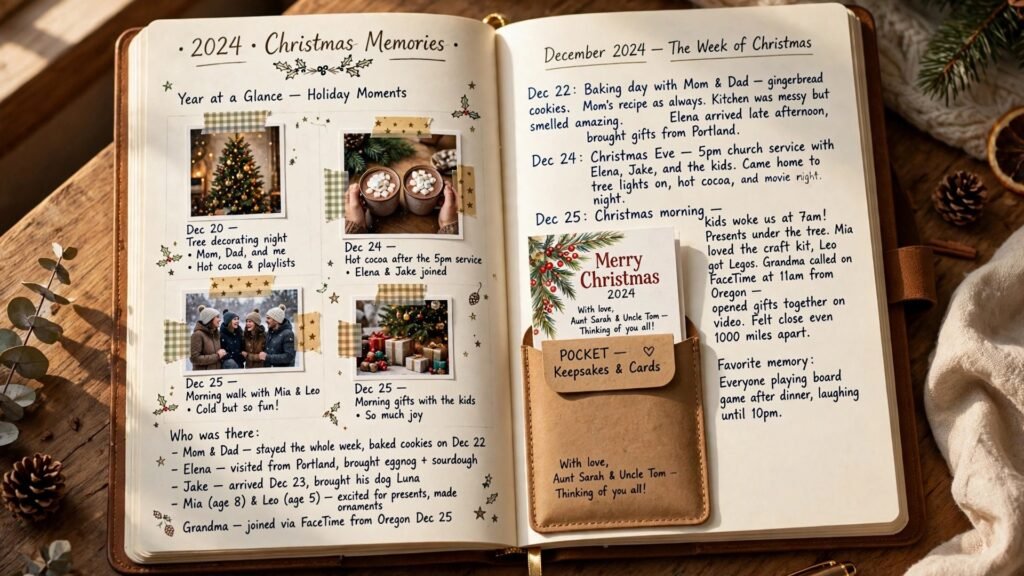
Start with a sturdy bound journal, not a spiral notebook, because this book will be opened and closed for decades, and a bound spine holds up far better than wire or rings. Choose a size you can write in comfortably at the kitchen table, usually A5 or a little larger, with thick paper that takes glue and ink without wrinkling. Leave the first two pages blank for a year index, where you will list each year and the page it starts on, and number the pages lightly in pencil as you go. On the inside cover, write the year you started the book and who it belongs to, because in twenty years that line will be the first thing someone reads.
Decide your spread layout before the first Christmas, and keep it the same every year, because a consistent layout makes the book easy to fill in and easy to read back. A simple layout works best: the left page holds one or two small photos, a list of who was there, and the menu or the main meal; the right page holds the tradition of the year, one short story, and a small pocket for a card or a piece of wrapping paper. Write the year large at the top of the left page so you can find any Christmas at a glance. If you like, add a small color code, one washi tape color per year, along the page edge, which creates a rainbow of years when the book sits on a shelf. For a daily format instead of this yearly one, see our December daily junk journal guide, which covers the day by day approach in detail.
What to Record on Each Christmas Spread
Every yearly spread answers the same six questions, and answering the same questions each year is what makes the comparison across years so delightful. First, who was there: list everyone who shared Christmas with you, including guests, visitors, and anyone who joined by phone or video call. Second, where you spent it: your own home, a parent’s house, a trip away, or a quiet Christmas at home. Third, what you ate: the main meal, one special dish, and any recipe that was new that year. Fourth, the gifts: not a full list, just the one gift that mattered most, who gave it, and why it was special. Fifth, the weather and the mood: snow, rain, sunshine, a power cut, a late start, or a perfect calm evening. Sixth, one story: the funniest moment, the biggest surprise, or the thing that went wrong and became a family joke.
Keep each answer short, two or three lines is enough, because long essays are the reason memory books get abandoned. Write in your normal handwriting, and do not worry about neatness, because your handwriting is part of the memory, and your grandchildren will love seeing it exactly as it was. If a child in the family wants to write their own line each year, give them a small box on the right page, and watch their handwriting and their answers grow up across the spreads. Add the date you wrote the spread, usually within a week of Christmas, so future readers know the notes were fresh. Small, honest details beat grand summaries every time: the burnt potatoes, the dog stealing a cracker, and the song everyone sang are the lines you will reread most. For more seasonal page ideas in the same spirit, our Christmas junk journal ideas offer layouts and prompts you can adapt to a yearly spread.
A simple checklist for every yearly spread
- The year, written large at the top of the left page.
- Who was there, including guests and anyone who joined by phone or video.
- Where you spent Christmas, and the weather that day.
- The main meal and one special dish or new recipe.
- The one gift that mattered most, and who gave it.
- One tradition kept, started, or changed that year.
- One short story: the funniest moment or the biggest surprise.
- One or two small photos, printed and glued in the same week.
- A pocket holding a card, a gift tag, or a scrap of wrapping paper.

Photos, Traditions, and One Recipe or Story Each Year
Photos are the heart of a christmas memory journal, but they only work if they actually get printed and glued in. Choose one or two photos per year, not twenty, and print them small, about the size of a playing card, so they fit the spread without covering your writing. Pick photos that show people together rather than posed portraits: everyone around the table, the tree being decorated, or a child asleep under a blanket of wrapping paper. Print them at home or at a local shop within a week of Christmas, and write the names of the people in each photo underneath in pencil, because faces you know today will need labels in twenty years. A small pocket on the spread can hold extra photos that did not fit, so nothing gets thrown away.
Traditions deserve their own line every year, because they are the first thing that changes. Note which traditions you kept, which ones you skipped, and any new one you started, even a small one like a new breakfast dish or a walk after lunch. If a tradition ended that year, write that down too, with one honest line about why, because the book should tell the truth, not a polished version of it. The same goes for recipes: copy one recipe per year onto the spread, or tuck a handwritten recipe card into the pocket, and over time the book becomes a family cookbook as well as a memory book. For public domain Christmas images and vintage cards you can print as extra ephemera, browse the Library of Congress free-to-use collections, and for historic holiday photographs, the Internet Archive Christmas collections hold a wealth of material to print and keep.
Reading Back Past Christmases Together
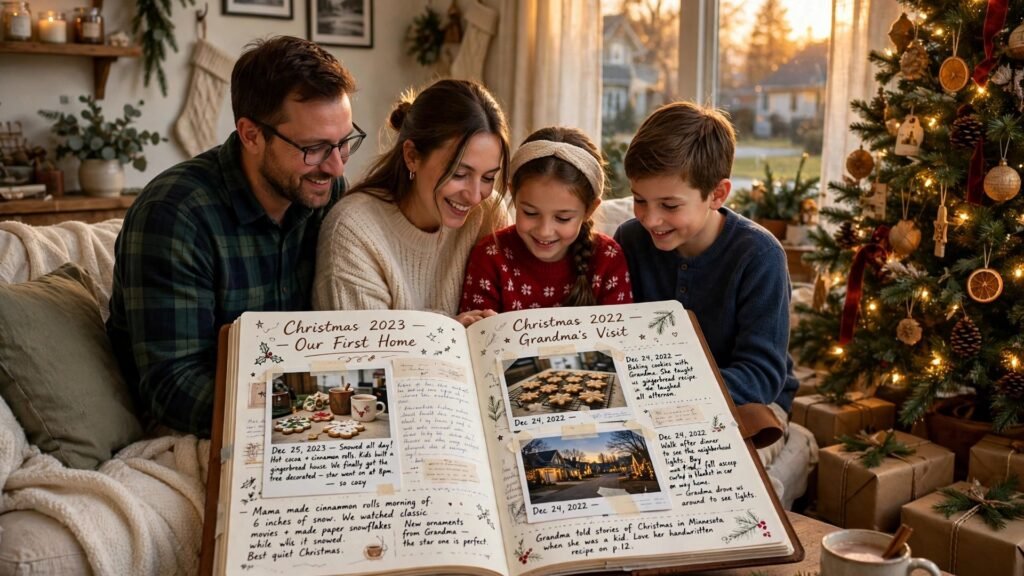
A memory book only becomes a tradition itself when you open it together, so build rereading into your Christmas. Pick a quiet moment, usually Christmas Eve or the afternoon of Christmas Day, and read back two or three past spreads out loud, one from the early years of the book, one from last year, and one from a year someone remembers fondly. Children love hearing what they said and did when they were small, and older relatives love hearing their own stories told back to them. Keep the reading short, ten minutes is enough, because the goal is laughter and conversation, not a formal recital, and let anyone add a correction or a detail they remember differently, writing it in the margin with the current year noted.
Over time, the rereading ritual does something the writing alone cannot do: it shows your family its own story. You will notice patterns, the same dish every year, the same joke at the table, the same person always arriving late, and you will notice changes too, new faces, new homes, and traditions that quietly retired. If a year was hard, a loss, an illness, or a Christmas spent apart, record it honestly and gently, because skipping hard years makes the book feel false, and future readers will understand that real lives include hard Christmases. Store the finished book somewhere safe but reachable, not buried in an attic, because a keepsake that cannot be found cannot be read, and this one deserves to be read every December. If you are choosing gifts for the person who keeps the family memories, our gifts for junk journalers guide has ideas that suit a memory keeper perfectly.
Frequently Asked Questions
What is a christmas memory journal?
A christmas memory journal is a single keepsake book that grows by one spread each Christmas, recording who was there, what you ate, one tradition, one photo, and one story each year. You open the same book every December, add the new year, and read back through past Christmases. It is a year after year record, not a daily December journal and not a list of Christmas craft ideas.
How is a christmas memory journal different from a December Daily?
A December Daily records one page every day of December, while a christmas memory journal records one spread per year. The yearly format takes only an hour or two each Christmas, so it is far easier to keep going for decades, and it shows change across years, children growing, traditions shifting, and new people joining, in a way a daily journal cannot.
What should I write in a christmas memory journal each year?
Record the same six things every year: who was there, where you spent Christmas, what you ate, the one gift that mattered most, one tradition kept or started, and one short story. Add one or two small photos and a pocket holding a card or gift tag. Keep each answer to two or three lines, so the spread stays easy to fill in and easy to reread.
When should I fill in my christmas memory journal?
Fill in your spread within a week of Christmas, while the details are still fresh. Print your photos in that same week and glue them in right away, because photos left on a phone rarely make it into a book months later. Set a reminder for the days between Christmas and New Year, and treat it as part of the holiday itself.
How many photos should go on each yearly spread?
One or two small photos per year is ideal, printed about the size of a playing card. Choose photos that show people together, such as everyone around the table or the tree being decorated, and write the names of the people underneath in pencil. Keep extra photos in the spread’s pocket, so nothing is thrown away and the pages never get overcrowded.
Can I start a christmas memory journal for past Christmases?
Yes. Start with the current Christmas, then work backwards one year at a time, using old photos and family memories to fill earlier spreads. Keep the backwards spreads shorter and mark them as remembered later, so future readers know they were written from memory. Even two or three remembered years make the book feel complete from the start.
Looking for ready-made vintage pieces? Visit the Etopica shop for printable ephemera you can cut and use in your Christmas memory journal today.
Our Etsy shop is full of adorable printable cliparts — birthday boys & girls, sweet animals, summer and spring themes — designed to print at home and layer straight into your journal.
Browse the Clipart Shop ↗
Leave a Reply