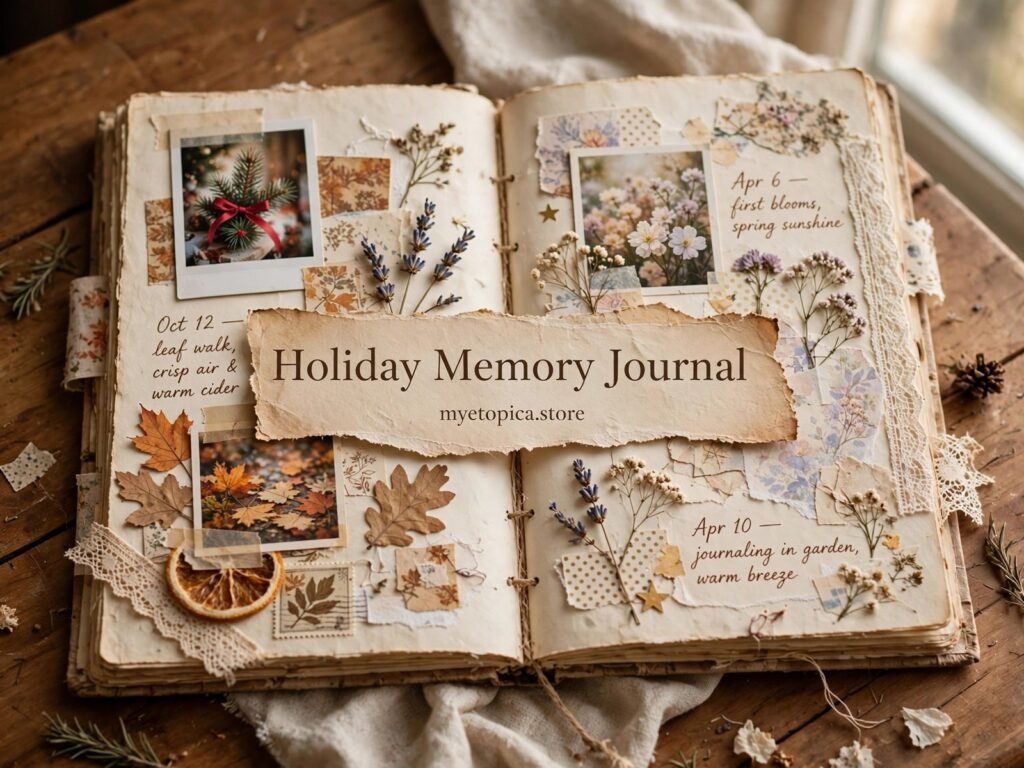
A holiday memory journal keeps the best parts of every celebration in one place, so the photos, stories and small keepsakes from Christmas, Easter, birthdays, Halloween, Thanksgiving and summer holidays never end up scattered across phones, drawers and boxes. Start with one sturdy journal, give each holiday its own dated section, and add a few photos, a short written memory and one small keepsake per celebration. This guide shows you how to build one step by step.
Key Takeaways
- One journal for the whole year keeps every holiday together and makes the book easy to find and enjoy.
- Give each holiday a dated section with the same simple layout, so every celebration gets equal care.
- Choose a few strong photos per holiday instead of printing everything you took that day.
- Write short, honest stories while the details are fresh, using simple prompts to get started.
- Use pockets, envelopes and tags to hold keepsakes without gluing flat every single item.
- Protect finished pages with fixative, wax paper and a dry storage spot, so the journal lasts for years.
How to Start a Holiday Memory Journal That Lasts All Year
Begin with a journal you enjoy opening. A bound journal with thick pages works well for a year long project, because it holds photos, pockets and layered paper without falling apart, while a ring binder lets you move pages around as the year grows. Choose a size you can carry to the kitchen table. Plain cream or kraft pages suit every season, and they let red Christmas paper, orange autumn leaves and pastel spring prints all look at home on the same spread.
Before the first holiday arrives, set up the bones of the book. Leave the first two pages for a contents list, then add a simple year plan on the next spread, with one line per holiday, the date, and a note about who will be there. Number the pages lightly in pencil as you go, so you can find Easter in April and Halloween in October without flipping through the whole book.
Choose your journal and your basic tools
You do not need expensive supplies to start, and a small kit kept in one box makes it easy to sit down and work for twenty minutes after each holiday. Keep a glue stick that dries flat, small sharp scissors, a soft pencil, a fine black pen, a roll of clear tape, and a handful of paperclips in the box. Add double sided tape for photographs, since it holds better than wet glue and will not wrinkle the print.
Set simple rules you can keep all year
- Give every holiday two to four pages, no more, so one big celebration cannot crowd out the rest of the year.
- Add photos, one short story and one keepsake per holiday as a minimum, then add more only if you have time.
- Write the date, the place and the names of the people in the photos on every spread.
- Finish each holiday section within two weeks, while the small details are still fresh in your mind.
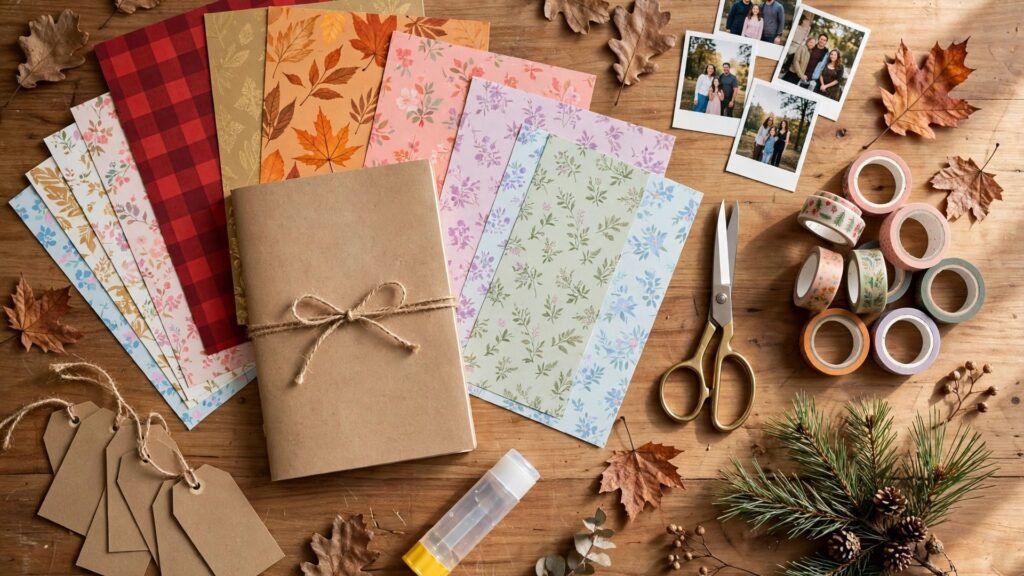
Choose a Year Round Structure That Fits Every Season
A year round journal needs a structure that works in January and in July, and the simplest one is a season by season flow with a clear marker at the start of each holiday. Use a colored paper tab, a painted strip or a small divider card to mark each new celebration, and keep the same layout inside every section. A good layout is a title line with the holiday name and date at the top, one or two photos in the middle, a short memory below, and a small pocket at the edge for the keepsake.
Give each season its own colors and papers
- Winter: deep red, pine green, gold and cream, with plaid, snowflakes and pine sprigs.
- Spring: soft pink, lilac, pale green and butter yellow, with flowers, eggs and pastel dots.
- Summer: bright coral, sea blue, sunny yellow and white, with shells, stripes and sunshine motifs.
- Autumn: burnt orange, rust, mustard and brown, with leaves, pumpkins and plaid.
Keep the background paper calm and let the seasonal colors appear in small pieces, such as a washi tape strip, a paper tag or a border, so the pages still feel like one book. A reader flipping through the journal should see the year change in a gentle wave, from pale spring flowers to bright summer color to warm autumn leaves and deep winter red. Save scraps from each season in a labeled envelope at the back of the journal. For more ideas, a guide to fall junk journal ephemera shows how small seasonal pieces can carry a whole theme.
Gather Photos, Papers and Keepsakes for Each Holiday
Good holiday pages start with good gathering, and the best time to gather is the day of the celebration itself. Put a small box or envelope by the door before guests arrive, and drop in the paper items as the day goes on: a place card, a gift tag, a menu, a ticket, a pressed flower from the table or a child’s drawing. Take one wide shot of the whole scene, one close shot of a detail, and one honest photo of people laughing.
Choose the photos that tell the story
When you sit down to choose photos, print small and choose slowly. A print about the size of a playing card fits easily beside a written memory, and three small prints across a spread feel generous without crowding the page. Pick the photo with the best light and the truest expressions, not the one where everyone is posed perfectly. Write the names of the people on the back of each print before you glue it down. If you have no printed photos of your own, the Library of Congress free to use image collections include historic photographs that suit a vintage style page beautifully.
Sort keepsakes into keep, copy or photograph
- Keep flat and small: gift tags, tickets, dried flowers, ribbons, menus, place cards and small drawings.
- Copy by hand: long letters, recipes, song lyrics or a child’s long story, written out in your own handwriting.
- Photograph bulky items: large ornaments, a birthday cake, a carved pumpkin or a handmade gift that will not fit on a page.
- Store the rest: keep bulky originals in a labeled box that matches the journal, and note the box on the page.

Write Short, Honest Stories While the Details Are Fresh
The writing is what turns a scrapbook into a memory journal, because photos show what happened and words explain how it felt. Write within a week of the holiday if you can, and aim for five to ten honest sentences rather than a long essay. Start with the plain facts, the date, the place, who was there and what you ate or made, then add one sensory detail, such as the smell of cinnamon or the sound of rain on the roof.
Prompts that work for every holiday
- What was the best moment of the day, and who was beside me when it happened?
- What did we eat, make or sing, and what did it smell or sound like?
- What went wrong, and what did we laugh about later?
- What did the youngest person there enjoy most?
- What should we do the same way next year, and what should we change?
Answer only one or two prompts per holiday, and let the rest wait for another year, because short dated entries build up into a record of the whole year without wearing you out. Write in pencil first if a blank page feels daunting, then go over the words in pen. If handwriting feels slow, write the story on a journaling card and tuck it into the pocket beside the photo. A short read about scrapbooking shows how this habit of saving photos and words together has been passed down through generations.
Make Christmas Pages That Belong in a Year Round Journal
Christmas deserves a generous section, because it usually brings the most photos, the most keepsakes and the longest list of memories, but it should still feel like one chapter in a year long book rather than the whole book itself. Give Christmas four to six pages, and use the same layout as the rest of the year. Start with the preparations, such as decorating the tree and baking, then move to Christmas Eve and Christmas Day, and finish with a quiet page for the days after.
Christmas keepsakes that fit on a page
- A gift tag with a handwritten message, trimmed and tucked into a small pocket.
- A strip of wrapping paper or ribbon from a favorite gift, glued flat as a border.
- A Christmas card, cut down to the front image and the signed message inside.
- A small sprig of pine or a dried orange slice, pressed flat for a week first.
- A photo of the tree, the table or the stockings, printed small with the date on the back.
Keep the Christmas palette warm and limited, with deep red, pine green, gold and cream, so the pages feel festive without turning busy. One strong photo per page is enough when the keepsakes are doing their own talking. If you make Christmas pages every year, note the year clearly on the title line. For more seasonal ideas, browse a guide to Christmas junk journal ideas, and the Internet Archive holds historic images and ephemera that suit a vintage Christmas page.

Protect Finished Pages and Keepsakes So They Last
A holiday journal is meant to be opened again, and a little protection keeps it looking loved rather than worn out. Mist finished painted or chalked pages very lightly with workable fixative in a ventilated space, and let each page dry completely before you close the book. Place a sheet of wax paper between spreads that hold fresh paint, pressed flowers or sticky keepsakes, so nothing transfers to the facing page.
- Store the journal flat and dry, away from damp rooms, direct sunlight and radiators.
- Keep it in a cloth bag or a box when it travels, so the cover and corners stay clean.
- Photograph every finished spread in soft daylight, as a backup and as a way to share it.
- Label the spine with the year, so the book is easy to find on a shelf next to other years.
Photographing the finished spreads is the simplest insurance you can give the journal, and it takes only a few minutes at the end of each holiday section. Lay the book open in soft daylight near a window, keep the camera straight above the page, and take one photo per spread. Save the photos in a folder named with the year, and print a fresh copy of any photo that fades.
Frequently Asked Questions
What is a holiday memory journal?
A holiday memory journal is one book where you keep photos, short written stories and small keepsakes from every holiday through the year, such as Christmas, Easter, birthdays, Halloween and Thanksgiving. Each holiday gets its own dated section.
How is this different from a Christmas only memory journal?
A Christmas only journal covers one holiday, while a year round journal covers many holidays across all four seasons, with Christmas as one chapter among others. The year round book uses the same layout for every celebration.
How many photos should I add for each holiday?
Three to six small photos per holiday is a good range. Choose one wide shot of the scene, one close detail and one photo of people together. Small prints about the size of a playing card leave room for writing and keepsakes.
What keepsakes fit in a holiday memory journal?
Flat and small keepsakes fit best, such as gift tags, tickets, menus, place cards, ribbons, dried flowers and small drawings. Copy long letters or recipes by hand, photograph bulky items, and store the originals in a labeled box noted on the page.
How do I start if the year is already half over?
Start with the next holiday on the calendar, and add the earlier holidays later from your phone photos and memory. Work backwards one holiday at a time, and write the dates clearly on each section.
How do I protect photos and keepsakes from damage?
Use pockets and envelopes for fragile items, double sided tape for photos, and a light mist of fixative for painted pages. Place wax paper between spreads, store the journal flat and dry away from sunlight, and photograph every finished spread as a backup.
Looking for ready-made vintage pieces? Browse the Etopica shop on Etsy for printable vintage ephemera, holiday cliparts, seasonal papers and aged tags that layer beautifully into year round memory pages.
Our Etsy shop is full of adorable printable cliparts — birthday boys & girls, sweet animals, summer and spring themes — designed to print at home and layer straight into your journal.
Browse the Clipart Shop ↗
Leave a Reply