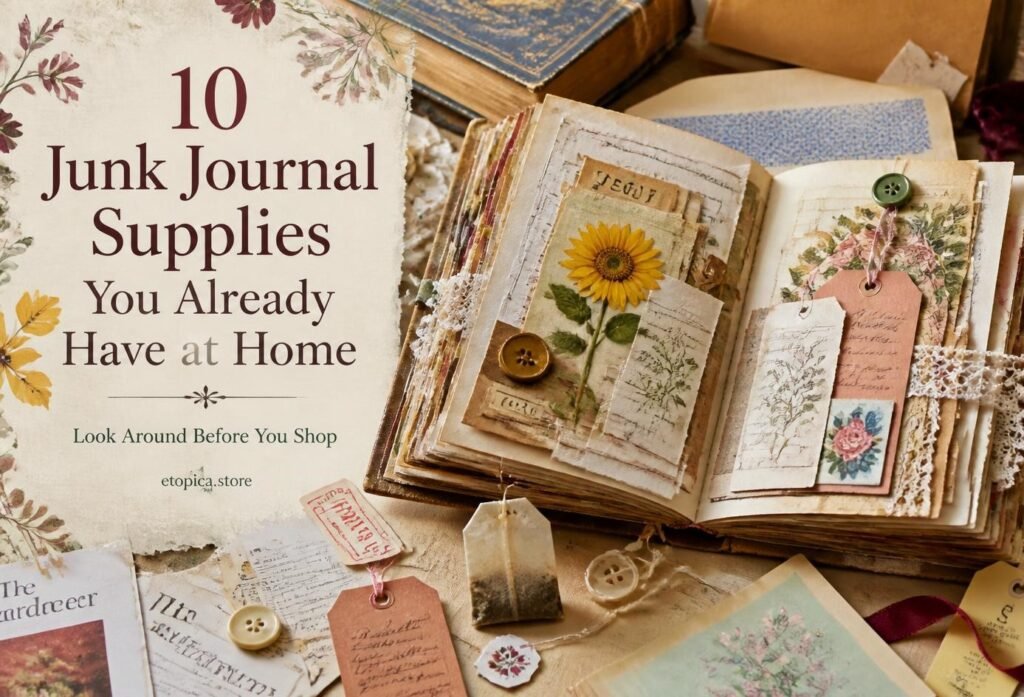
Here’s a secret the craft industry doesn’t advertise: the best junk journal supplies aren’t in a store. They’re in your kitchen drawer, your recycling bin, and that pile of mail on the counter.
Before you spend a single rupee, dollar or pound on supplies, go on a treasure hunt through this list. You’ll be amazed what’s already waiting for you, and honestly, the found things always make better pages than the shop-bought ones, because they’re mismatched and real.
1. Used tea bags:
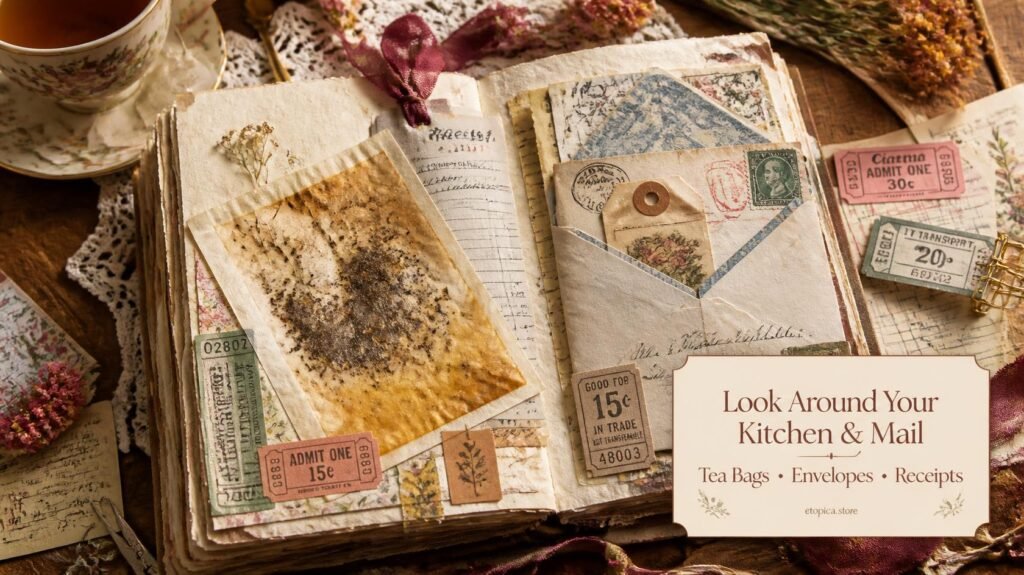
The queen of free junk journal supplies. Dry out a used tea bag, carefully open it along one seam, empty the leaves, and you’re left with a beautifully stained, delicate paper that layers like a dream.
The staining is different every time, some come out golden, some deep amber, depending on the tea and how long it steeped. Glue them flat as backgrounds, or leave the edges loose for texture.
How to prepare them: squeeze gently, then lay flat on kitchen paper somewhere airy for a day. Don’t rush it in a warm oven, they go brittle and tear. Once fully dry, press them under a heavy book overnight and they’ll flatten beautifully.
2. Old envelopes:
Envelopes are secretly the most versatile item on this list, and there are three separate things you can do with each one.
As a pocket: glue one in unopened-side down, and the opening becomes a tuck spot for tags, notes and treasures. This is the single easiest pocket in junk journaling.
As patterned paper: the security lining inside many envelopes, those tiny blue, grey or crosshatch prints, makes wonderful decorative paper. Cut the envelope open and you have two free patterned sheets.
As ephemera: stamps, postmarks, handwritten addresses and airmail borders are instant vintage character, and impossible to buy convincingly.
3. Receipts and tickets:
Bus tickets, cinema stubs, shopping receipts, parking slips. On their own they look like clutter; layered into a page they become a diary entry that needs no words.
A receipt from a day out says “I was here, and it mattered” better than a paragraph ever could.
One thing worth knowing: most modern till receipts are thermal paper, and the print fades to blank within a few years — sometimes much faster in warm light. If a receipt genuinely matters to you, photocopy or photograph it and glue the copy in, or write the details beside it.
4. Book pages from damaged books:
A water-damaged or falling-apart old book is a goldmine: hundreds of pages of aged, yellowed paper with beautiful typography. Charity shops sell them for pennies, and you may already own one.
Use them as backgrounds, fold them into pockets, or tear out interesting phrases to layer into your pages. Dictionaries, hymn books, old textbooks and sheet music are especially good, the dense text and unusual layouts read instantly as “vintage”.
One rule: only sacrifice books that are already beyond saving. No destroying readable books in this house.
5. Packaging and product boxes:
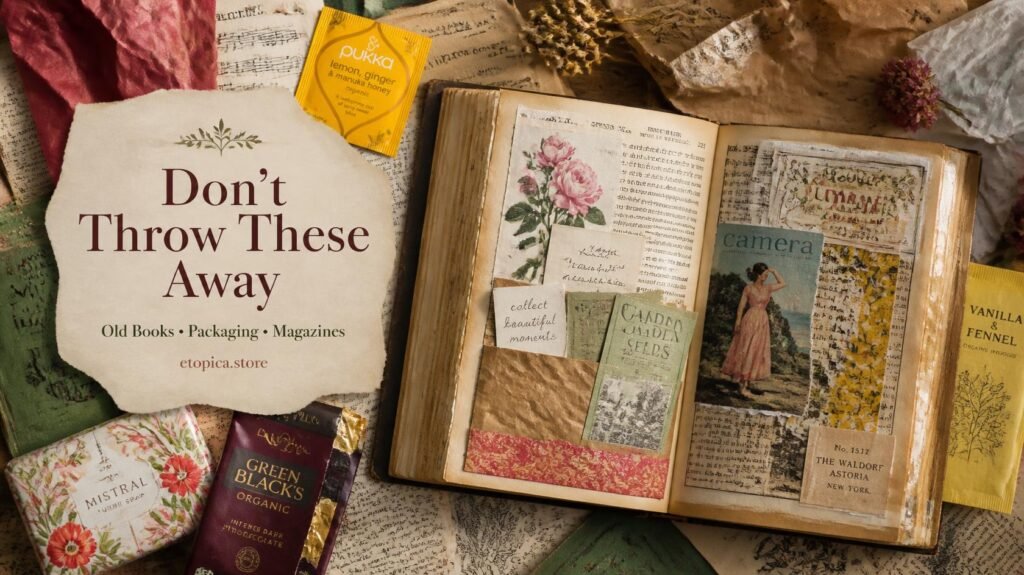
Tissue paper from deliveries, pretty soap wrappers, the inside of biscuit boxes, chocolate wrappers with gold foil, perfume boxes, tea packaging. Product designers spend fortunes making packaging beautiful, let their work live on in your journal instead of the bin.
Brown kraft paper from parcels and paper bags deserves a special mention. It’s sturdy, takes ink beautifully, crumples into gorgeous texture, and instantly adds warmth to a page. Never throw it away.
6. Magazines and newspapers:
Old magazines give you colour photos, interesting textures and letters for collage. Newspapers give you columns of text that make sophisticated, muted backgrounds, especially once tea-stained. The crossword and classified sections have particularly lovely typography.
A small caution: newsprint is acidic and will yellow and grow brittle over the years, and it can discolour paper it sits against. Use it freely for pages you’re making for the pleasure of it, and think twice before gluing it right up against something irreplaceable.
7. Clothing tags and labels:
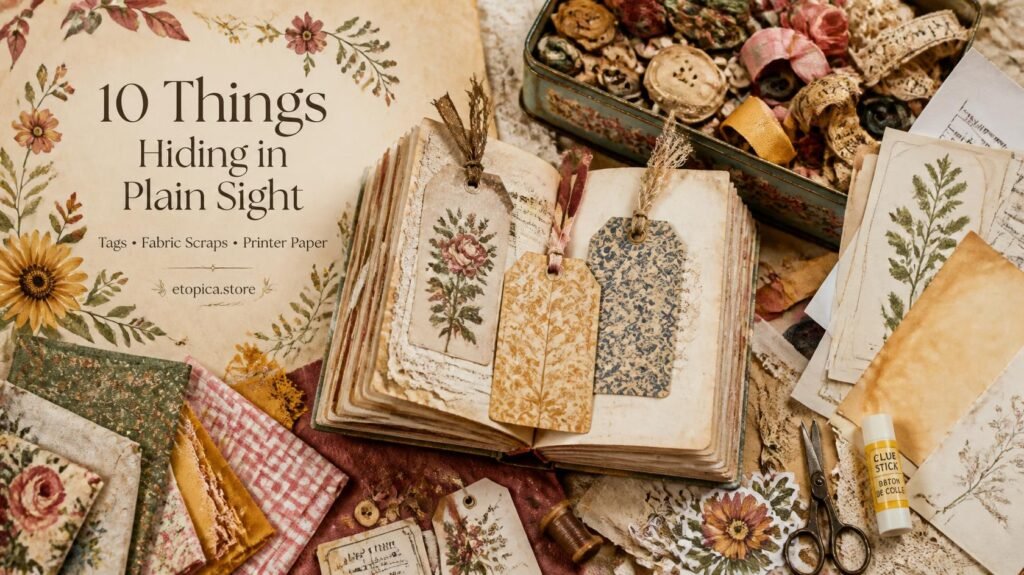
Those thick cardboard tags on new clothes are literally pre-made journal tags, and most even come with a string attached. Collect them for a month and you’ll have a full set.
Fabric care labels and woven brand labels also add lovely texture when stitched or glued down, a small cloth element among all that paper is a beautiful contrast.
8. Old greeting cards and postcards:
The fronts of birthday and holiday cards are heavyweight, beautifully printed card stock, perfect for journal covers, tags and sturdy layering pieces. Cut off the written half and the front becomes free decorative card.
Handwritten messages inside old cards from loved ones are treasures in their own right. Many journalers build entire memory pages around a single card, especially ones from people no longer around.
9. Sewing box extras:
Buttons, ribbon scraps, lace trim, embroidery thread, fabric offcuts. A short length of lace peeking out from under a paper layer is the fastest way to make a page look expensive.
If you don’t sew, check whether your mother or grandmother has a tin she’d let you raid. Vintage sewing notions are the best kind, the colours have softened, and the trims are usually far nicer than anything sold today.
10. Printer paper and your printer:
Plain printer paper feels boring until you remember what it can become: tea-stain it for instant aged pages, print free public-domain vintage graphics onto it, or print digital cliparts and ephemera sets.
Your humble home printer is honestly the most powerful supply on this whole list, it can produce unlimited decorative paper for the cost of ink. If you’d like ready-made pieces to print, our clipart sets are designed exactly for this: buy once, print forever. Have a peek in our Etsy shop.
How to prepare found paper:
Most of what you collect needs five minutes of attention before it’s usable. Worth doing properly, it’s the difference between a stash you enjoy and a box you avoid.
Flatten everything. Crumpled packaging and curled receipts won’t glue flat later. Press them under a stack of heavy books for a day or two, and they’ll behave.
Dry properly before storing. Anything tea-stained or damp needs to be completely dry before it goes in a box, or the whole stash will smell musty within a fortnight.
Deal with sticky bits. Old sellotape yellows and goes gluey. Remove it where you can, and cut around it where you can’t.
Air out charity-shop finds. Old books often carry a strong musty smell. Stand them open somewhere airy for a few days, or seal them in a box with an open pot of bicarbonate of soda for a week.
Three things not worth collecting:
A short list, because collecting everything quickly turns a lovely stash into a stressful pile.
Glossy junk mail. The coating repels glue, resists ink, and refuses to tear nicely. It also photographs badly, looking plasticky next to soft paper.
Anything food-stained. Grease spreads through paper over time and attracts pests. A charming wrapper isn’t worth the risk to a whole journal.
Duplicates of things you already have plenty of. Twenty identical supermarket receipts don’t make better pages than three. Collect for variety, not volume.
Where else to find free materials:
Once your house is picked clean, these are the next best sources, all free, all legal.
- Library book sales: damaged withdrawn books, often given away or sold for coins
- Public-domain archives: Archive.org, Smithsonian Open Access and the Biodiversity Heritage Library hold millions of vintage illustrations, free to print
- Tourist information racks: maps, leaflets and timetables, designed to be taken
- Friends and family: tell one person you junk journal and you’ll be handed envelopes and packaging forever
- Your own post: cards, statements, franked stamps and window envelopes arrive every week
What to collect first:
If you’re starting from nothing today, these five will get you the furthest:
| Item | Why it earns its place |
| Brown kraft paper | Sturdy background layer, takes ink beautifully |
| Used tea bags | Free aged paper, different every time |
| Envelopes | Instant pockets and tuck spots |
| Old book pages | Unlimited vintage-looking backgrounds |
| Clothing tags | Ready-made tags, string included |
How to store it all
One box, sorted loosely, kept somewhere you can reach without standing up.
A shoebox works perfectly. Some people sort by colour, some by type, some not at all, what matters is that you can tip it out and rummage, because rummaging is how pages start.
Two things to avoid: sealed plastic boxes, which trap any remaining damp and cause musty smells, and a system so tidy that putting things away becomes a chore. If maintaining the storage takes longer than making a page, the system is wrong.
Frequently asked questions
1- Do I really need to buy any junk journal supplies?
Not to start. Glue and scissors are the only two things most people need to buy, and you probably own both. Everything else on this list is free.
2- How do I stop my collected papers from smelling musty?
Leave them somewhere dry and airy for a few days before storing, and never seal damp paper in a plastic box. A shoebox with the lid slightly off works perfectly. For stubborn old books, a week in a box with bicarbonate of soda usually does it.
3- Is it okay to use pages from books?
Yes, as long as the book is already damaged or unreadable. Charity shops often have a damaged pile they sell very cheaply for exactly this purpose.
4- How long before I have enough supplies to make a page?
Usually about a week of normal life. Post, packaging, receipts and tags arrive faster than you think once you’re actually looking for them.
5- Will my receipts and tickets fade over time?
Thermal receipts will, often within a few years. Tickets and printed stubs generally last much longer. For anything you’d hate to lose, glue in a photocopy and keep the original elsewhere, or write the details on the page beside it.
6- Can I use magazine paper as a background?
You can, though glossy pages resist glue and ink. Matte magazine pages work far better, and any glossy piece can be lightly sanded or gessoed if you want to write on it.
7- What household item makes the best “vintage” paper?
Brown kraft paper from parcels, closely followed by tea-stained printer paper. Both are free, endlessly available, and look far more convincing than most shop-bought “vintage” paper packs.
8- Should I sort my scraps or keep them in one box?
One box is fine, and for most people it’s better. Elaborate sorting systems tend to become another chore. Sort loosely by colour once the box is genuinely overflowing, and not before.
Start your scrap box today
Grab any box, a shoebox is perfect, and label it your scrap box. From today, every pretty paper that enters your life goes in the box instead of the bin.
Set yourself a one-week challenge: collect at least one item from each category above. By next week you’ll have a supply stash that cost you exactly nothing, and it’ll be more interesting than anything you could have bought.
New to all this? Start with What Is Junk Journaling?, then turn your collected papers into something lovely with How to Age & Distress Paper. ♡
Our Etsy shop is full of adorable printable cliparts — birthday boys & girls, sweet animals, summer and spring themes — designed to print at home and layer straight into your journal.
Browse the Clipart Shop ↗
Leave a Reply