Have you noticed how you feel after a junk journaling session? Not during, during you’re just gluing bits of paper. But afterwards, when you close the book and look up, there’s this quiet settled feeling. Like your brain finally stopped buzzing.
You’re not imagining it, and you’re definitely not alone. Ask a room full of junk journalers why they do this and hardly anyone says “to make pretty books.” They say things like “it calms me down” and “it’s the only time my head goes quiet.”
So let’s talk properly about the benefits of junk journaling for your mind, what’s actually happening when you sit down with a glue stick, and why this particular craft seems to soothe people the way it does.
The short answer
Junk journaling is good for your mind because it slows your hands down, absorbs your attention without any pressure to perform, and gives you a screen-free way to hold onto small moments. In short, it calms a busy mind for five main reasons:
- It’s slow and repetitive: tearing, gluing and waiting set a gentle pace
- It creates “flow”: absorbing enough to quiet mental chatter, easy enough to stay restful
- You can’t fail at it: mistakes literally become part of the page
- It replaces screen time: something tactile to reach for instead of scrolling
- It processes memories: keepsakes get a place to live instead of being lost
It gives your hands something slow to do:
Most of our days are fast. Scroll, tap, refresh, reply. Everything is instant, and our attention is pulled in ten directions at once.
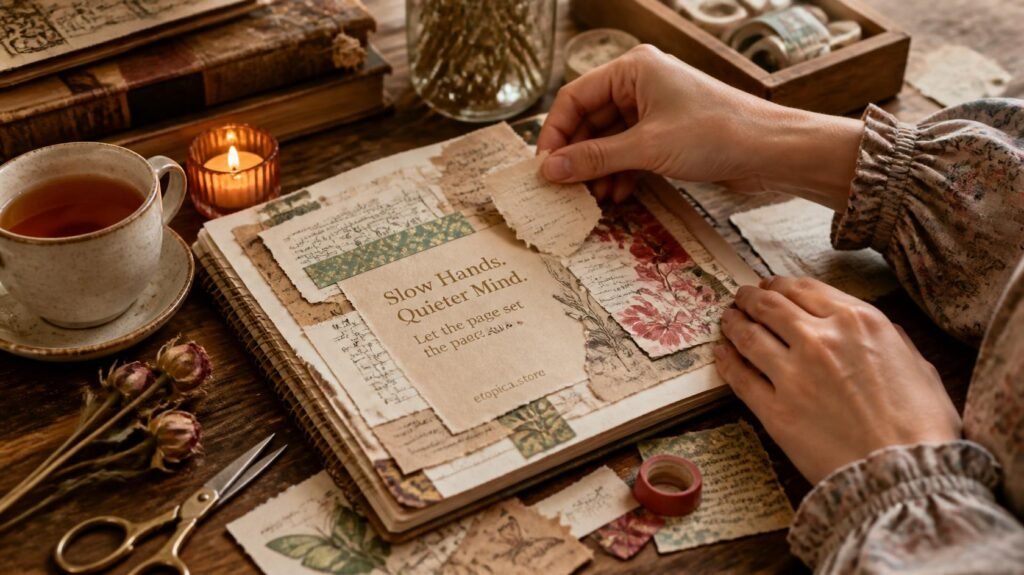
Junk journaling is the opposite of all of that. You tear one edge. You wait for glue to dry. You move a scrap a few millimetres to the left and look at it again. The pace is set by the paper, not by you, and there’s no way to speed it up.
That forced slowness is a big part of why this calming craft works. Your body is doing something gentle and repetitive, and your mind gets to come along at the same speed instead of racing ahead.
The waiting matters more than people expect. Glue drying is dead time you can’t fill productively, and there’s something quietly restorative about a hobby that builds pauses into itself.
It’s absorbing enough to quiet the noise:
There’s a well-known idea called “flow”, that state where a task is engaging enough to hold your full attention, but not so hard that it stresses you out. Time goes strange. The mental chatter fades. You look up and an hour has gone.
Junk journaling lands almost perfectly in that zone. Arranging a page takes real attention, you’re making dozens of small decisions about colour, balance and layering, but none of those decisions carry any weight. Nothing bad happens if you get it “wrong.”
That combination is rare, and it’s exactly what makes the craft absorbing rather than draining.
There’s no way to fail, and your brain knows it:
A lot of hobbies come with a quiet standard hanging over them. Your drawing either looks like the thing or it doesn’t. Your cake either rises or it doesn’t.
Junk journaling has no such standard, and it’s genuinely built that way. Torn edges are correct. Wonky layers are correct. Smudges are texture. If you truly dislike something, you glue another pretty piece over the top and it becomes a background, the “fix” is literally more creating.
When there’s no way to fail, the part of your brain that monitors performance gets to switch off for a while. For a lot of us, that’s the most restful part of the whole thing.
It’s a screen break that doesn’t feel like discipline:
We all know we should look at our phones less. Knowing has never once helped.
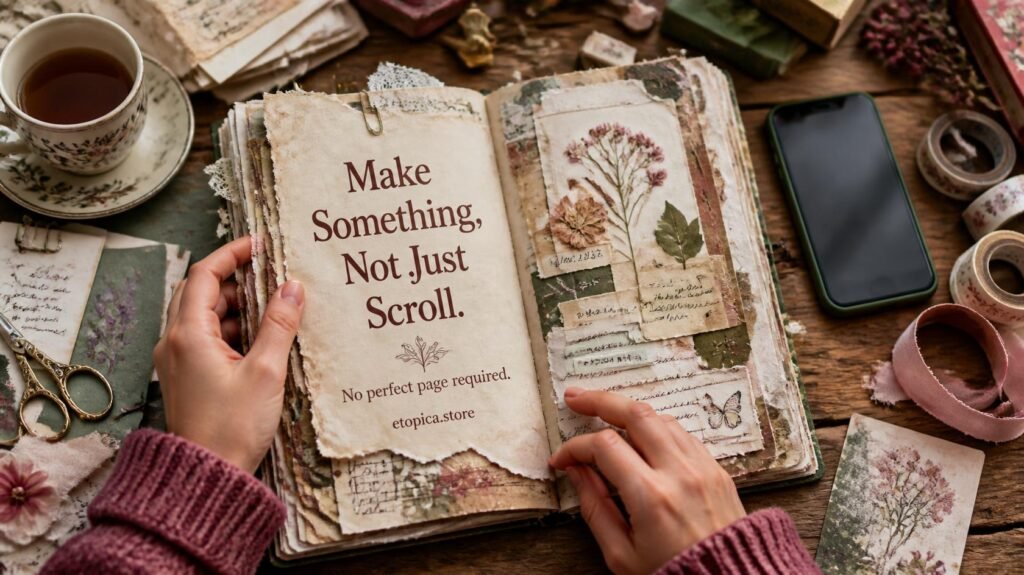
What works better is having something in your hands that you’d rather be doing. Junk journaling is tactile in a way screens simply aren’t, the texture of old paper, the smell of a charity-shop book, the satisfying snip of scissors. It occupies the exact space scrolling usually fills: those little pockets of restless downtime.
This is a big part of why the craft has grown so much lately. People aren’t just looking for a hobby. They’re looking for a reason to put the phone down that doesn’t feel like a punishment.
It makes something out of what you’ve been through:
Here’s the part that’s harder to explain but matters most.
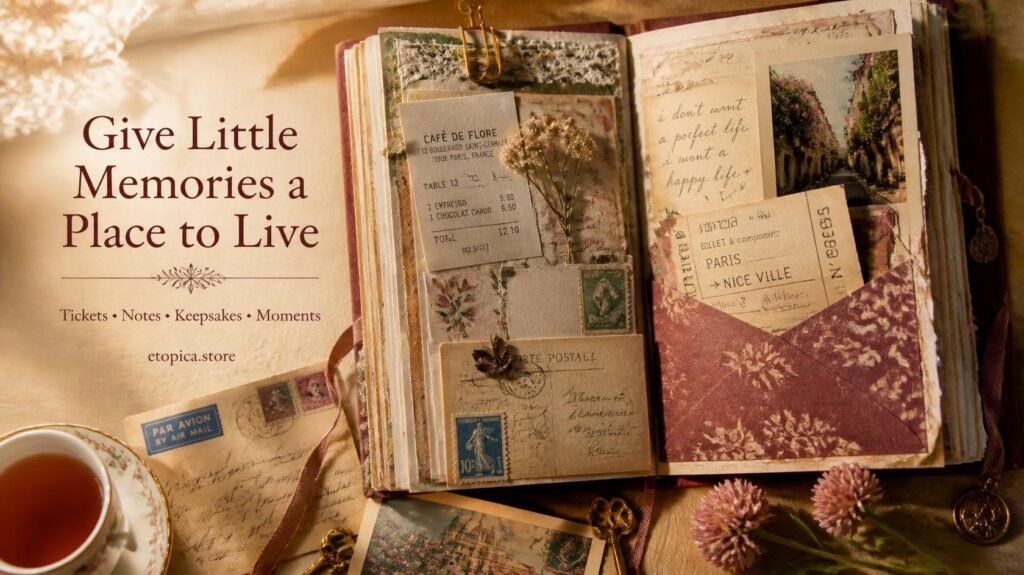
When you glue in the ticket from a good day, or the card someone sent you, or the receipt from a coffee you had while waiting for news, you’re not just decorating. You’re holding a moment still and giving it a place to live.
Later, flipping back, you don’t just remember what happened. You feel the shape of it. That’s a quiet, ordinary kind of processing, and it’s one of the reasons junk journaling is so good for your mind in a way that a photo roll on your phone never quite manages.
It’s also why a lot of people turn to this craft during hard stretches, after a loss, during an illness, through a move. Not to fix anything, but because having somewhere to put the small physical remnants of a difficult time is a kindness to yourself. A folded hospital wristband in a journal is doing something a photograph can’t.
It’s creativity without the pressure to be creative:
So many people say “I’m not creative”, usually meaning “I can’t draw.”
Junk journaling quietly sidesteps that whole story. You’re not making something from nothing; you’re arranging things that already exist. Choosing which scraps go together, which colours sit nicely, what to put where, that is creative work, but it never feels like being put on the spot.
Watching yourself make something lovely when you’d always believed you couldn’t is genuinely good for how you see yourself. It sneaks up on people.
Why not just colour in, or use a meditation app?
Both are lovely, and neither does quite the same job.
Colouring books give you the repetitive, soothing motion, but the decisions are made for you, the design already exists and you’re filling it in. That’s restful, but there’s no sense of having made something of your own at the end.
Meditation apps ask you to sit still with your thoughts, which is exactly the hard part when your head is loud. A busy mind often does better with something for the hands to do while it settles.
Junk journaling sits between the two: repetitive enough to soothe, creative enough to feel like yours, and it leaves a physical object behind that you can flip through later. That last part is worth more than it sounds.
How to get the calming part (not the stressful part)?
It’s entirely possible to turn this craft into another thing to feel behind on. A few gentle guardrails:
- Don’t journal to post it. The second you’re making pages for an audience, the pressure comes back in.
- Stop comparing. The pages you scroll past belong to people with years of practice and full supply cupboards.
- Let sessions be tiny. Ten minutes counts. A page can take a week.
- Keep a “no rules” journal. One book that’s allowed to be ugly, just for you.
- Don’t buy your way in. Shopping for supplies feels like progress and isn’t. The calm comes from making, not owning.
- Notice how you feel after. That settled feeling is the actual point, not the finished page.
And if a blank page ever feels like too much to start, a printed clipart is a gentle way in, print, cut, glue it down, and the page has begun without you having to decide anything. Our ready-to-print sets are in our Etsy shop if you’d like a soft landing.
A small, honest note:
Junk journaling is a lovely, grounding thing to have in your life, but it’s a craft, not treatment. If you’re struggling with your mental health, please talk to a doctor or a qualified professional. A journal can sit alongside real support; it isn’t a replacement for it. Be kind to yourself either way. 🤍
Frequently asked questions:
1- Is junk journaling good for anxiety?
Many people find repetitive, hands-on crafts calming, and junk journaling has the added benefit of having no “right” outcome to worry about. It’s not a treatment, but plenty of journalers describe it as a helpful way to settle a busy mind.
2- How is this different from normal journaling?
Traditional journaling asks you to find words, which can feel like hard work on a heavy day. Junk journaling lets you express something through paper, colour and keepsakes instead — and you can write as much or as little as you want.
3- Do I need to journal every day for it to help?
Not at all. Little and often is more sustainable than long, rare sessions. Even ten quiet minutes a couple of times a week is enough to feel the benefit.
4- I find crafting stressful. Will this be the same?
It’s worth trying, because this is a craft with the pressure deliberately removed, no skill requirement, no way to ruin it, and no finished-product standard. Start with one scrap on one page and see how it feels.
5- What time of day is best for a calming session?
Evenings suit most people, because it’s a natural wind-down and doesn’t need bright light or full concentration. If your mind races at bedtime, doing something with your hands an hour beforehand is a gentle alternative to scrolling.
6- Can junk journaling help with grief?
Many people find it a gentle way to keep hold of physical things connected to someone, letters, tickets, handwriting. It gives those items somewhere to be, which can feel easier than a box in a cupboard. It isn’t a substitute for support from people who can help, but it can sit alongside it.
7- Is it normal to feel emotional while journaling?
Yes, particularly if you’re working with keepsakes from a meaningful time. Handling objects tends to bring things up more directly than looking at photos. Go slowly, and stop whenever you want to, the page will still be there tomorrow.
8- Can children or teenagers do this too?
Very much so, and it suits them well, no drawing skill required, no wrong answers, and it uses materials that are already lying around. For younger children, a glue stick and a box of scraps is genuinely all that’s needed.
Go be quiet for ten minutes
You don’t need a plan, a free afternoon, or a single new supply. Just open the book, glue one thing down, and let your hands be slow for a bit.
That’s really all this calming craft asks of you, and it gives back far more than a pretty page.
New here? Start with What Is Junk Journaling?, then make your first page with this step-by-step guide. Struggling to make it stick? Try How to Build a Junk Journaling Habit. ♡
Our Etsy shop is full of adorable printable cliparts — birthday boys & girls, sweet animals, summer and spring themes — designed to print at home and layer straight into your journal.
Browse the Clipart Shop ↗
Leave a Reply