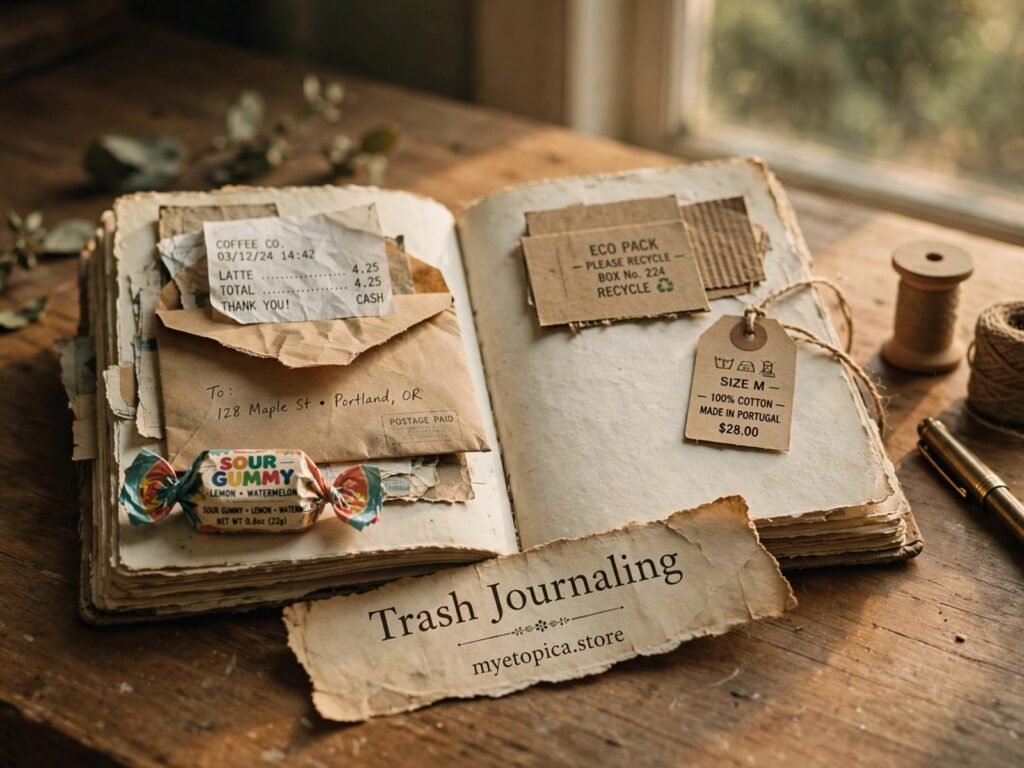
Trash journaling is the practice of building junk journal pages from real everyday discards, coffee receipts, cardboard packaging, clothing tags, candy wrappers, junk mail, and ticket stubs, instead of (or alongside) store-bought supplies. Named the “trash journaling” movement in 2026, it turns the paper you were about to throw away into the raw material of your journal, making your pages a genuine record of the life you actually lived.
Unlike traditional junk journaling, where you buy vintage-style ephemera to recreate a romanticized past, trash journaling documents your real present. The grocery receipt from Tuesday’s shopping run, the mailer from a sale you ignored, the wrapper from a chocolate bar eaten on a rainy afternoon, these humble discards become the pages, pockets, and collages of a journal that could only belong to you. Nothing in it is purchased for the sake of journaling. Everything in it is evidence of a life in progress.
Why Trash Journaling Became a 2026 Movement
Three forces collided to make 2026 the year of the trash journal. First, the cost of living made “no-buy” crafting irresistible — crafters openly asked why they were spending money on imitation vintage paper when their recycling bins overflowed with authentic, characterful paper every week. Second, the zero-waste movement matured beyond shopping bags into creative reuse, and journalers realized their hobby was quietly generating waste through excess packaging and unused kits. Third, social media fatigue with “perfect desk” aesthetics pushed journalers toward radical authenticity: pages that show real life, with its smudged receipts and crumpled tags, feel honest in a way curated flat-lays no longer do.
The philosophy is old, though. Writers have kept commonplace books, collections of scraps, quotes, and clippings, for centuries, and librarians have long treasured printed ephemera, the paper not meant to be kept. Trash journaling is that same instinct, democratized: your kitchen drawer is the archive, and the archivist is you.
What Counts as “Trash” (and What to Skip)
The beauty of trash journaling is that the supply chain is your own week. Before you start hoarding, learn to sort.
Keep: the everyday discards that journal beautifully
- Receipts, grocery, coffee shop, bookstore. Thermal receipts have lovely type and timestamps.
- Packaging, kraft mailers, cardboard sleeves, cookie boxes, tea carton panels, paper shopping bags.
- Tags and labels, clothing hang tags, price tags, shipping labels, address stickers.
- Wrappers, candy and chocolate wrappers, soap bands, napkin bands, paper straw sleeves.
- Junk mail and flyers, the inserts, not the envelopes; bold typography makes great collage fodder.
- Tickets and stubs, cinema, transit, parking, museum. Instant memory anchors.
- To-do lists and notes, shopping lists, phone-message scribbles, appointment cards.
- Food ephemera,, seed packets, produce stickers, takeaway menus, paper coffee cups (flattened).
Skip: the discards that cause trouble
- Food-stained or greasy paper, it will stain neighboring pages and can go rancid.
- Wet or moldy paper, anything that was damp belongs in compost, not your journal.
- Sharp or metallic objects, tin ties, staples, foil shards; keep only soft flat foils.
- Thermal receipts you plan to keep long-term as-is, they fade within a few years; photocopy the ones that matter onto plain paper and journal the copy (a neat trick archivists use too).
- Anything with personal data, bank statements, medical mail, anything with full account numbers. Either redact with a black marker (the marker stripe can become a design element) or skip it.

A simple rule: if it is flat, dry, clean, and free of sensitive data, it can go in the journal.
Cleaning and Prepping Discards for Archival Safety
Real trash is real life, which means it arrives dusty, creased, and occasionally sticky. Ten minutes of prep makes your discards journal-safe and far more pleasant to work with.
Flatten. Press creased discards under a stack of heavy books for a day or two. Warm them with an iron on low heat through a cloth if they are stubbornly curled (never iron thermal receipts on high, the whole thing turns black).
Clean. Brush off dust with a soft dry cloth. For sticky residue from labels, a tiny dab of rubbing alcohol on a cotton pad dissolves adhesive without soaking the paper. Let everything dry completely before gluing.
Deacidify the worst offenders. Newsprint, flyers, and cheap packaging are acidic and yellow over time. If you want a journal that lasts, mist these with an archival deacidification spray (available from craft and conservation suppliers) or sandwich them between acid-free scrapbook pages as backing. For a deliberately “aged” look, a tea-dye wash also adds a protective barrier of color while unifying mismatched papers.
Stabilize fragile items. Tissue wrappers and onion-skin receipts tear at the fold. Glue them onto a backing of kraft paper or an index card before cutting them into journal elements. Your future self, flipping pages, will thank you.
This is the one place trash journaling overlaps with traditional scrapbooking technique, the difference is you are conserving the mundane instead of the precious, which feels delightfully subversive.
The Everyday-Life Documentation Philosophy
The deepest part of the trash journaling movement is not the technique. It is the question it asks: what counts as worth remembering?
Traditional journals record milestones, birthdays, trips, resolutions. Trash journaling records Tuesdays. The philosophy is that an ordinary life, documented honestly, becomes extraordinary in retrospect. Ten years from now, the receipt showing what milk cost in 2026 will be a museum artifact of your daily reality. The takeaway menu from the place you ordered from on a exhausted Friday will mean more than any posed photograph, because it carries the texture of the actual day.
This is why the movement resonates so strongly with busy parents, students, and anyone who has ever thought “my life is too boring to journal.” Trash journaling removes the pressure to have something impressive to say. You do not need an adventure. You need an envelope, a wrapper, and ten honest words. The discards do the heavy lifting of memory; your job is simply to gather them and annotate them.
It also reframes a habit many of us carry with quiet guilt: keeping the movie ticket, the gift tag, the note scribbled on a napkin. Trash journalers are not hoarders-in-denial. They are curators of the ordinary, and their journals are the exhibition.
Trash to Treasure: The Sustainable Junk Journaling Angle
Every trash journal is, by definition, a zero-waste craft project. The average household discards kilograms of usable paper every month, paper with beautiful typography, interesting textures, and built-in stories. Trash journaling diverts a small stream of that paper into something kept and loved.
The sustainability angle goes deeper than supply. It changes how you see consumption. When the wrapper becomes journal material, you start noticing packaging design the way a designer does. You choose the soap with the letterpressed band. You flatten the beautiful shopping bag instead of binning it. The journal becomes a feedback loop that makes you a more conscious consumer, not through guilt, but through genuine appreciation of materials.
Pair this mindset with public-domain artwork when you want imagery beyond your own discards: the Library of Congress Free to Use collection and the Smithsonian Open Access collection offer thousands of copyright-free vintage illustrations you can print and combine with your real-life discards. Old meets new, curated meets found.
And if you want to dip into beautiful printable ephemera to complement your real trash — vintage backgrounds that make discards pop, my printable kits at Etopica were designed to layer perfectly with real-life paper. Think of the printables as the gallery walls and your trash as the art.
10 Page Ideas Using Real Discards
Ready for the practical part? Here are ten spread ideas, each built around something you were about to throw away.
1. The Receipt Timeline
Line up a week’s worth of receipts chronologically down a page, journaling one line next to each: what you bought, where you were, who you were with. It reads like a diary written by your wallet.
2. The Takeaway Menu Map
Glue down menus from every takeaway spot you order from, annotate with ratings and the story of your laziest Fridays. Over a year it becomes a delicious geography of your couch.
3. Tag Garland
String clothing hang tags along a length of twine across a spread like bunting. Write the memory of wearing each item on its tag. A wardrobe memoir.
4. The Junk Mail Collage
Cut the boldest words and images from a week’s junk mail into a ransom-note-style collage about modern life. Add your commentary in the margins. Equal parts art and protest.
5. Packaging Texture Study
Glue swatches of every cardboard texture in your recycling, corrugated, kraft, printed box board — and label each with what it carried. A materials library of your household.
6. Wrapper Rainbow
Arrange candy and snack wrappers by color into a gradient spread. Candy wrappers have some of the best graphic design in your kitchen; treat them like the art they are.
7. Ticket Stub Memory Lane
A pocket page stuffed with transit tickets, parking stubs, and cinema tickets. Each stub is a doorway: annotate where you were going and why.
8. The Shopping List Archive
Photocopy or glue in actual handwritten shopping lists (yours, a partner’s, a child’s). Handwriting is the most personal ephemera there is, a list in someone’s hand is a portrait.
9. Seed Packet Garden Journal
Flatten and mount seed packets after sowing, then journal the growing season around them. By autumn you have a complete record from packet to harvest.
10. The “This Week in Trash” Spread
My favorite ongoing practice: once a week, grab the five most interesting discards from your bin and make one spread. No theme, no plan. The randomness IS the theme — it captures the week exactly as it happened.
If you are new to junk journaling entirely, start with our step-by-step beginner guide to build your first journal base, then fill it with trash-journaling spreads. An old book makes a perfect trash journal base too — discarded book, discarded paper, one beautifully consistent philosophy.
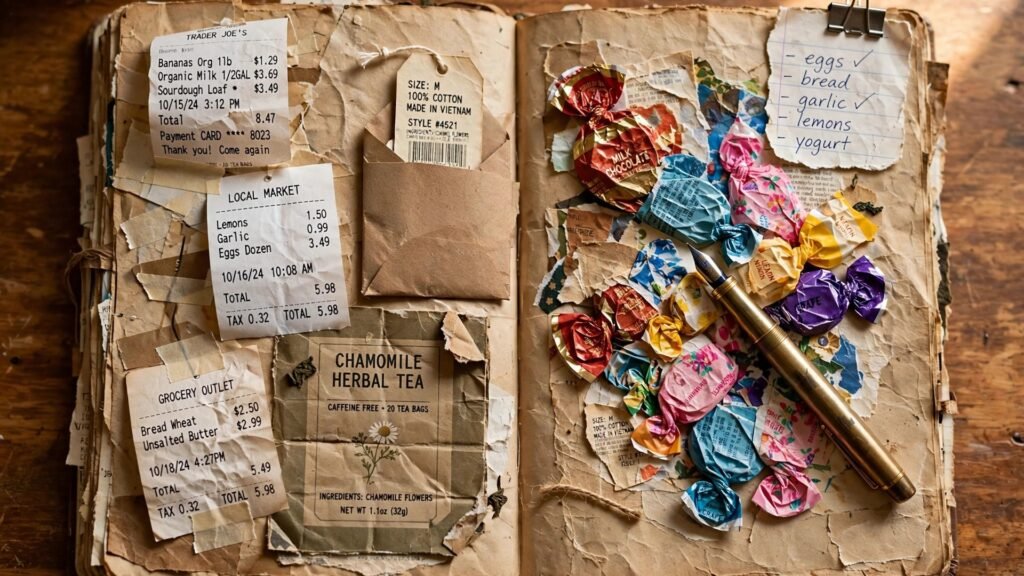
The 7-Day Trash Journal Challenge
The best way to understand the movement is to live it for a week. Here is your starter challenge — no purchases required, nothing to prepare.
- Day 1 — The Receipt Jar. Drop every receipt you get today into an envelope. Tonight, glue them into your journal in the order received and write one line about each purchase.
- Day 2 — Packaging Hunt. Before recycling day, rescue the three most beautiful pieces of packaging in your bin. Make a texture-and-typography spread.
- Day 3 — The Tag Page. Gather every tag in the house — clothing, gifts, shipping. Arrange them artfully and annotate each with its story.
- Day 4 — Wrapper Art. Eat something with beautiful packaging (this is the fun day). Flatten the wrapper and build a full collage page around it.
- Day 5 — Mail Makeover. Take today’s junk mail and transform it into a collage about your actual week. Cut, rearrange, comment.
- Day 6 — Memory Anchors. Find three old tickets, stubs, or cards you have kept for no rational reason. Give them a pocket page and write down why you kept each one.
- Day 7 — The Week in Review. Pull it all together: one spread summarizing your week using only the discards you gathered. Read it back. That is trash journaling, and it is completely yours.
Share your challenge spreads with the junk journal community using the hashtag, the movement grew on social media, and your ordinary Tuesday might be exactly what inspires someone else’s first page. For the bigger picture of what this craft is all about, our complete guide to junk journaling in 2026 puts the trash movement in context.
Key Takeaways
- Trash journaling is the 2026 movement of building journals from real everyday discards, receipts, packaging, tags, wrappers, and junk mail, rather than purchased supplies.
- It documents ordinary life instead of milestones: the philosophy is that Tuesdays, recorded honestly, become the most precious pages.
- Keep discards that are flat, dry, clean, and free of sensitive data; skip greasy, damp, sharp, or data-bearing paper.
- Prep your trash like an archivist: flatten under books, clean adhesive with rubbing alcohol, deacidify cheap newsprint, and back fragile items with kraft paper.
- It is inherently sustainable, a zero-waste craft that diverts household paper into kept art and makes you a more conscious consumer.
- Start with the 7-day challenge: one discard-based spread a day for a week, and you will have a journal that could only belong to you.
What is trash journaling?
Trash journaling is the practice of building journal pages from real everyday discards, receipts, packaging, tags, wrappers, and junk mail, instead of store-bought supplies. It emerged as a named movement in 2026, centered on the idea that the paper you were about to throw away can become a genuine record of your ordinary life.
How is trash journaling different from junk journaling?
Traditional junk journaling often uses purchased vintage-style ephemera to recreate a romanticized past. Trash journaling uses only real discards from your own life, so every page documents the life you actually lived rather than an imagined one. The two can overlap, but trash journaling has a strict 'nothing bought for the journal' ethos.
Is it safe to glue receipts and packaging into a journal?
Yes, with simple prep: flatten discards under heavy books, brush off dust, remove sticky residue with a dab of rubbing alcohol, and let everything dry fully before gluing. Avoid greasy or damp paper, skip anything with sensitive personal data, and photocopy thermal receipts you want to keep long-term since they fade within a few years.
What paper trash should I avoid in my journal?
Skip food-stained or greasy paper, anything wet or moldy, sharp metallic bits like tin ties and staples, and any paper with personal data such as bank statements or medical mail. A good rule is: if it is flat, dry, clean, and free of sensitive data, it can go in the journal.
How do I start trash journaling with no supplies?
Start the 7-day challenge: collect every receipt on day one, rescue interesting packaging before recycling day, gather clothing tags, flatten a favorite wrapper, transform junk mail into collage, give old ticket stubs a pocket page, and finish with a week-in-review spread. You need nothing but what your household already discards.
Can trash journaling really be sustainable?
Yes, it is inherently a zero-waste craft. It diverts usable household paper into kept art and, more importantly, changes how you see consumption: you start noticing packaging design, choosing beautifully packaged products, and appreciating materials instead of binning them. The journal becomes a feedback loop that makes you a more conscious consumer.
Our Etsy shop is full of adorable printable cliparts — birthday boys & girls, sweet animals, summer and spring themes — designed to print at home and layer straight into your journal.
Browse the Clipart Shop ↗
Leave a Reply