Here’s a story you might recognise. You made three gorgeous pages in one weekend, felt amazing, told everyone about your new hobby… and then life happened. The journal moved to a shelf. Then under a pile. Now it’s been six weeks and there’s a small guilty feeling every time you walk past it.
You haven’t failed. You just tried to build a junk journaling habit the way most people try to build habits, in big, ambitious bursts. And big bursts are exactly what busy lives break first.
Let me show you the small, forgiving way instead. It’s the reason I still journal years later, on weeks when I barely have twenty free minutes.
Why this particular hobby is so easy to drop?
Junk journaling has three quiet traps that other hobbies don’t, and it helps to name them.
It has a setup cost. Reading needs a book. Journaling needs a book, glue, scissors, scraps, and a clear surface. That’s four decisions before you’ve started, and tired brains refuse at the second one.
It has no natural end point. A page is never objectively finished, so there’s never a clean moment of “done” to feel good about, which means less of the small reward that keeps habits alive.
It’s visible when you’re behind. An unfinished page sits there, half-made, quietly reminding you. Nobody feels guilty about a book they haven’t opened, but an abandoned page feels like a small failure.
Every fix below is aimed at one of those three.
First, drop the idea of a “full page”
This is the single biggest thing standing between you and consistency.
Somewhere along the way we decided a journaling session means an hour, a cleared table, and a finished spread. So on a normal tired Tuesday, your brain does the maths, “I don’t have an hour”, and you don’t open the journal at all.
Swap it for this: a session is one small action. Gluing one scrap counts. Tearing a few edges counts. Writing one line counts. A page can take a week to finish, and it will look exactly as lovely as one made in an afternoon.
The rule that changed everything for me: if you open the journal and touch it at all, that day counts. That’s it. That’s the whole bar.
Leave it out where you can see it:
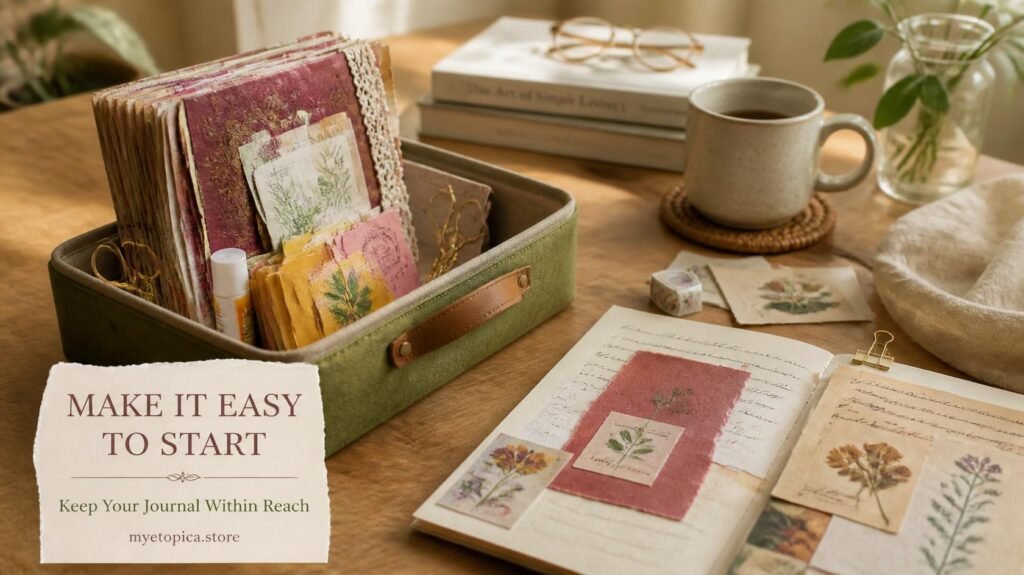
Habits die inside cupboards. If your journal lives in a box under the bed, you have to decide to journal, then find everything, then set up, that’s three chances to give up before you start.
Instead, keep a small tray or basket somewhere you actually sit: the coffee table, your desk, the kitchen counter. Journal, glue stick, scissors, a handful of scraps. Nothing else.
Keep it deliberately small. A full craft caddy is another decision to make; four items in a shallow tray is not. When the setup takes zero seconds, you’ll reach for it in the little gaps you didn’t know you had.
Attach it to something you already do:
The easiest habits ride along with existing ones. Pick a thing you do every single day without thinking, and park your journaling right after it:
- After your morning coffee → tear or ink a few papers
- While dinner is in the oven → glue one layer
- After the kids are in bed → write one line on today’s page
- While your evening show is on → fussy-cut some clipart
- Sunday morning, before anyone else is up → one proper session
Notice that half of these need almost no concentration. Cutting and tearing are perfect “while doing something else” tasks, save the arranging for when you have real focus.
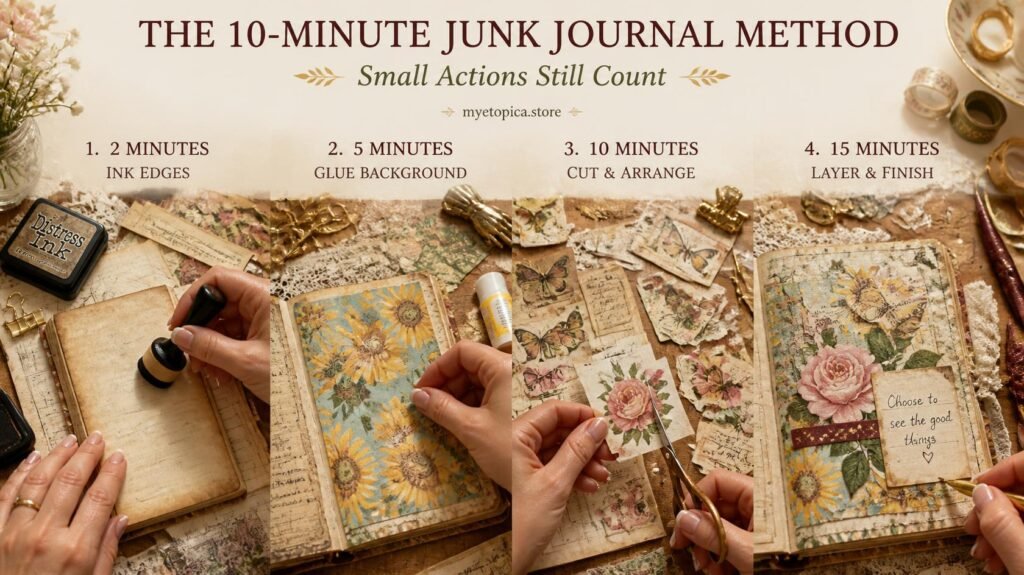
The 10-minute version:
On genuinely busy days, do one of these and close the book:
| Time you have | Do this |
| 2 minutes | Ink the edges of 5 papers for later |
| 5 minutes | Glue one background layer down |
| 10 minutes | Cut out clipart and tuck it in loosely |
| 15 minutes | Finish a page you started earlier |
A junk journaling habit built on ten-minute sessions beats one built on three-hour sessions you never actually schedule. Consistency is just showing up small.
Prep in batches, create in moments:
This is the trick that makes short sessions possible. Separate the boring work from the fun work.
Once a week or so, do a “prep session”: tea-stain a stack of papers, tear a pile of edges, print and cut a sheet of cliparts, sort your scrap box. None of it needs inspiration, and most of it can happen in front of the television.
Then, on a normal day, everything is ready and you get to do the good bit, arranging and gluing, in the ten minutes you have. Having pre-cut pieces waiting is the difference between “I’ll do it later” and actually doing it.
If you want ready-to-print pieces for those prep sessions, our clipart sets print at home and cut down in minutes, have a peek in our Etsy shop.
Give yourself a tiny prompt:
Half of the “I don’t have time” feeling is actually “I don’t know what to put on the page.” Decision fatigue looks a lot like busyness.
Fix it by removing the decision. Keep a simple rotating prompt so the page starts itself:
- One good thing — write the best small moment of today
- Something I kept — glue in one piece of paper from this week
- A colour — build the page around one shade
- A word — pick a word for the month and add to it
- Where I went — a ticket, a receipt, a leaf from a walk
Write these five on a tag and clip it inside the front cover. Then the question is never “what should I make?”, it’s just “which one today?”
The two-journal trick:
If perfectionism is what stops you, this one is worth trying.
Keep two journals. One is your nice one, the pages you take your time over. The other is a scruffy notebook that is officially allowed to be ugly: no arranging, no matching, just stick things in.
On low-energy days you go to the ugly one, and the habit survives. On good days you go to the nice one, and it stays special instead of becoming a source of pressure.
Most people find the ugly journal quietly becomes their favourite.

Track it, but gently:
A tiny bit of tracking helps, the trick is tracking in a way that can’t make you feel bad.
Draw a small grid inside your back cover, one square per day, and colour in any day you touched the journal. That’s all. No streak to protect, no target to hit, no app.
The point isn’t discipline. It’s evidence, on the days you feel like you never journal any more, you can look at the grid and see that you did, eleven times last month.
What about when you have too much time?
The opposite problem is real, and it derails people just as often. A free Saturday arrives, you sit down expecting a magical five-hour session, and instead you feel blank and disappointed.
Long stretches work best when you split them: prep first, then create. Spend the first hour tearing, staining and cutting with a podcast on, and the second hour arranging. Going straight into “make something beautiful” from a standing start is hard for anyone.
What to do when you fall off (because you will)?
You’ll miss a week. You’ll miss a month. This is not a failure state, it’s just how hobbies work alongside real lives.
The only thing that matters is what you do next. Don’t start a fresh journal. Don’t apologise on the page. Don’t try to “catch up” and backfill three weeks. Just open it, glue one scrap in today, and carry on. The gap becomes invisible almost immediately.
Honestly, some of my favourite pages were made after long breaks. The journal doesn’t hold a grudge.
Frequently asked questions:
1- How often should I junk journal?
There’s no correct number. Little and often works better than long and rare, even five minutes a few times a week keeps the momentum alive. Aim for “regularly”, not “daily”.
2- I’m too busy to finish a page in one sitting. Is that okay?
Completely. Pages built over several days often end up richer, because you come back with fresh eyes and add things you wouldn’t have thought of in one go.
3- How do I stay motivated when my pages look messy?
Flip back to your very first page. Progress in this craft is obvious and fast, and seeing it is far more motivating than comparing yourself to someone online with five years of practice.
4- What’s the easiest way to restart after a long break?
Do the smallest possible thing: glue in one scrap, no plan, no pressure. Restarting a junk journaling habit is nearly always easier than we imagine, it’s the thinking about it that’s hard, not the doing.
5- Should I journal at the same time every day?
It helps, but attaching it to an existing routine works better than a clock time. “After my morning coffee” survives a chaotic week in a way that “at 7pm” doesn’t.
6- Is it bad to have several unfinished pages at once?
Not at all, many experienced journalers keep three or four half-built spreads going and add to whichever suits their mood. Unfinished pages are a sign of an active journal, not a neglected one.
7- How do I journal with small children around?
Split the tasks by how much attention they need. Tearing, inking and cutting can happen at the kitchen table with interruptions; arranging and gluing are better saved for nap time or after bedtime. Keeping the tray portable matters more than keeping it tidy.
8- I’ve lost interest completely. Should I quit?
Put it away without any decision attached, and leave it. Interest in this craft comes in waves, often seasonal, and plenty of people return after months away. Quitting is a decision you can make later, if you ever actually need to.
Small and steady wins
You don’t need more free time. You need a smaller definition of “journaling”, a kit you can reach without standing up, and permission to make a page in pieces.
Open your journal tonight, glue in one thing, and close it. That’s a session. Do that a few times this week and the habit builds itself.
Need somewhere to start? Try How to Start a Junk Journal: A Step-by-Step Guide, or prep a stack of pretty papers with How to Age & Distress Paper. ♡
Our Etsy shop is full of adorable printable cliparts — birthday boys & girls, sweet animals, summer and spring themes — designed to print at home and layer straight into your journal.
Browse the Clipart Shop ↗
Leave a Reply