Altered books, handmade journals, travelers notebooks and more — find the style that fits your hands
Walk into the world of junk journaling and you will quickly discover there is no single “junk journal book.” Some crafters hollow out old hardcovers, others sew signatures of kraft paper by hand, and some simply tuck folded inserts into elastic bands. Each style feels different in your hands, holds up differently over time, and suits a different kind of maker.
If you are trying to decide which junk journal book to make (or buy) first, this guide walks you through the six most popular types, compares the main binding options side by side, and ends with a simple decision framework so you can choose with confidence instead of guesswork.
1. Altered book journals
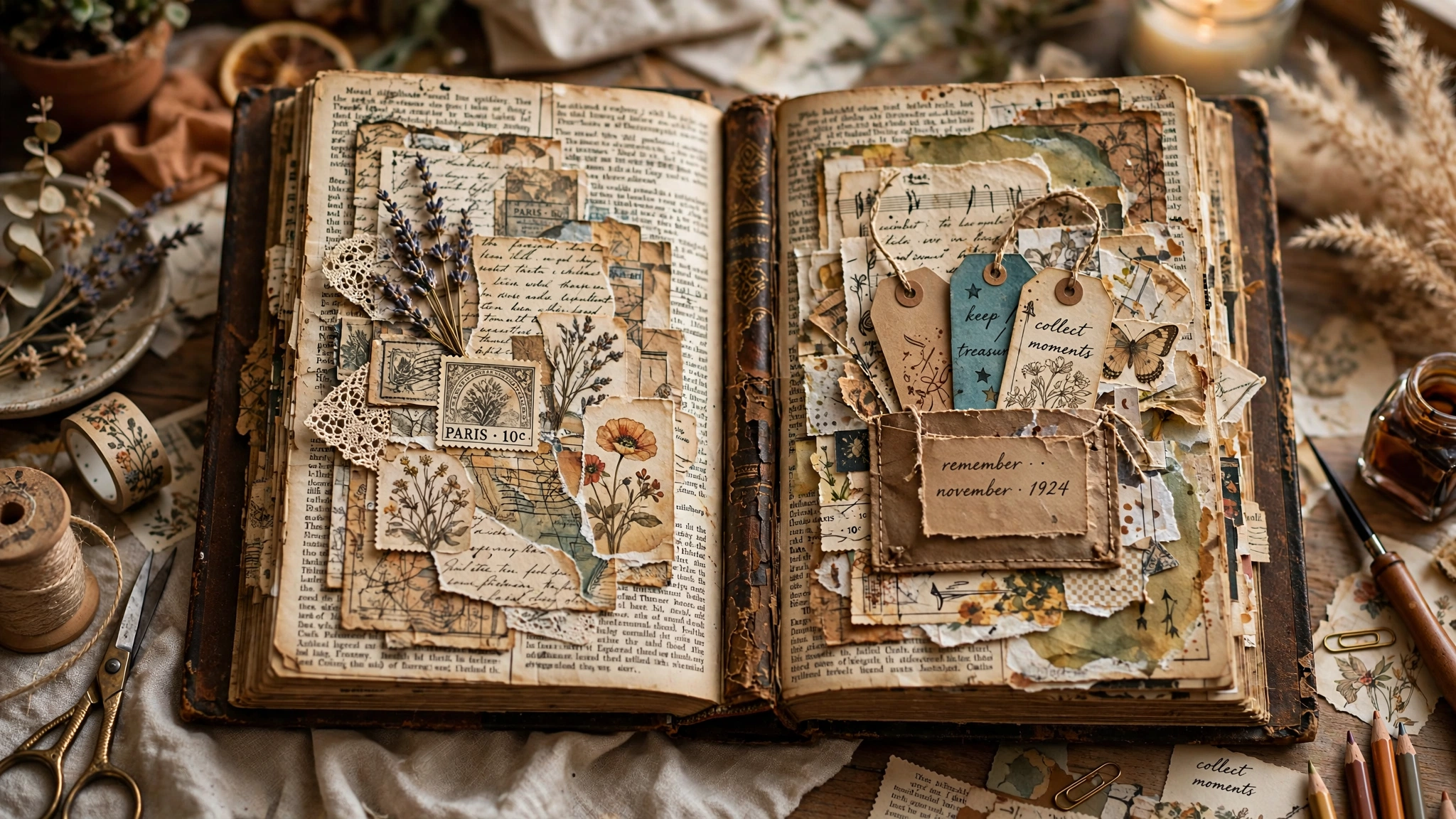
An altered book journal starts life as a real published book — usually an old hardcover rescued from a thrift store or library sale. You remove some pages, glue others together into clusters, and build pockets, tuck spots, and decorated spreads directly inside the existing binding. The book’s cover becomes your journal’s cover, already sturdy and full of character.
- Best for: Beginners who want a finished-looking cover with zero cover-making effort, and anyone who loves the weight and nostalgia of real vintage books.
- Pros: The hardcover binding is strong, the pages are already cut to size, and the printed text underneath your collage adds instant vintage texture. It is also the cheapest option if you thrift the book.
- Difficulty: Easy to start, medium to finish well. Gutting pages and reinforcing the spine takes a little patience.
- Watch out for: Thick journals can strain the original spine, so do not overstuff it. Remove roughly one-third of the pages before you begin decorating.
2. Handmade sewn-signature journals
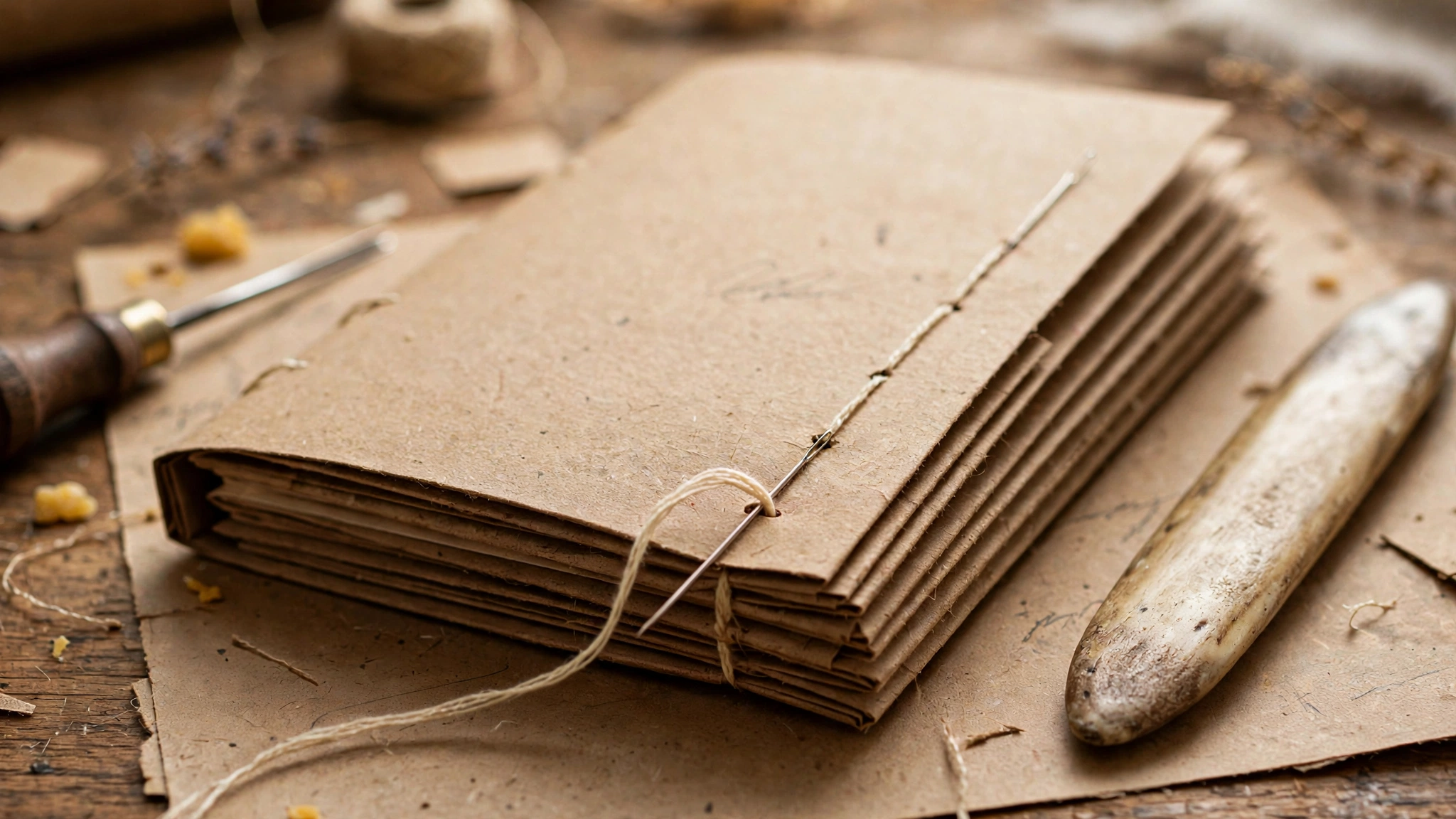
This is the classic handmade junk journal book: folded sheets of paper (signatures) stitched together through the fold, usually with a simple pamphlet stitch or a 5-hole binding. The cover is often kraft cardstock, a paper bag, or a piece of fabric-covered cardboard, and the whole book is built from scratch around your chosen papers.
- Best for: Makers who want full creative control over size, paper mix, and page count, and anyone who enjoys the rhythm of hand-stitching.
- Pros: Completely customizable, lies beautifully flat when open, and the exposed stitching on the spine looks gorgeous. You can mix printer paper, kraft, book pages, and envelopes in one signature.
- Difficulty: Medium. The pamphlet stitch itself takes about ten minutes to learn, but keeping signatures even and the spine snug requires a little practice.
- Watch out for: Keep each signature to 5–7 folded sheets so the booklet stays manageable, and use an awl or pushpin to pre-punch holes before stitching.
3. Travelers notebook style journals
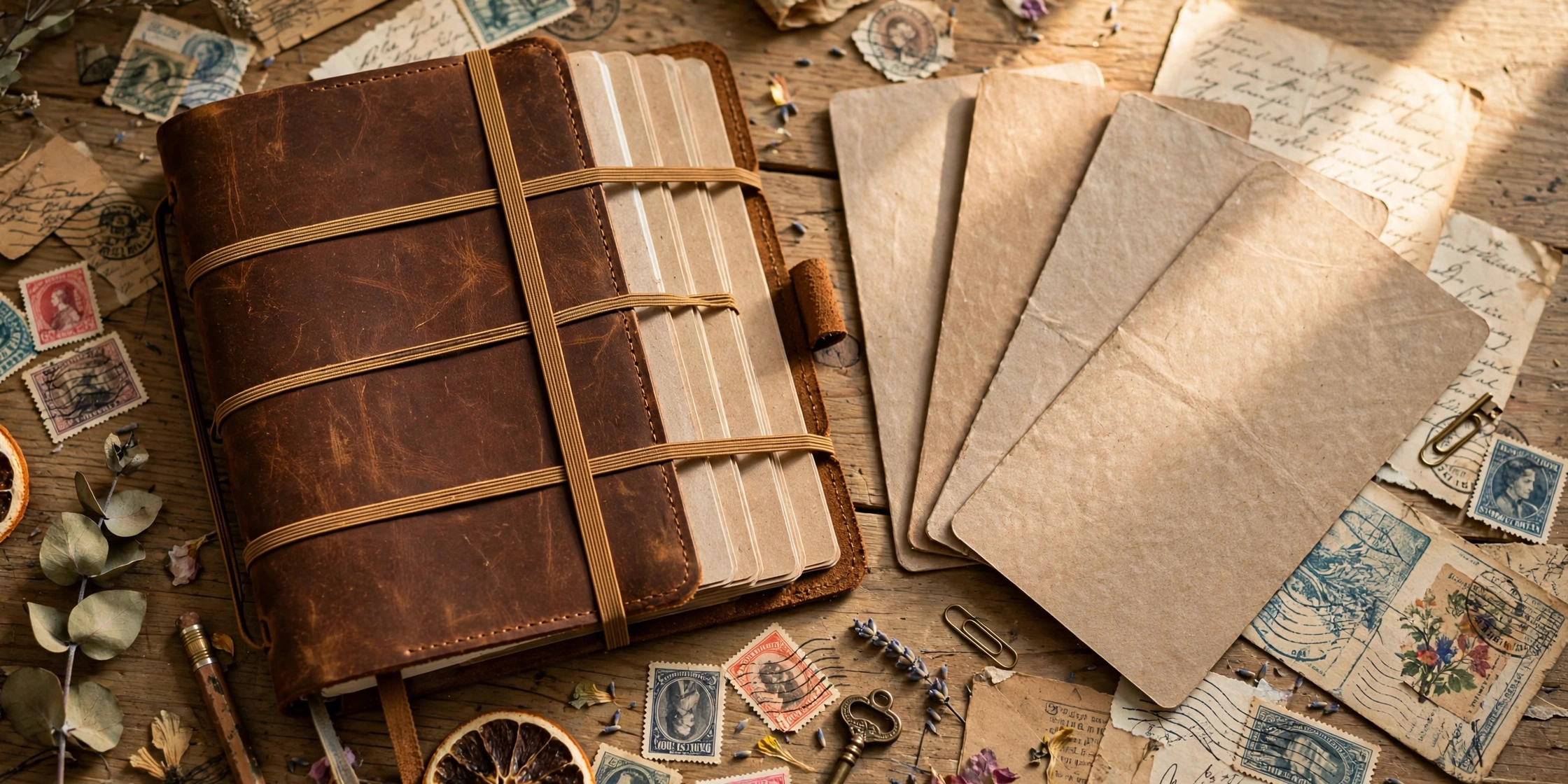
Borrowed from the travel journaling world, this style uses a flexible leather or faux-leather cover with elastic bands stretched across the spine. Instead of one bound block of pages, you slide in 2–4 slim folded inserts that can be swapped, removed, or rearranged whenever you like.
- Best for: Journalers who like to work on one theme at a time, travelers, and anyone nervous about “ruining” a permanent book — nothing here is permanent.
- Pros: Ultra-flexible: pull out a full insert, replace it, or reorder them in seconds. The slim inserts are also the least intimidating blank page in junk journaling.
- Difficulty: Easy. If you can fold paper and loop an elastic band, you can assemble this in under fifteen minutes. No sewing, no glue on the binding at all.
- Watch out for: Each insert holds fewer pages than a bound book, so this style suits ongoing, lightweight journaling better than one giant memory-keeping volume.
4. Ring-bound and disc-bound journals
Ring-bound junk journal books use metal rings, binder rings, or disc-bound systems (like Happy Planner discs) to hold punched pages together. The pages can be anything — decorated cardstock, laminated ephemera, envelope pages — and the rings let you add, remove, or reorder pages at will.
- Best for: Organized crafters who rearrange constantly, memory keepers who add photos over time, and anyone who wants a journal that opens perfectly flat every time.
- Pros: Maximum flexibility: pages lift right off and go back on. Great for bulky additions like ticket stubs and layered clusters that would strain a sewn spine.
- Difficulty: Easy, once you have the punch. A single-hole punch works for binder rings; disc systems need their special punch, which is a small investment.
- Watch out for: Rings add weight and can snag in bags. Choose sturdy rings and reinforce punched holes with small adhesive rings so pages do not tear out.
5. Envelope and paper-bag journals
These playful journals are built from brown paper bags, kraft envelopes, or folded file folders instead of traditional pages. Each bag or envelope becomes a built-in pocket, so the journal is interactive from the very first page — every spread has somewhere to tuck things.
- Best for: Ephemera hoarders, gift journals, and kids or teens starting out, because the format is forgiving and instantly fun.
- Pros: Built-in storage on every page, wonderfully sturdy paper, and a warm kraft look that needs almost no decoration to look good. Very inexpensive to make.
- Difficulty: Easy. Fold, glue two edges, and you have a pocket page. Binding the bags together is usually done with a simple pamphlet stitch or binder rings.
- Watch out for: Paper bags are bulky, so keep the page count modest (8–12 bags is plenty) or the finished book will not close.
6. Mixed media and art journals
Art journals use heavier paper — watercolor paper, mixed media paper, or gessoed pages — so they can handle paint, ink, and wet glue without buckling. They are often bound like handmade sewn journals but with thicker signatures, or they start as a store-bought mixed media sketchbook that gets the junk journal treatment.
- Best for: Painters, ink lovers, and anyone whose journaling involves more art supplies than writing.
- Pros: Handles wet media beautifully, pages stay flat, and the heavier stock makes the finished book feel substantial and high quality.
- Difficulty: Medium. The techniques are the same as handmade sewn journals; the only extra skill is learning how each paper type reacts to paint and water.
- Watch out for: Heavy paper plus lots of paint equals a very thick book. Plan fewer pages than you would with regular paper, and let each painted spread dry fully before closing the book.
Binding options compared
Choosing a journal type and choosing a binding often happen together, but it helps to see the bindings side by side. Here is how the most common options stack up:
| Binding | Strength | Flexibility | Skill needed | Best paired with |
|---|---|---|---|---|
| Pamphlet stitch | Medium | Low (permanent) | Beginner | Handmade sewn journals, paper-bag journals |
| 5-hole sewn signature | High | Low (permanent) | Beginner+ | Handmade journals with multiple signatures |
| Coptic stitch | Very high | Medium (lays flat) | Intermediate | Art journals, chunky keepsake books |
| No-sew (glue + tape) | Low–medium | Low | Beginner | Quick gifts, kids’ journals |
| Elastic bands | Medium | Very high | Beginner | Travelers notebook style |
| Binder / book rings | High | Very high | Beginner | Ring-bound journals, rearranging |
| Existing book binding | High | None | Beginner | Altered book journals |
As a rule of thumb: sewn bindings are strongest and most permanent, elastic and ring systems are the most flexible, and no-sew methods are the fastest way to finish a first project. There is no wrong answer — only trade-offs that matter more or less depending on how you journal.
How to choose your junk journal book
Still torn? Answer these five questions and your match will practically choose itself:
- Do I want to make the cover or skip straight to decorating? If you want to skip it, pick an altered book or a travelers notebook cover. If cover-making sounds fun, go handmade sewn.
- Will I rearrange pages later? If yes, choose rings, discs, or elastic bands. If no, any sewn or altered book works.
- How chunky will it get? Lots of pockets, photos, and ephemera? Choose rings, elastics, or a coptic-stitched art journal. Mostly flat pages? Any binding works.
- Do I want to sew? A pamphlet stitch takes ten minutes to learn and is worth trying once. If the answer is a hard no, pick altered book, travelers notebook, or rings.
- Is this a gift or for me? Gifts do well as altered books or paper-bag journals (impressive, inexpensive). For yourself, pick whatever excites you most — excitement is what finishes journals.
When in doubt, start with the altered book. It is the fastest route from “I want a junk journal” to actually journaling in one, and everything you learn — layering, pockets, balancing a spread — transfers directly to every other type later.
MAKE IT EASY, FASTER: Not ready to build from scratch? A beautiful cover is half the battle, and ready-made vintage ephemera makes any journal type look finished fast. Browse the Etopica Etsy shop for printable cliparts and ephemera that work in every style in this guide: https://www.etsy.com/shop/Etopica
Frequently asked questions
What is a junk journal book?
A junk journal book is simply the physical book — handmade or repurposed — that holds your junk journal pages. The term covers everything from altered vintage hardcovers to hand-sewn kraft journals to travelers notebooks with elastic bands. “Junk journal” describes the creative style; “junk journal book” describes the actual bound object you write and collage in.
What is the easiest type of junk journal book for a beginner?
The altered book is the easiest starting point because the cover and binding already exist — you only decorate and build inside. The travelers notebook style is a close second since it needs no sewing or gluing on the binding. Both let you start journaling within an hour, which is exactly what a beginner needs.
Do I need to know how to sew to make a junk journal book?
No. Only the handmade sewn types require stitching, and even the simplest pamphlet stitch can be learned in about ten minutes from a single video. Altered books, travelers notebooks, ring-bound journals, and no-sew glued journals all skip sewing entirely, so pick one of those if needles are not your thing.
Which binding is strongest for a chunky junk journal?
The coptic stitch is the strongest hand-sewn option and handles very thick, heavy books beautifully. For maximum durability with rearranging, binder rings or disc systems win because pages can be removed before they strain anything. Avoid plain glue-only bindings for chunky journals — adhesive gives up long before thread or metal does.
Can I buy a ready-made junk journal book instead of making one?
Yes. Many Etsy sellers offer blank handmade junk journals in sewn, altered book, and travelers notebook styles, and craft stores sell mixed media sketchbooks that work as art journals. Buying blank gives you a quality binding without the learning curve, and you still get all the fun of decorating the pages yourself.
What size should my junk journal book be?
There is no standard size, but beginner-friendly sweet spots exist: around 6×8 inches for altered books (a common hardcover size), A5-ish for handmade journals, and standard travelers notebook sizes for that style. Smaller books feel less intimidating to fill; larger books suit big collage work and photos. When unsure, go smaller — a finished small journal beats an abandoned large one.
How many pages should a junk journal book have?
For a first journal, aim for 40–80 finished pages (20–40 folded sheets). That is enough to feel substantial without becoming a months-long commitment. Remember that pockets, fold-outs, and tags effectively multiply your space — a 60-page journal with tuck spots holds far more than 60 flat pages. You can always make volume two.
Our Etsy shop is full of adorable printable cliparts — birthday boys & girls, sweet animals, summer and spring themes — designed to print at home and layer straight into your journal.
Browse the Clipart Shop ↗
Leave a Reply