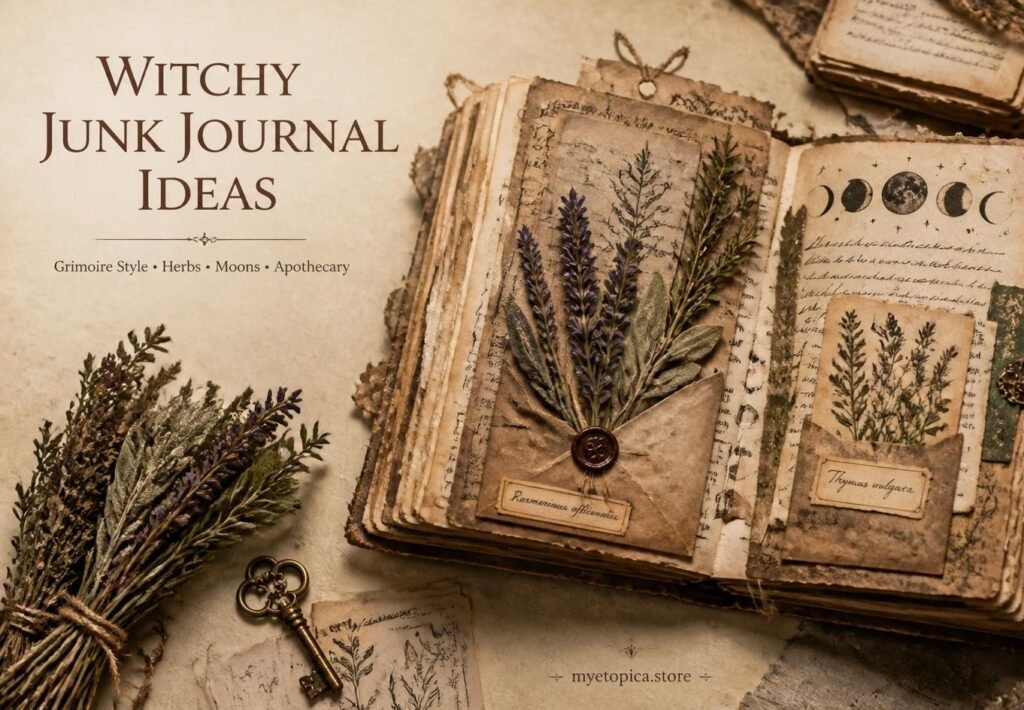
Of all the directions a Halloween section can take, this is the one that outlives October.
Grimoire-style pages, herbs, moon phases, handwritten labels, botanical studies on aged paper, sit somewhere between a nature journal and an old apothecary’s notebook. They look wonderful, they’re genuinely useful, and people keep making them long after the pumpkins have gone.
Here’s how to build a witchy junk journal, what goes in one, and the materials that make it look properly old rather than freshly crafted.
Two kinds of reader, both welcome here. For some people a book like this is a genuine spiritual record and has been for a long time. For others it’s purely an aesthetic they love the look of. This guide works either way — it’s about how to make the pages, not what you believe.
Grimoire, Book of Shadows, or junk journal?
The words get used interchangeably online, which is confusing when you’re starting out.
Traditionally, a grimoire is a reference book, herbs, correspondences, recipes, methods. Things that stay true. A Book of Shadows is more personal: a record of what you actually did and what happened, closer to a diary.
A witchy junk journal borrows the look and structure of both, built the junk journal way, layered, aged, made from scraps. Some people keep it as a real practice book; plenty of others keep it as a beautiful place to write about plants, seasons and moons.
You don’t have to pick a label before you start. The pages are the same either way.
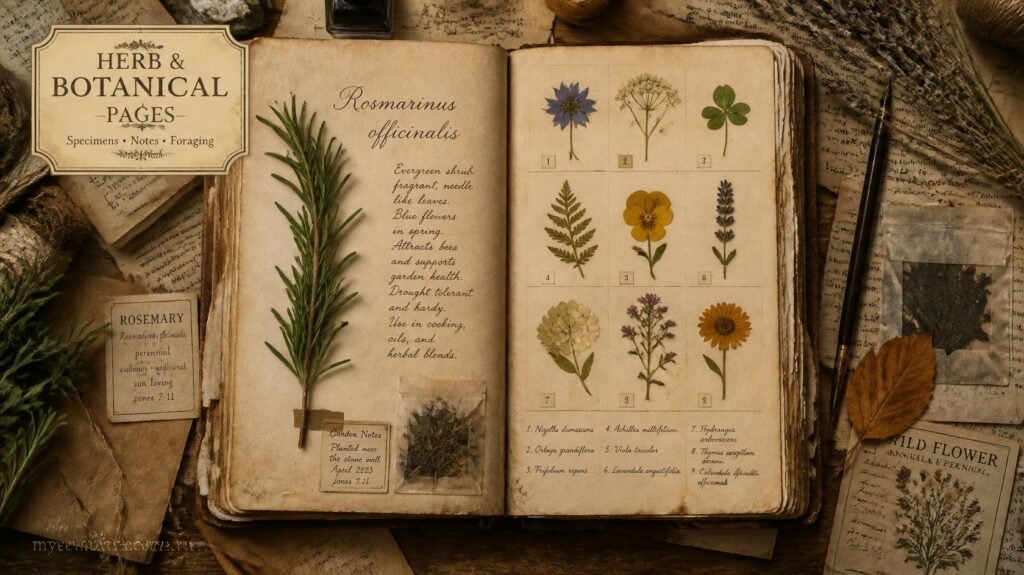
Herb and botanical pages (5 ideas):
1. A single-herb study page. One herb per spread: a pressed sprig, its name in Latin-ish handwriting, what it smells like, when it flowers, what you use it for. Rosemary, sage, lavender, thyme and mint are the easiest to source and press.
2. A dried flower specimen board. Several pressed flowers arranged in a grid, each with a tiny numbered label, like a Victorian collection. Number them and add a key at the bottom of the page.
3. A tea and tisane page. What you brewed, what was in it, and how it made you feel. Glue in the actual tea bag paper or a pinch of the leaves in a small glassine envelope.
4. A seasonal foraging page. What you found on an autumn walk, leaves, seed heads, feathers, bark rubbings. Date it. Do the same walk next year on the same page spread and compare.
5. A window-sill garden log. What you planted, when, whether it survived. Seed packets glued in as ephemera, with honest notes about the ones that died.
Moon and season pages (5 ideas):
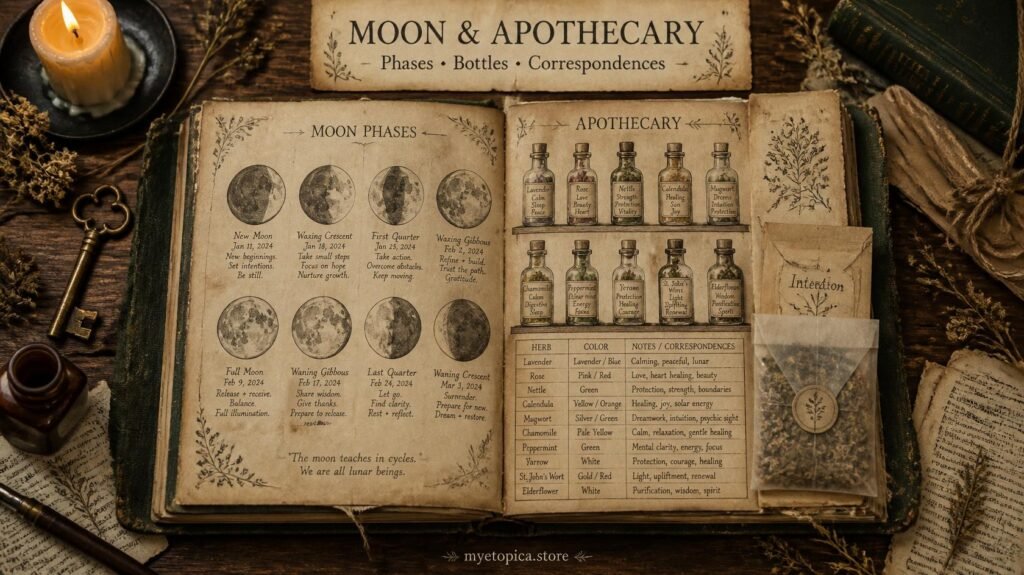
6. A moon phase spread. Eight circles across the page, inked and deliberately imperfect. Underneath each, one short line about the day. It’s a gentle way to journal without facing a blank page.
7. A wheel-of-the-year page. A circle divided into eight, one for each seasonal festival, with a note or a small pressed item in each segment. Built up slowly across a whole year.
8. A weather and sky page. Written like an old almanac: “Cold. First frost on the car windows. The rooks were loud all afternoon.” Deeply satisfying to read back years later.
9. A candle-burning page. Colour, scent, how long it burned, what you were doing. Rub a little of the actual wax onto the page for texture.
10. A darkest-days page. Something for December: what helped, what got you through, small comforts. It’s the most honest page in most people’s books.
Apothecary and reference pages (5 ideas):
11. A bottle shelf spread. Rows of drawn or printed bottles with hand-lettered labels. The most recognisable grimoire page there is, and the most fun to make.
12. A correspondence table. Herbs, stones or colours in one column, meanings in another, laid out like an old textbook. Tables look wonderfully authoritative on aged paper.
13. A recipe page for something that isn’t food. A “recipe” for a good night’s sleep, a brave week, a quiet Sunday — written in old cookery-book format, with quantities.
14. A symbols and sigils page. Whatever marks mean something to you, drawn small and repeated across a page like a practice sheet. Repetition is what makes it look like a working book.
15. A protection or intention pocket. A small envelope glued in, holding a folded note. Nobody has to read it, including you. Some of the best pages in a book like this are the ones that stay closed.
Materials that read as witchy:
You don’t need special supplies. You need old-looking supplies, and the difference is mostly technique.
| Material | Where to find it free | Why it works |
| Dictionary pages | Damaged charity-shop books | Dense old type reads as reference |
| Pressed herbs | Your kitchen or garden | Real texture nothing can fake |
| Brown kraft | Parcels and paper bags | Warm, aged base tone |
| Glassine envelopes | Stamp collecting, some packaging | Holds seeds and leaves visibly |
| Wax and candle drips | Any candle stub | Instant “this book was used” |
| String and jute | Parcels, garden twine | Rougher than ribbon, suits the style |
| Tea and coffee | Kitchen | The base of every aged page |
If you’d like printed pieces to build these pages faster, bottles, labels, moths, botanical illustrations, our sets print at home and cut down in minutes. Have a peek in our Etsy shop.
The handwriting is the whole aesthetic:
More than any material, handwriting is what makes these pages work, and people avoid it because they don’t like their own writing.
Three things that help enormously:
- Write smaller than feels natural. Small handwriting reads as notes; large handwriting reads as a poster. Old reference books are full of cramped writing.
- Use brown ink, not black. Brown looks like faded iron gall ink. Black looks like a biro from 2026.
- Let it be uneven. Lines that wander, words squeezed in at the end, a crossing-out left visible. Perfect lettering looks printed, and printed looks new.
The trick that fixes everything: write on a separate scrap of aged paper, then glue that scrap onto the page. If you hate it, you’ve lost a scrap rather than a spread, and knowing that makes your handwriting relax immediately.
Colours for grimoire pages:
Two palettes carry almost everything in this style.
Moonlit Garden, deep green, ink navy, silver-grey and bone. Cool and botanical. Best for herbs, moons and nature pages.
Witch’s Cupboard, bottle green, oxblood, brass and ink. Rich and old-world. Best for apothecary shelves, correspondence tables and anything you want to feel weighty.
Both are laid out with hex codes in Halloween Junk Journal Colour Palettes.
How to organise the book so you can actually find things:
This is the practical problem nobody mentions, and it’s the reason a lot of these journals get abandoned. A reference book you can’t navigate stops being a reference book.
The junk journal answer is pleasingly low-tech: tabs and a rough index.
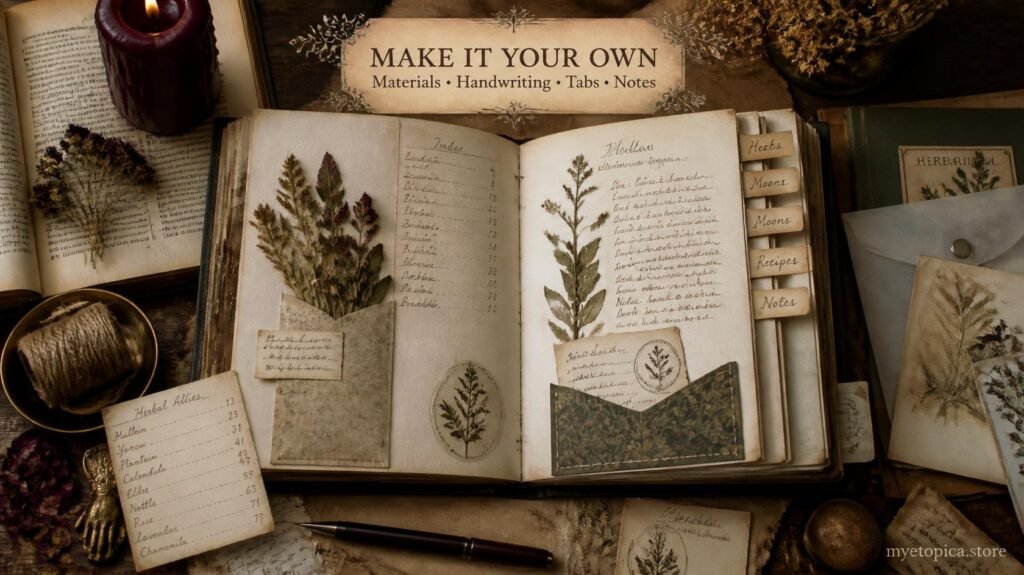
Cut small tabs from aged card and glue them onto the outer edge of the first page of each section, staggered down the page so they don’t overlap. Four or five is plenty, Herbs, Moons, Recipes, Notes. Ink the tab edges so they match everything else.
Then leave the first spread of the book blank, and fill it in as an index as you go rather than planning it in advance. A handwritten list of page numbers and headings, added to over months, is far more useful than a structure you designed before you knew what you’d write.
Leave gaps deliberately. Two or three blank pages after each section means you can add to a topic later without starting a new one halfway through the book. It’s the single thing people wish they’d done.
Where the pages come from when you’re stuck:
The hardest part of a book like this is not technique, it’s knowing what to put in it. Three sources that never run dry:
Your kitchen. Every herb and spice in your cupboard is a potential page, what it smells like, what you cook with it, where it grows. That’s twenty pages sitting in a cupboard right now.
Your walks. Whatever you pick up outside, plus the date and the weather. The same walk in four different seasons makes a beautiful four-page sequence.
Old books. Charity-shop herbals, gardening books and cookery books from the 1950s are full of language and layouts worth borrowing. Copy a page structure you like and fill it with your own content.
Frequently asked questions:
1- What’s the difference between a grimoire and a Book of Shadows?
A grimoire is traditionally a reference book, herbs, methods, correspondences. A Book of Shadows is more personal, recording what you did and what happened. Many people keep one book that does both.
2- Do I have to be a witch to make a witchy junk journal?
No. Plenty of people keep one purely as a nature and herb journal because they love the aesthetic, and plenty of others keep it as a genuine practice. Both are entirely valid, and the pages look the same either way.
3- What should go in a grimoire-style junk journal?
Herbs and their uses, moon phases, seasonal notes, recipes, correspondences, and anything you want to remember about the natural year. Reference pages and personal notes sit happily side by side.
4- How do I press herbs and flowers for the pages?
Lay them flat between sheets of kitchen paper inside a heavy book, and leave for two to three weeks. Thinner leaves press best, thick stems and fleshy petals tend to go brown.
5- How do I stop pressed plants falling off the page?
Use a thin layer of PVA or matte medium rather than a glue stick, and either place a strip of vellum over the top or glue them inside a small glassine envelope so nothing rubs off.
6- What pen should I use?
A fine-tip brown pen for most writing, and a slightly broader one for headings. Brown reads as faded old ink; black reads as modern, however carefully you write.
7- Can I make one without any drawing skill?
Yes. Almost everything here is pressed plants, printed pieces, handwriting and tables. Nothing on this page requires you to draw anything more complicated than a circle.
8- Is this only a Halloween project?
Not at all, and that’s its great advantage. A grimoire-style journal suits every season, herbs in spring, foraging in autumn, quiet notes in midwinter. It’s the Halloween page type most likely to become a year-round book.
Start with one herb
Go to your kitchen, take a sprig of whatever’s there, rosemary, thyme, a bay leaf, and press it in a heavy book tonight.
In two weeks you’ll have your first specimen, and by then you’ll have decided what kind of book this is going to be.
Want the full Halloween section? Start with 20 Halloween Junk Journal Ideas, or build the book itself with How to Make a Halloween Junk Journal. For the aged-paper base every one of these pages needs, see How to Age & Distress Paper. ♡
Our Etsy shop is full of adorable printable cliparts — birthday boys & girls, sweet animals, summer and spring themes — designed to print at home and layer straight into your journal.
Browse the Clipart Shop ↗
Leave a Reply