
A junk journal is a handmade book built from paper you already have: old book pages, envelopes, wrapping paper, maps, ticket stubs, and scraps most people throw away. You fold those pages into signatures, stitch them into a cover, add pockets and tags, and fill the book with writing, photos, and small keepsakes. This guide explains what junk journals are, the kinds you can make, the supplies worth gathering, and fifteen simple ways to start, fill, and love your very first book.
Key Takeaways
- A junk journal is a handmade book made from found and recycled paper, not a bought notebook.
- Choose one kind to start: travel, memory, themed, or everyday.
- Start with paper and tools you already own, then add a few cheap basics.
- Fold pages into signatures and bind them with a simple stitch or elastic.
- Fill the first pages the same week you make the book.
- Keep it going with a small daily habit.
What Junk Journals Are, and Why People Love Them
Junk journals are books made from rescued paper. The pages come from old novels, sheet music, maps, brown paper bags, envelopes, and wrapping paper, mixed with a few new sheets for writing. The cover might be an old book cover or a piece of card. Every junk journal is one of a kind.
People love them because they are forgiving. A plain notebook punishes a spelling mistake or a crooked line, but a junk journal welcomes both. A torn edge, a coffee stain, or a crooked page only adds to the charm. They are also cheap to start. The craft has roots in scrapbooking and commonplace books, as the history of scrapbooking shows, and it keeps the same spirit: saving what matters, by hand, in a book.
A junk journal suits almost anyone. Travellers keep one for tickets and maps. Parents keep one for their children. Crafters keep one for swatches and ideas. Writers keep one for lists and half-formed thoughts. You do not need to draw, and you do not need neat handwriting. You only need a small pile of paper and a willingness to start.
The Kinds of Junk Journals You Can Make
There is no single right kind of junk journal. The kind you choose decides what goes inside it, so pick the one that matches the life you want to record. Start with one kind and finish it.
Travel journals
A travel journal holds one trip: tickets, maps, postcards, cafe receipts, and a few lines written each evening. Make it small enough to carry in a day bag, with a pocket inside the cover for the bits you collect during the day. Date each page, so the book reads like a journey at home.
Memory journals
A memory journal keeps the moments you do not want to lose: a child’s first drawing, a letter from a friend, a photo from a birthday. Give each memory its own spread, with a few honest lines beside it, noting who was there and what was said. Old photographs in the Library of Congress scrapbook collections show families have kept books like this for generations.
Themed journals
A themed journal follows one subject: a garden, a season, a hobby, or a holiday. A christmas journal keeps one December on paper, and a garden journal might hold seed packets and pressed leaves. Pick a theme you already care about, and the pages will fill themselves.
Everyday journals
An everyday journal has no theme at all. It holds lists, ideas, quotes, sketches, and the small scraps of an ordinary week. This is the easiest kind to start, because there is nothing to plan. Open it when you have five minutes, add one thing, and close it again.
Gather Your Supplies
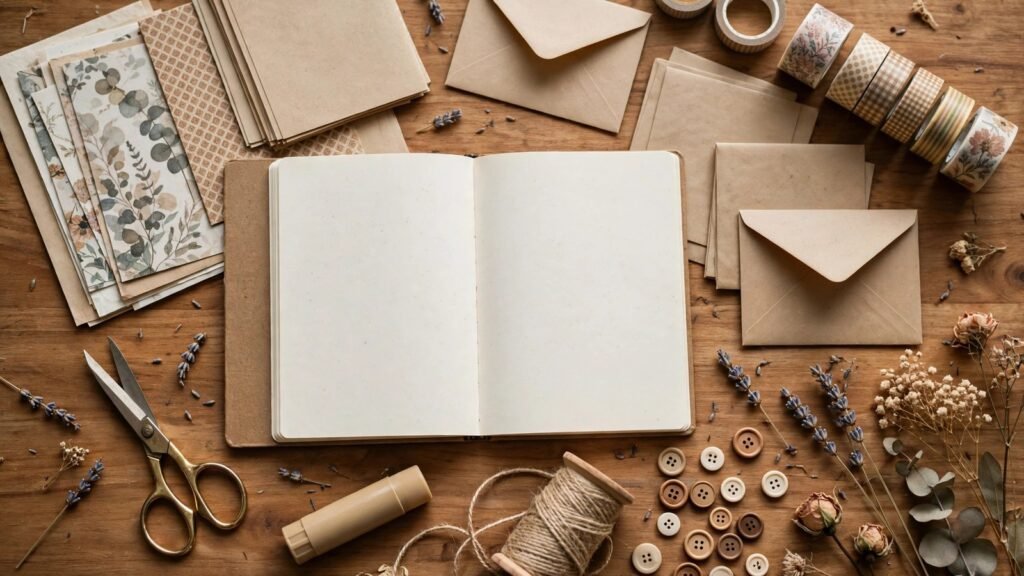
You need very little to begin, and most of it is already in your house. Start with the paper, add a few tools, and buy nothing until you know what you enjoy using. Our guide to junk journal supplies lists the basics in detail.
Start with paper you already own
Look through the house before you buy anything. Old book pages, brown paper bags, envelopes, maps, sheet music, wrapping paper, and paper shopping bags all make lovely pages. Add a few plain sheets for writing, some kraft paper for pockets, and a small stack of printed photos.
A few tools that make it easier
A glue stick, a small pair of scissors, a ruler, and a pencil will carry you through your first book. Add a needle and strong thread for stitching, an awl or a thick needle for punching holes, and a roll of washi tape for quick decoration. Buy the fancy tools later, once you know which ones you reach for.
- Mixed rescued paper: old book pages, maps, envelopes, and wrapping paper.
- A few plain sheets and kraft paper for writing pages and pockets.
- A glue stick and small scissors for photos and paper scraps.
- A needle, strong thread, and an awl for binding.
- A pen you enjoy, plus a pencil and ruler for planning.
Signatures, Binding, and Putting the Book Together
A signature is a small stack of folded pages that sits inside the cover like a little booklet. Most junk journals hold three or four signatures, each with four to six folded sheets. Signatures give the book its chunky feel, and they make binding simple.
Fold pages into signatures
Fold each sheet in half with the patterned side out, and nest four to six folded sheets inside each other to make one signature. Mix the papers as you go: a map page, a plain writing page, an old book page, a kraft page.
Choose a binding
The three-hole pamphlet stitch is the best first binding: punch three holes along the fold of each signature, then sew in and out with strong thread and tie a knot inside. Elastic binding is even simpler, with loops of cord holding the signatures in a cover with slots. Try one method now, and another on the next book.
Your First Pages: How to Start Without Fear
The blank first page stops more journals than any other problem. The trick is to make it ugly on purpose, so there is nothing left to be afraid of. Glue down a torn scrap, stamp a date, stick in a photo, and the page is started. A started page is easy to finish. Fill the first pages in the same week you make the book, while the excitement is fresh.
Make a simple first spread
Open the book to the first spread and keep it simple. On the left page, glue a pocket or a photo, and on the right page, write the date, the reason you started the book, and one line about what you hope it will hold. That is a complete first spread, and it sets the tone for the book.
Date it, then write one honest line
Every entry needs only two things: a date and one honest line. The date tells future you when it happened, and the honest line is the memory itself. Write what only you could have noticed: the smell of rain, the exact words someone said, the song playing in the kitchen. One true line beats a page of careful, empty writing.

Pockets, Tuck Spots, and Tags
Pockets are what make a junk journal feel like a treasure chest. They hold the loose things that do not fit on a flat page: tickets, notes, pressed flowers, and tiny photos. A good journal has several, spread through the book, so every few pages hides a small surprise. Make them early, while you are building the book.
Easy pockets from envelopes and folded pages
An envelope glued along three edges is an instant pocket, and a page folded up from the bottom and glued at the sides works just as well. Cut a small notch from the top edge, so you can see what is tucked inside.
Tags and tuck spots for loose keepsakes
Tags are small cards you write on and tuck into pockets or behind belly bands. Cut them from kraft card, punch a hole in one end, and thread a short piece of twine through it. A tuck spot is simpler still: a strip of paper glued at both ends across a page, with a photo or a note slid underneath.
Filling Your Journal Day by Day
A junk journal fills slowly, one small addition at a time, and that is exactly how it should work. You do not sit down to fill a whole book. You add one photo after breakfast, one line after a walk, one ticket after a day out.
Fifteen small ways to fill a page
- Glue in a photo and write one line about it.
- Press a leaf or a flower between two pages.
- Save a ticket or a label from a favourite place.
- Write a list: books read, meals cooked, songs loved.
- Copy a quote you want to remember.
- Stick in a map and mark the places you have been.
- Make a small collage from magazine pictures.
- Write a short letter to someone you love.
- Record a recipe the way you really made it.
- Sketch something simple: a cup, a window, or a tree.
- Keep a page for swatches of fabric, paper, and ribbon.
- Note the weather in one line.
- Save a greeting card or a note from a friend.
- Make a page of small wins from the week.
- End the month with a closing page of best moments.

Keeping It Going: A Gentle Rhythm
A journal survives only if the daily ask is small. Five minutes is enough: one line, one small detail, one thing stuck in. On a blank day, use a prompt to get going. Our december writing prompts give you a starting line when your mind is empty, and a december daily junk journal shows how a small daily rhythm can carry a whole month. Old printed ephemera in the Internet Archive ephemera collections can inspire pages too.
Do not worry about missed days. A journal with gaps is still a finished journal, and a finished journal is worth more than a beautiful one that stops in the second week. When the book is full, close it with a short closing page, write the year on the cover, and put it on a shelf where you can reach it. Then start the next one.
Frequently Asked Questions
What is a junk journal?
A junk journal is a handmade book built from found and recycled paper: old book pages, envelopes, maps, wrapping paper, folded into signatures and bound into a cover. You fill it with writing, photos, and small keepsakes, so it becomes a personal record no bought notebook can match.
What supplies do I need to start a junk journal?
You need mixed paper from around the house, a few plain sheets for writing, a glue stick, small scissors, a needle and strong thread, and a pen you enjoy. Washi tape, ribbon, and printed photos are useful extras. Start with what you own.
How do I bind a junk journal?
Fold your pages into signatures of four to six folded sheets each, punch three holes along each fold, and sew each signature to the cover with a simple pamphlet stitch. Elastic binding, with loops of cord holding the signatures, is an even simpler first choice.
What do I put in a junk journal?
Put in anything that holds a memory: photos, tickets, maps, pressed flowers, recipes, lists, quotes, letters, and small sketches. Add one honest line beside each item, with the date, so future you knows why it mattered.
How do I keep going when I run out of ideas?
Keep a list of easy page ideas inside the front cover, and use one whenever you feel stuck. A prompt, a photo, or a list is a complete page, and five quiet minutes a day is enough to keep the habit alive. Missed days are normal.
Looking for ready-made vintage pieces? Browse the Etopica shop on Etsy for printable junk journal ephemera, vintage page templates, aged papers, tags, and pockets that layer beautifully into your first book.
Our Etsy shop is full of adorable printable cliparts — birthday boys & girls, sweet animals, summer and spring themes — designed to print at home and layer straight into your journal.
Browse the Clipart Shop ↗
Leave a Reply