Every October, thousands of people start a 31-day Halloween journal. A good number of them stop somewhere around the 8th, feel guilty, and quietly close the book.
I’ve done it. It’s not a discipline problem, thirty-one consecutive creative days is genuinely a lot to ask of a normal month with a job and a life in it.
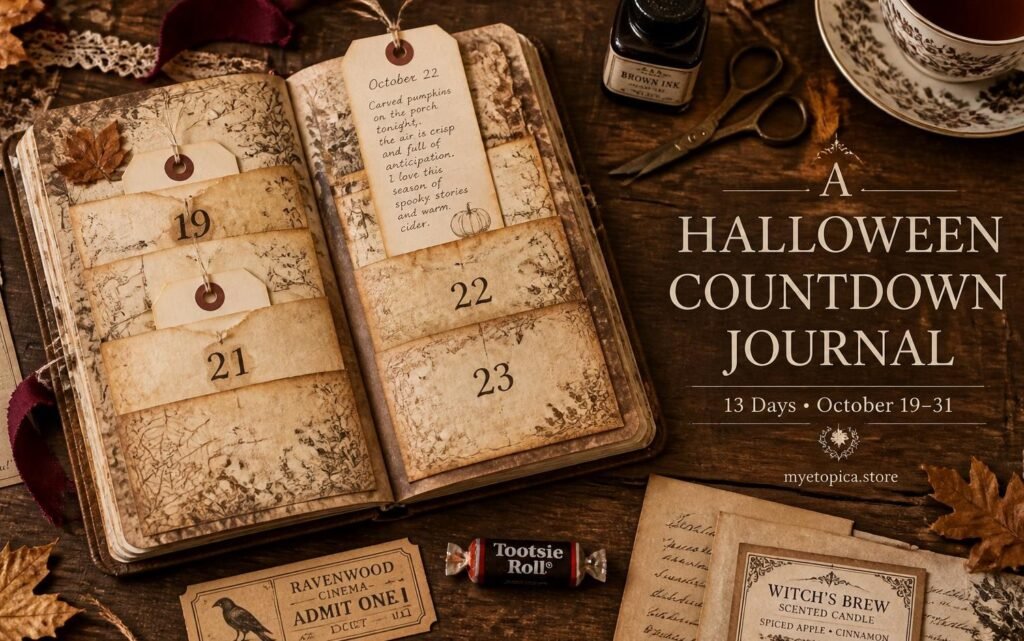
So here’s a Halloween countdown journal built to be finished: thirteen days rather than thirty-one, starting on 19 October and ending on Halloween night.
Why thirteen? It’s a properly Halloween number, it fits in a small book, and it starts late enough that the excitement is already building. Thirteen days of small entries beats thirty-one days of guilt — and you’ll have a finished book instead of a third of one.
Choose your format first
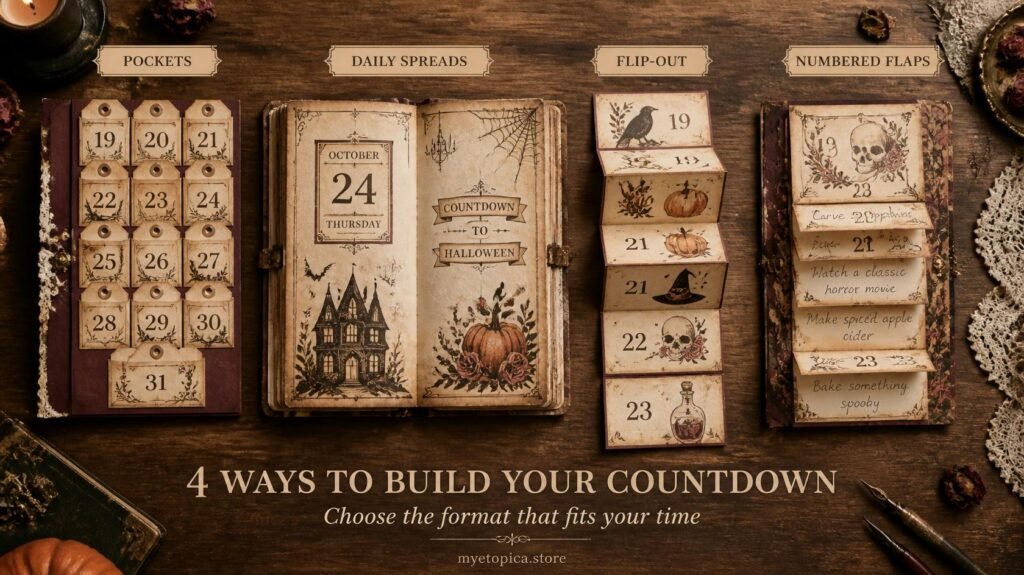
Four ways to build it, from least to most work. Pick the one that matches how much time you actually have, not how much you’d like to have.
Format 1: Numbered pockets (easiest)
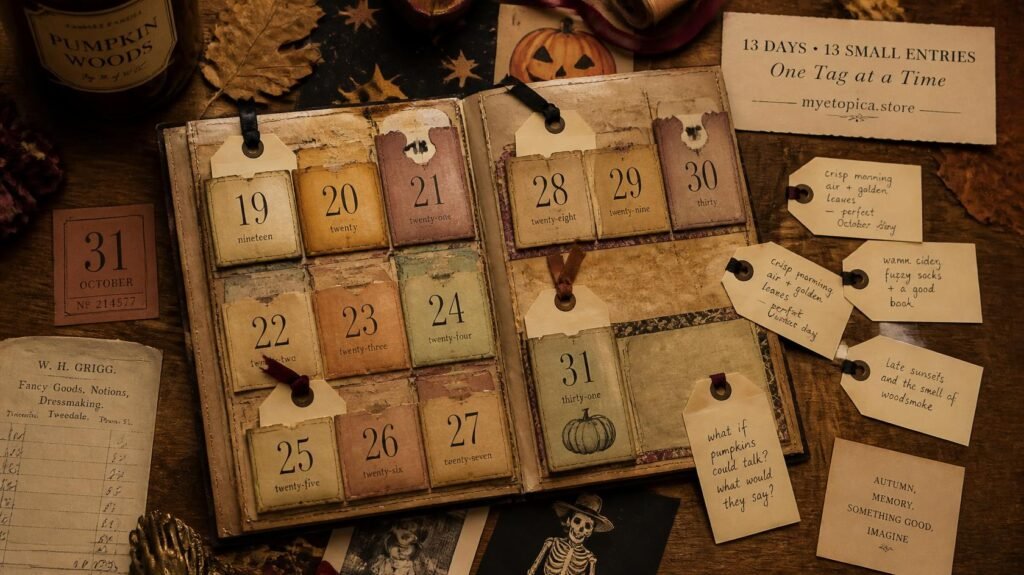
Six spreads, each holding two or three small pockets made from cut-down envelopes. Number them 19 to 31. Each day you write on a tag and slot it into that day’s pocket.
The whole book can be built in one evening, and the daily commitment is one tag. This is the format most people should choose.
Format 2: One spread per day
Thirteen spreads, one per day. The most beautiful option and by far the most work, you’re committing to a decorated page every single evening for nearly two weeks.
Only choose this if journaling is already a daily habit for you.
Format 3: A flip-out strip
One long strip of paper, folded concertina-style into thirteen panels, glued into the back of an existing journal. Each panel gets a date and a small entry.
Takes about twenty minutes to make, holds all thirteen days, and unfolds dramatically, which is genuinely satisfying every time you open it.
Format 4: Numbered flaps on two spreads
Thirteen small paper flaps, each glued along one edge only so it lifts, spread across two pages with a number on the front of each. Underneath, you write.
Compact, interactive, and everyone who picks up your journal will lift every single flap.
Building the 13-pocket version, step by step
About an hour, and you can split it across two evenings.
- Age your papers. Tea-stain eight sheets and let them dry. Ink all the edges. This is the longest step and it’s mostly waiting.
- Build the book. Six spreads is twelve pages, three or four folded sheets. Staple, ribbon-tie or pamphlet-stitch them into a simple cover.
- Make the pockets. Cut envelopes down to about a third of the page height, opening at the top. Ink the edges. Glue each one along the bottom and both sides — never the top.
- Number them. Small aged squares with 19 to 31 written on them in brown ink, glued to the front of each pocket. Slightly crooked.
- Cut thirteen tags. Aged card, about 4 × 8cm, one corner cut at an angle, hole punched and reinforced, twine threaded through. Make them all now, while you’re set up.
- Decorate lightly. One small element per spread, and no more. The pockets and numbers are already doing the visual work, over-decorating now leaves no room for what you add later.
- Slot the blank tags in. The book is ready, and each evening you pull one out, write on it, and put it back.
If you’d like ready-made numbers, labels and small motifs to speed this up, our Halloween sets print at home and cut down in minutes, have a peek in our Etsy shop.
What goes on each day’s tag
Keep it small. Two or three lines is a full entry.
| Day | A gentle structure |
| 19–21 | What autumn looks like right now, weather, light, what’s changed outside |
| 22–24 | A memory: a costume, a house, a film that frightened you |
| 25–27 | Something small and good from that day |
| 28–30 | Something imaginative, a label, a ghost, a recipe for courage |
| 31 | How the night actually went, written the next morning |
You don’t have to follow it. But having a rough shape means you never open the book and think “…what now?”, which is the moment most countdowns quietly end.
For twenty-five specific prompts to draw from, see 25 Halloween Journal Prompts.
Adding the small things as you go
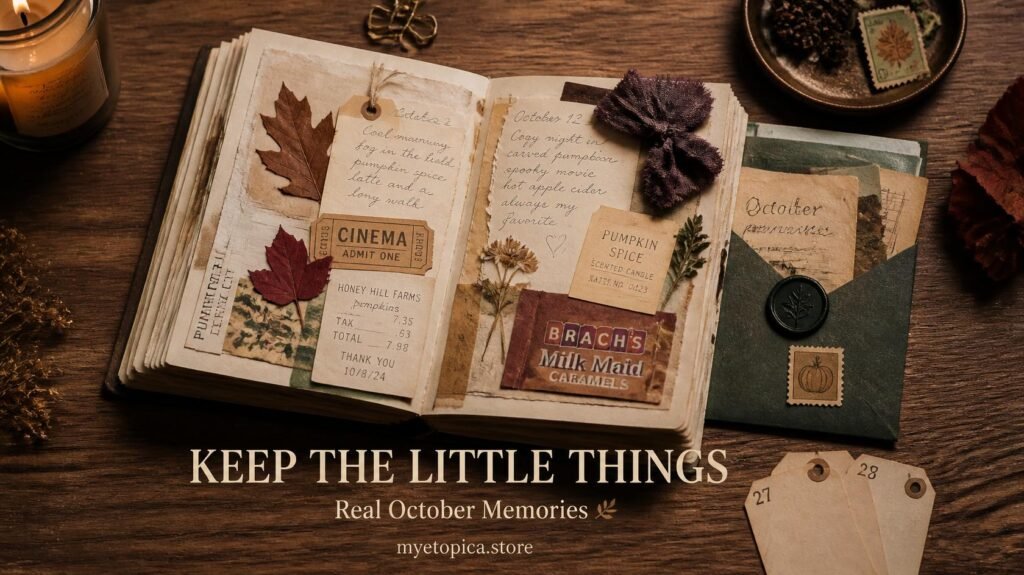
The best countdown journals aren’t the prettiest, they’re the ones with actual bits of October in them.
Keep a small envelope in the back of the book and put things in it as the month goes: a leaf from a walk, the receipt from the pumpkin, a sweet wrapper, a cinema ticket, a scrap of costume fabric, the label off a candle you burned.
On 31 October, glue them in wherever there’s room. That’s the page you’ll actually come back to in five years, not the beautifully layered spread, but the one with a bus ticket on it.
When you fall behind (you will):
You’ll miss three days somewhere around the 24th. This is normal and it is not the end of the project.
Don’t backfill. Trying to reconstruct four days you can’t really remember is dull, and it’s the single most common reason countdowns get abandoned entirely.
Skip to today’s date and carry on. Leave the missed tags blank, or write one line across all of them: “A blur. Work was hard.” That’s honest, it takes ten seconds, and in five years it will tell you something true about this October.
The rule that saves the project: a blank day is data, not failure. A countdown journal with four empty tags is a finished countdown journal. One you stopped on the 24th is not.
Making it with children:
The pocket format works beautifully with children, because the daily commitment is one small tag rather than a whole page.
Let them do the inking, they apply ink pads with a generosity that genuinely improves the look, and let them dictate while you write, or write themselves if they can. Their answers are almost always better than ours.
Ask the same question every day: “What was the best bit of today?” Thirteen answers to one question is a lovely thing to have.
Using it again next year:
This is where a countdown journal quietly becomes something more than a craft project.
Leave the last two spreads empty and add next year’s thirteen days there instead of starting a new book. Or simply make a new small book each October and keep them tied together with ribbon.
After three or four years you can lay them side by side and read the same date across several autumns. That’s a genuinely remarkable thing to own, and it started with thirteen small tags.
Frequently asked questions:
1- When should I start a Halloween countdown journal?
Build the book in the first week of October and start writing on the 19th. Building it in advance is what makes the daily part easy, a book that already exists is far harder to abandon than one you still have to make.
2- Why 13 days instead of 31?
Because most people don’t finish 31. Thirteen days is achievable in a normal month, it’s a fitting Halloween number, and a finished small book is worth far more than an abandoned big one.
3- Can I do all 31 days?
Of course, if daily journaling is already a habit for you. Use the pocket format rather than one spread per day, keep entries to a single line, and build every pocket before 1 October.
4- What’s the easiest format for a beginner?
Numbered pockets. The whole book can be made in one evening, and each day’s commitment is writing on one small tag, which is about as low as the bar goes.
5- What do I write each day?
Two or three lines is plenty. The weather, one good thing, a memory, or simply the date. There’s a rough day-by-day structure above and twenty-five prompts in the linked post if you want more.
6- What if I miss several days?
Skip to today and carry on. Leave the missed tags blank or write one honest line across them. Never try to backfill, that’s what ends countdowns.
7- Can I make one without building a book?
Yes. The flip-out strip glues into the back of a journal you already have, and the numbered flaps need only two spreads in an existing book.
8- How big should the book be?
Small. A6 or half-A5 is ideal, big enough for a pocket and a tag, small enough that six spreads feels quick rather than daunting.
9- What should I keep in it besides writing?
Anything physical from October: leaves, tickets, wrappers, receipts, a scrap of costume fabric. Keep them in an envelope at the back as the month goes and glue them in at the end.
Build it this weekend:
Stain eight sheets of paper, fold them into a small book, and glue in thirteen pockets made from envelopes. One evening, and the whole thing is ready before the 19th.
Then all October asks of you is two lines a day on a small tag, which is a promise you can actually keep.
Need the book itself first? See How to Make a Halloween Junk Journal. For what to write, try 25 Halloween Journal Prompts, and for the tags, Halloween Tags, Bookmarks & Gift Toppers. ♡
Our Etsy shop is full of adorable printable cliparts — birthday boys & girls, sweet animals, summer and spring themes — designed to print at home and layer straight into your journal.
Browse the Clipart Shop ↗
Leave a Reply