When I first started, these three words got tangled up in my head all the time, junk journal, scrapbook, smash book. They sound similar, they use a lot of the same bits and pieces, and honestly they overlap more than anyone online admits.
So let me untangle junk journal vs scrapbook vs smash book the way I wish someone had explained it to me: simply, honestly, and without making it feel like a test you could fail.
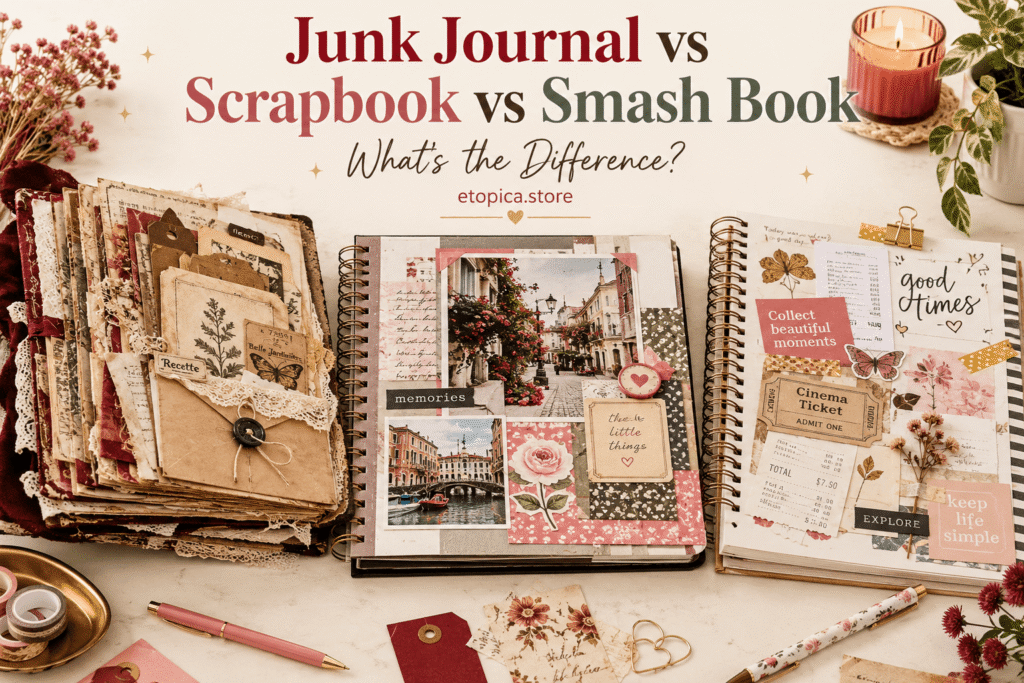
The short answer: A junk journal is about the paper, a handmade book built from scraps, layered and textured, where the making is the point. A scrapbook is about the photos, a designed album where paper decorates the pictures. A smash book is about speed, a grab-and-go book where you stick things in fast, with no plan at all.
What is a junk journal?
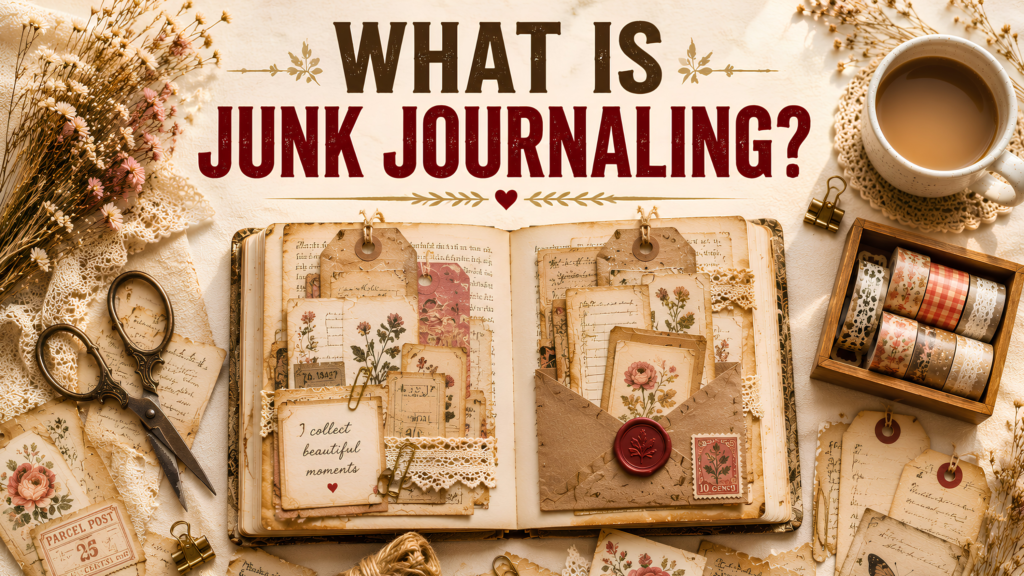
A junk journal is a handmade book made mostly from “junk”, recycled papers, ephemera, old book pages, envelopes, fabric scraps and found bits that were heading for the bin.
The magic is in the making. Very often you build the book itself: folding your own pages, sewing or stapling them together, adding pockets and tuck spots, ageing the paper with tea until it looks like it was found in an attic. Then you layer things onto those pages until each spread has depth.
Two things make junk journals feel different from the other two:
- Imperfection is the aesthetic. Torn edges, wonky layers, mismatched papers and stains aren’t mistakes to hide, they’re the entire look you’re going for.
- There’s no required purpose. You can write a diary in it, or never write a word. You can fill it with memories, or just make pretty pages because making them feels good.
A junk journal suits you if you love texture, working with your hands, a cozy vintage feel, and the idea of making something lovely from almost nothing.
What is a scrapbook?
A scrapbook is memory-focused and photo-first. Think holidays, birthdays, a new baby, a graduation, a big trip.
Pages are built around actual photographs. The decorative paper, stickers, borders and handwritten notes are all there to frame and support the pictures, not to be the main event. Because of that, scrapbooks tend to look more designed and deliberate: cleaner layouts, matching paper collections, and clear organisation by event or date.
Scrapbooking also has a practical side the other two don’t. Serious scrapbookers care about archival quality, acid-free paper, photo-safe adhesive, materials that won’t yellow your photographs in twenty years. That matters when the whole point is preserving pictures you can’t replace.
A scrapbook suits you if you have photos you actually want to print and keep, you like a neater finished page, and you want the album to make sense to someone else flipping through it.
What is a smash book?
A smash book is the most relaxed of the three, the name literally comes from smashing things into it.
It’s a grab-and-go book where you quickly tape or glue in whatever the day handed you: a receipt, a wrapper, a concert ticket, a note someone left you, a doodle from a boring meeting. There’s no arranging, no layering, and no waiting for the right moment. You stick it in and close the book.
Less about beauty, more about capturing life while it’s still happening. A finished smash book page often looks a bit chaotic, and that’s exactly right. It’s a record, not a display piece.
A smash book suits you if you’re busy, you collect things without meaning to, and the idea of “making a nice page” is precisely the pressure that stops you journaling at all.
A quick side-by-side comparison
| Junk Journal | Scrapbook | Smash Book | |
| Main focus | Layered handmade pages | Photos & memories | Quick everyday bits |
| Star of the page | The paper itself | The photograph | Whatever you collected |
| Look | Vintage, textured, layered | Polished, designed | Casual, messy-cute |
| Pace | Slow & cozy | Planned in sessions | Fast & spontaneous |
| Time per page | 30 mins to several days | 30–60 minutes | 2 minutes |
| The book itself | Often handmade by you | Bought album | Any cheap notebook |
| Typical cost | Nearly free | Highest of the three | Very low |
| Great for | Unwinding & making art | Documenting events | Capturing daily life |
The three differences that actually matter
Forget the labels for a second. When you strip it back, there are only three real questions, and your answers tell you which craft you’re actually doing.
1. Are photos the point, or are they optional?
This is the biggest divider. In a scrapbook, remove the photos and the page has no reason to exist. In a junk journal, photos are welcome but entirely optional, plenty of beautiful junk journals contain none at all. In a smash book, a photo is just one more thing you might stick in.
2. Did you make the book, or buy it?
Junk journalers frequently build the book itself, folding signatures, sewing spines, or gutting an old hardback and rebuilding it. That’s part of the craft. Scrapbookers and smash bookers almost always start with something bought.
3. Is the page planned, or collected?
A scrapbook page is designed before it’s made, you know which photos are going where. A junk journal page grows through layering, often over several sittings. A smash book page isn’t designed at all; it accumulates.
Where all three overlap (more than people admit)
Here’s the part most comparison posts skip: the boundaries are blurry, and nobody in real life is policing them.
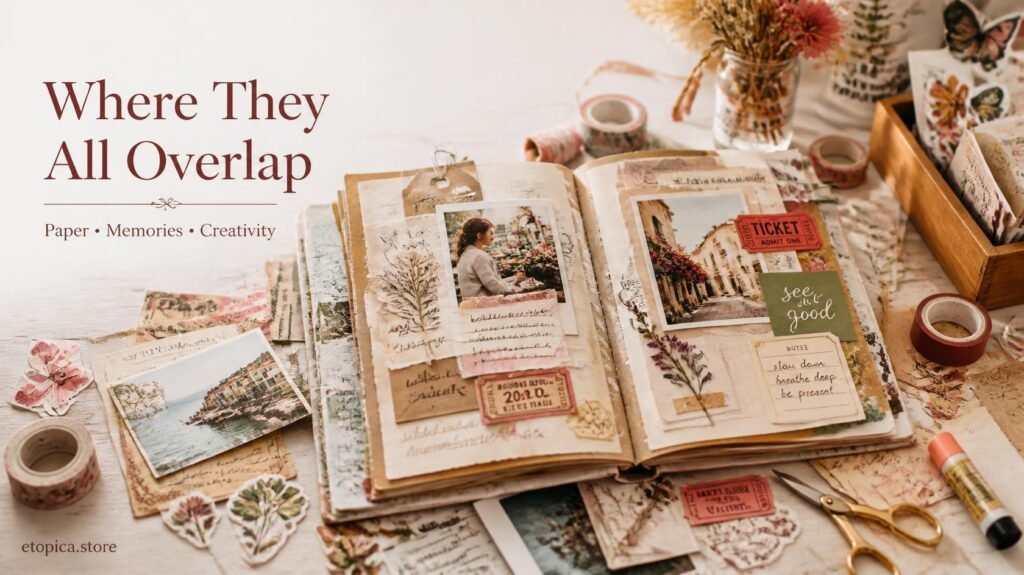
They all use paper, glue and collected bits. They all end up as a book of things that mattered to you. Ephemera turns up in all three. Plenty of junk journalers glue in photos. Plenty of scrapbookers tear edges and age paper. Smash books quietly get prettier the longer you keep them.
The labels are genuinely most useful for searching, knowing the right word helps you find the right tutorials, the right supplies and the right community. Beyond that, they matter very little.
So which one should you start?
Don’t overthink it. But if you’d like a nudge, find yourself in this list:
- You have boxes of printed photos you feel guilty about → scrapbook
- You love texture, vintage paper and making things with your hands → junk journal
- You want to journal but never seem to have time → smash book
- You want to relax and switch your brain off → junk journal
- You want the finished book to make sense to your family later → scrapbook
- You’ve started and abandoned three journals already → smash book, and lower the bar right down
- You have almost no money to spend → junk journal, genuinely
Little reminder: the “right” one is simply the one you’ll actually enjoy sitting down to make. That’s the whole rule, and there isn’t a second one.
What does each one cost to start?
Worth knowing before you commit, because the gap is bigger than people expect.
A junk journal can genuinely cost nothing. An old notebook, a glue stick from the drawer, and papers from your recycling is a complete starting kit. Most junk journalers spend under $15 in their first few months.
A smash book is nearly as cheap, a cheap notebook and some tape. The only ongoing cost is glue.
A scrapbook is the expensive one, and it’s not close. You’re buying an album, page protectors, archival-quality paper packs, photo-safe adhesive, and printing the photographs themselves. A single well-stocked scrapbooking session can cost more than a year of junk journaling.
That cost gap is a big part of why junk journaling has grown so fast. It’s the version of this hobby you can start today, with what’s already in your house.
Can you mix them?
Yes, and most people eventually do.
The most common blend is a junk journal with photos tucked into pockets, you get the layered, textured pages plus the memory-keeping. Another popular hybrid is a smash book that slowly turns into a junk journal as you get more confident: you start sticking things in fast, then one day you tear an edge, then you add a layer, and before long you’re junk journaling without having decided to.
Nobody will mind. There is no committee.
Frequently asked questions
1- Is a junk journal the same as a scrapbook?
No. A scrapbook is built around photographs and usually uses bought, matching materials. A junk journal is built around the paper itself, recycled scraps, ephemera and found bits, and photos are entirely optional. They share tools, but the focus is different.
2- Which is easier for a complete beginner?
A smash book is the easiest to start, because there’s no skill involved at all. But most beginners find junk journaling more rewarding within a couple of weeks, because you can see yourself improving. If you’re nervous, start smashing things in and let it evolve.
3- Do I need special paper or archival supplies?
Only for scrapbooking, and only if you’re preserving irreplaceable photographs. Junk journals and smash books have no such requirement, the whole point is using ordinary paper that was heading for the bin anyway.
4- Can I put photos in a junk journal?
Absolutely. Print them small, tuck them into pockets, or layer them under torn paper edges. Many people prefer photos in a junk journal because they sit inside a textured page rather than on a plain background.
5- What’s the difference between a smash book and a regular journal?
A regular journal is written. A smash book is stuck. One holds your words, the other holds the physical bits and pieces of your days, and most smash books contain very little writing at all.
6- How long does a page take in each one?
A smash book page takes about two minutes. A scrapbook page usually takes half an hour to an hour, because it’s designed. A junk journal page can take twenty minutes or a fortnight, depending on how many layers you add and how patient you’re feeling.
7- Which one is best if I have very little time?
A smash book, easily, or a junk journal made in tiny sessions. Junk journal pages don’t have to be finished in one sitting, which makes the craft far more forgiving of a busy week than scrapbooking is.
8- Do I have to pick just one?
Not at all. Lots of people keep a junk journal for pleasure and a scrapbook for family photos, and they serve completely different needs. Starting one doesn’t close the door on the others.
Just start with whichever one you’re drawn to
If you’ve read this far and one of the three kept catching your eye, that’s your answer, that pull is more reliable than any comparison table.
And if you love that cozy, layered, vintage feeling, the junk journal is a beautiful place to begin. It costs almost nothing, there’s no way to do it wrong, and you can start this evening with what’s already in your recycling bin.
Printable cliparts work gorgeously in all three, so you really can’t go wrong there either, you’ll find sweet sets to print at home in our Etsy shop.
New to all of this? Start here: What Is Junk Journaling? ♡
Our Etsy shop is full of adorable printable cliparts — birthday boys & girls, sweet animals, summer and spring themes — designed to print at home and layer straight into your journal.
Browse the Clipart Shop ↗
Leave a Reply